
2 Realizing Peaceful, Secure, and Stable Societies, and Maintenance and Strengthening of a Free and Open International Order Based on the Rule of Law
(1) Support for Peacebuilding and Refugees/Displaced Persons
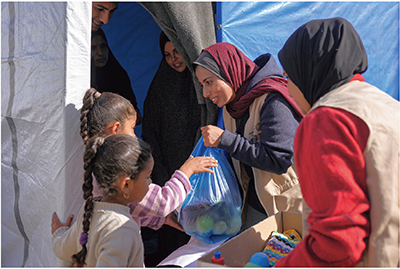
Distribution of food and daily necessities to households with persons with disabilities and other vulnerable households in the Gaza Strip, Palestine (Photo: Campaign for Children of Palestinian, a nonprofit organization (CCP) Japan)
The international community continues to witness regional and internal conflicts due to various factors such as ethnic, religious, and historical differences, as well as poverty, disparities, and other issues. In recent years, intensifying geopolitical competition and heightened tensions between nations, as well as the emergence of countries that challenge the existing international order more assertively, have left considerable negative impacts on the development and stability of the global economy and society.
Such conflicts generate a great number of refugees and displaced persons, resulting in humanitarian crises, undermining years of development efforts and causing significant economic losses. The impact of a conflict in one country or region affects the entire world in one way or another, and the prolongation of such conflicts has become a challenge. Russia’s aggression against Ukraine, which started in 2022, and the deteriorating situation in the Middle East since the terror attacks by Hamas and other militant groups in October 2023 have caused increasingly serious humanitarian crises, becoming major issues for the entire international community. In addition, there are concerns about the impact of climate change on peace and stability. As the challenges faced by the international community become more complex and diverse, peacebuilding efforts aimed at establishing the foundations for development are increasingly important for the consolidation of sustainable peace.
●Japan’s Efforts
■Support for Peacebuilding
In response to humanitarian crises caused by conflicts and other issues, Japan promotes the “Humanitarian-Development-Peace Nexus (HDP Nexus),”Note 39 in which urgently needed humanitarian assistance is provided, taking into account the medium- to long-term perspective of development cooperation from an early stage. As humanitarian crises become more prolonged and diverse, Japan upholds an approach that provides support for sustaining peace through resilient nation-building and social stabilization from a medium- to long-term perspective, even in times of peace. In countries and regions where fragile situations continue due to the impacts of conflicts and others, Japan supports the self-reliance of refugees and also provides seamless assistance ranging from humanitarian assistance to poverty reduction, economic development, peacebuilding, and conflict prevention in order to address the root causes of further crises.
In order to provide seamless assistance, Japan combines grants, including those managed by international organizations, and technical cooperation, to provide humanitarian assistance for refugees and displaced persons affected by conflicts, as well as assistance for holding elections as part of post-conflict political peace processes. To promote the consolidation of peace and prevent the recurrence of conflict, Japan also supports the disarmament, demobilization and reintegration (DDR) of ex-combatants, security sector reform, and the enhancement of administrative, judicial, and police functions. Furthermore, Japan supports the rebuilding of basic infrastructure, institutional development, and social development in areas such as health and education. Japan also extends reconstruction support, such as initiatives to promote coexistence of refugees and displaced persons with host communities and efforts toward the repatriation and resettlement of such displaced persons. As part of these efforts, Japan actively promotes women’s participation in conflict prevention, conflict resolution, and peacebuilding in line with a series of UN Security Council (UNSC) resolutions, including the UNSC resolution 1325, which recognizes the importance of the role of women in peacebuilding (see Note 93 regarding Women, Peace and Security (WPS)).
In Uganda, tensions have been rising since 2017 between refugees who have fled to Uganda due to conflicts in neighboring countries, whose numbers have grown to more than 1.5 million, and the residents of host communities suffering from deteriorating economic conditions. In response, Japan is providing training to enhance conflict prevention and resolution capabilities and vocational training for women who are refugees and residents of host communities, as well as strengthening protection for survivors of sexual violence.
Discussions are taking place in the international community on conflict resolution and prevention, as well as post-conflict recovery and assistance for nation-building in forums such as the UN Peacebuilding Commission (PBC).Glossary Japan has been a member of the PBC since its establishment, and has made active contributions by emphasizing the importance of efforts to build institutions and to develop human resources, and the need to strengthen cooperation among relevant organizations (related UN bodies such as the UN Security Council, UN General Assembly and the PBC, donor countries, regional agencies, international financial institutions such as the World Bank and the IMF, and the private sector). As of December 2024, Japan contributed a total of $67.2 million to the UN Peacebuilding Fund (PBF)Glossary and supported it as a major donor. Japan started its two-year term as a non-permanent member of the UN Security Council in January 2023 and hosted a total of two open debates on peacebuilding and conflict prevention during the two presidency months. Japan will continue to actively contribute to peacebuilding as one of its priorities at the UN even after the end of its term as a Security Council member.
Japan has long made efforts to strengthen coordination between development cooperation and international peace cooperation activities such as UN peacekeeping operations (UN PKOs). In the countries and regions where UN PKOs are deployed, many initiatives are underway that contribute to efforts for protecting refugees/displaced persons, women, and children affected by conflict and developing basic infrastructure. To maximize the benefits of these efforts, it remains important for Japan to promote such forms of coordination.
Japan proactively contributes to the “UN Triangular Partnership Programme (TPP),” in which trilateral parties, namely the UN, supporting member states, and troop-contributing countries, work together to conduct training and other activities for uniformed personnel to be dispatched to UN PKO missions. Under this framework, for example, Japan Self-Defense Forces (JSDF) personnel are dispatched to Africa and Asia to train engineering personnel on the operation of heavy engineering equipment. In the field of medical care, Japan dispatches JSDF personnel to conduct training on life-saving treatment and contributes to the development of telemedicine systems for UN PKO missions.
In addition, since the skill sets demanded of those in the field of peacebuilding are increasingly diversified and complex, Japan cultivates civilian specialists who can make a significant contribution on the ground both in Japan and abroad through the “Program for Global Human Resource Development for Peacebuilding and Development.”Note 40 So far, a total of over 1,000 people have participated in training programs in Japan. Many graduates of these programs are playing active roles in the fields of peacebuilding and development around the world including regions such as Asia and Africa.
■Support for Refugees and Displaced Persons
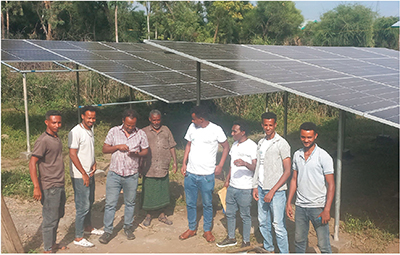
Supporting the restoration of solar-powered water supply facilities in response to the crisis caused by conflict in North Wollo Zone, Amhara Region, Ethiopia (Photo: ADRA Japan)
Given the situations in Lebanon, Syria, Afghanistan, Myanmar, Ukraine, Sudan, and other countries, the number of forcibly displaced people including refugees and displaced persons worldwide has been increasing year after year. In May 2024, the number reached 120 million people, the highest level since the end of World War II, and humanitarian situations are becoming increasingly severe. Japan co-hosted the Second Global Refugee Forum (GRF) in Geneva in December 2023 and called for strengthening unity and cooperation of the international community to prevent the deterioration of humanitarian situations, to help refugees and displaced persons both at home and abroad become self-reliant, and to ease the pressures on host countries. Japan provides humanitarian assistance from the viewpoint of human security, including for refugees, displaced persons and others, in order to ensure the life, dignity, and security of the people in the most vulnerable positions and to enable each individual to get back on their own feet.
In particular, Japan continuously provides for basic human needs, such as shelter and food, to those in need around the world, working mainly with the United Nations High Commissioner for Refugees (UNHCR), the World Food Programme (WFP), the International Organization for Migration (IOM) and other international organizations. Japan also collaborates with the above-mentioned UN agencies, as well as with the United Nations Relief and Works Agency for Palestine Refugees in the Near East (UNRWA) and the International Committee of the Red Cross (ICRC), in order to deliver humanitarian assistance to refugees, displaced persons, and others, even in areas with security concerns, leveraging their respective expertise and coordination capabilities. For example, in 2024, Japan provided humanitarian assistance to Ukrainian nationals displaced by Russia’s aggression in Ukraine and neighboring countries through partnerships with UNHCR and other organizations. In Sudan, Japan worked with WFP, ICRC and other organizations to provide humanitarian assistance to refugees and internally-displaced persons affected by the armed conflict. Humanitarian assistance is also provided by Japanese NGOs to refugees and internally-displaced persons through the Japan Platform (JPF)Note 41 (see “Featured Project”).
Upon providing humanitarian assistance for refugees, displaced persons, and others through international organizations, Japan also promotes cooperation among NGOs and the Japanese private sector. For example, in the case of refugee assistance, JICA works in collaboration with UNHCR to implement a program combining emergency and reconstruction assistance from the perspective of the HDP Nexus.
■Actions against Anti-Personnel Landmines, Unexploded Ordnance, and Illicit Small Arms and Light Weapons
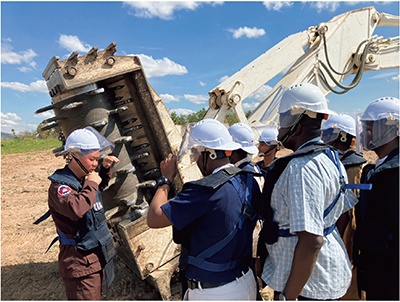
Mr. Oum Phumro, Deputy Director General of CMAC explaining Cambodia’s mine clearance operations using Japan-made mine clearance equipment to a delegation from four African countries (Photo: JICA)
In post-conflict countries and regions, anti-personnel landmines and unexploded ordnance (UXO) remain, and illicit small arms and light weapons are still in wide circulation. Such weaponry not only harms civilians indiscriminately and hinders reconstruction and development efforts, but also exacerbates animosities. Therefore, it is important to pursue sustained cooperation with a view to ensuring stability and safety in these countries and regions, through assistance for the disposal of anti-personnel landmines and UXO, proper management of small arms and light weapons, support for landmine survivors, and capacity building for personnel involved in UXO/mine action.
Japan also steadily promotes international cooperation from the perspective of the HDP Nexus as a signatory to the “Convention on the Prohibition of the Use, Stockpiling, Production and Transfer of Anti-Personnel Mines and on their Destruction” and the “Convention on Cluster Munitions,” through preventive measures such as risk reduction education, in addition to mine clearance and assistance for survivors. For example, Japan supports the Cambodian Mine Action Centre (CMAC) with an overall capacity enhancement program, such as strengthening its training capacity at home and abroad, capacity building of its administrative staff, and the development of its information systems, so that CMAC can make further international contributions. Japan also supports the upgrading of CMAC’s training complex and outreach facility in order to improve its training and educational environment for mine-action personnel and to raise awareness of landmine issues among visitors. Through such comprehensive support, as of December 2024, CMAC, with assistance from Japan, has conducted training for more than 500 staff members engaged in mine and UXO countermeasures in Angola, Colombia, Ethiopia, Iraq, Laos, Nigeria, Somalia, South Sudan, and Ukraine since 2009, thereby contributing to the realization of South-South cooperation and triangular cooperationNote 42 (see “Stories from the Field” regarding mine action support in Cambodia and its application to support for Ukraine).
In July 2024, then Foreign Minister Kamikawa visited CMAC during her visit to Cambodia. On that occasion, she announced the “Comprehensive Package of Assistance to Humanitarian Mine Action”Note 43 as Japan’s vision for its assistance to humanitarian mine action. This vision outlines comprehensive support aligned with the stages for various mine-related needs, in partnership with various actors, encompassing risk education, awareness-raising, mine clearance and victim assistance. At the same time, she announced the launch of the “Japan-Cambodia Landmine Initiative”Note 44 in cooperation with Cambodia as a new cooperation approach that embodies the above-mentioned comprehensive package.
In Laos, where the damage caused by UXO is particularly severe, in addition to training at CMAC, Japan dispatches experts to UXO Lao, a UXO countermeasure organization, to strengthen its operational capacity for formulating work plans and monitoring, while also developing facilities for its activities and providing necessary equipment such as mine detection sensors. Utilizing its experience and knowledge gained through many years of cooperation in mine action in Cambodia and other parts of the world, Japan proactively assists in the clearance of mines and UXO in Ukraine, which is essential not only to ensure the safety and security of residents, but also to rebuild livelihoods, agriculture, and industries in its post-war reconstruction.
In Cambodia, Sri Lanka, and several countries in the Middle East and Africa where landmines and UXO remain, Japan conducted mine clearance activities through international NGOs and provided landmine clearance equipment such as demining machines and hydraulic excavators through the Grant Assistance for Grass-Roots Human Security Projects.Note 45
Japan is also contributing to the improvement of connectivity in the Western Balkans, by supporting mine clearance activities in Bosnia and Herzegovina conducted by a Slovenia-based international nonprofit organization ITF Enhancing Human Security in cooperation with the Bosnia and Herzegovina Mine Action Center.
n Afghanistan, the Association for Aid and Relief, Japan (AAR Japan), implements education projects, including seminars, to raise awareness on the risks posed by landmines, UXO, and other remnants of conflict, and to teach appropriate ways of avoiding them, through the Grant Assistance for Japanese NGO Projects. As a result, awareness among residents is steadily expanding. Japan is also proactively engaged in measures against mines and UXO through international organizations. In 2024, Japan supported mine clearance, risk education, and victim assistance against landmines and UXO through the United Nations Mine Action Service (UNMAS) in Ethiopia, Nigeria, Palestine, and Somalia. Other support in 2024 includes mine risk education in Afghanistan, Central Africa, Palestine, and Myanmar via the United Nations Children’s Fund (UNICEF). Support including risk education is also provided to Afghanistan, Myanmar, Syria, Ukraine, and other countries and regions through the ICRC. In addition, Japan is coordinating to host an international conference on Ukraine mine action in Japan in the fall of 2025.
Small arms and light weapons are called “the de-facto weapons of mass destruction” because they are still used in actual conflicts and claim many lives. Japan is a donor country to the “Saving Lives Entity (SALIENT),” a UN fund established to embody the commitment made by UN Secretary General Guterres in “An Agenda for Disarmament (2018),” and actively contributes to the discussions on countermeasures against small arms and light weapons.
Glossary
- UN Peacebuilding Commission (PBC)
- An advisory body to the UN Security Council and the General Assembly established in accordance with the Security Council and General Assembly resolutions in 2005. The PBC aims to advise and propose integrated strategies for post-conflict peacebuilding and recovery. It provides advice to the Security Council and the General Assembly, among others through briefings and written submissions. Japan has consistently served as a member of the Organizational Committee, which is a central body of the PBC, since its establishment.
- UN Peacebuilding Fund (PBF)
- A fund established in 2006. The fund provides assistance in Africa and other regions to prevent the recurrence of regional conflicts and civil wars, as well as support for conflict prevention. Specifically, it supports peace processes and political dialogue, revitalization of economies, institution building of states, and participation of women and youth in nation-building, among other efforts.
- Note 39: In parallel with humanitarian assistance, the approach of the HDP Nexus is to provide development cooperation to enhance refugee self-reliance and reduce the burden on host countries, and also to address the root causes of refugee issues by promoting peace efforts to resolve and prevent conflicts.
- Note 40: In FY2007 Japan began the “Program for Human Resource Development for Peacebuilding,” and in FY2015, the program was renewed with expanded content as the “Program for Global Human Resource Development for Peacebuilding and Development” (https://www.mofa.go.jp/mofaj/gaiko/peace_b/j_ikusei_shokai.html (in Japanese only)). The renewed program includes the “Mid-Career Course,” which supports the career advancement of those with a certain degree of practical experience in fields related to peacebuilding and development, in addition to the existing “Primary Course,” which offers training in Japan to acquire the knowledge and skills necessary on the ground and on-the-job training at the field offices of international organizations.
- Note 41: See the glossary.
- Note 42: See the glossary.
- Note 43: A vision outlining comprehensive support for various mine-related needs and stages, implemented in partnership with diverse partners, including international organizations, NGOs, and Japanese companies, utilizing ODA as a catalyst. The approach to assistance is based on the following: (1) promoting triangular cooperation with Cambodia as a hub, (2) collaboration with like-minded countries and international organizations, and (3) utilizing Japanese science and technology.
- Note 44: An initiative to strengthen cooperation in mine action, building on many years of successful cooperation, under the following four pillars: (1) raising awareness of the inhumanity of landmines and building international momentum for mine reduction, (2) creating an international cooperation team in the relevant Cambodian organization for a world free from landmines, (3) undertaking Japan-Cambodia cooperation to support humanitarian mine action in third countries, and (4) developing equipment using the latest technologies.
- Note 45: See Part V, Section 2 (2).