
4 Latin America and the Caribbean
As a major force in the international arena, Latin America and the Caribbean has an enormous emerging market with a population of approximately 660 millionNote 17 and a regional GDP of approximately $7 trillion.Note 18 Many countries in the region share values and principles with Japan, such as freedom, democracy, and the rule of law, and are strategically important from diplomatic and economic perspectives. Also, since the region is a supplier of minerals, energy, and food, and particularly given the current circumstances where the stability of global food and energy supplies is a major challenge, it has become increasingly important in terms of strengthening supply chains and economic security in the international community including Japan. In addition, this region has the world’s largest Nikkei community (Japanese immigrants and their descendants) with a population of approximately 3.1 million, and there are also descendants who crossed the ocean to come to Japan and support Japanese industry. Thus, the personal and historic bond with Japan has been traditionally strong and this helps Japan maintain a stable and friendly relationship with the region for a long time.
On the other hand, the Latin American and the Caribbean region still has major developmental needs to be addressed as common challenges facing the international community, including climate change, disaster risk reduction, vulnerabilities in the areas of health and medical care, and poverty. There are also many countries in this region having vulnerabilities particular to small island states. In addition, the region is confronted by challenges, such as migrants who aim to immigrate to North America to flee from poverty and insecurity in their countries, Venezuelan refugees fleeing to neighboring countries due to the worsening political, economic, and social situations, and the situation in Haiti where the domestic political, economic, and security environments have continued to deteriorate since the murder of the president in July 2021.
Japan has deepened trust and friendship as partners with Latin American and Caribbean countries, under the keyword “juntos” (meaning “together” in both Spanish and Portuguese). As part of such foreign policy, Japan provides assistance unique to Japan (such as “quality infrastructure,” disaster risk reduction and mitigation utilizing Japan’s experiences, clean energy technology, “Visible Japanese Development Cooperation” through technical cooperation by volunteers and others) in ways that consider each country’s income level, situations, and needs. Through such assistance, Japan strives to help the region realize resilient and sustainable development. Japan also supports and leverages the Nikkei people and their communities that form the foundation of strong ties with Japan, and is further strengthening its multi-layered network of human resources based on trust.
●Japan’s Efforts
In 2024, which became a “Year of Latin America and the Caribbean” with Latin American and Caribbean countries chairing the G20 and APEC and leading the international community, Japan advanced diplomacy under the “Diplomatic Initiative toward Latin America and the Caribbean.” This Initiative seeks to strengthen cooperation in areas of increasing importance in international arenas, including oceans, gender, and disarmament and non-proliferation, while pursuing “diplomacy through diverse networking” as an approach to complement and strengthen historically strong relationships with Latin America and the Caribbean. Various efforts were also implemented in development cooperation to materialize the “Diplomatic Initiative toward Latin America and the Caribbean” (see also “ODA Topics”).
In February 2024, then Foreign Minister Kamikawa visited Brazil and Panama. In Panama, in addition to strengthening traditional bilateral relations grounded in shared values and principles, she confirmed that Japan will strengthen cooperation in areas where both countries put priorities, such as ocean and gender cooperation. With Brazil, the G20 Chair in 2024, she confirmed that Japan will further cooperate in addressing urgent issues facing the international community and in global governance reforms, including the UN Security Council reform. In May 2024, then Prime Minister Kishida visited Brazil and Paraguay, and confirmed the importance of cooperation in various fields, from maintaining and strengthening the international order to environmental protection and climate change measures. Through these efforts, Japan continues to deepen its engagement with the Latin American and the Caribbean region.
■Efforts toward Disaster Risk Reduction and Environmental Issues
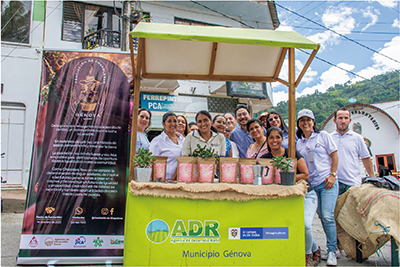
Promotional activities for Genova coffee by the Women Coffee Producers’ Association in Genova City, Colombia (Photo: JICA)
While the Latin American and the Caribbean region is blessed with abundant nature, the region is prone to natural disasters such as earthquakes, tsunamis, hurricanes, and volcanic eruptions. Therefore, it is of great importance that Japan supports this region, drawing on its expertise and experience in disaster risk reduction.
Japan provides assistance utilizing its expertise in the disaster risk reduction to the Latin American countries facing the Pacific Ocean, such as Ecuador, Mexico, and Peru, where earthquakes frequently strike. In 2024, Japan provided emergency relief goods through JICA to Brazil, which suffered from flooding, and Bolivia, which was affected by forest fires, as well as to Grenada, Jamaica, and Saint Vincent and the Grenadines, which were all affected by hurricanes. For Caribbean countries, Japan delivers various assistance and helps them overcome the particular vulnerability of small island states to natural disasters. In recent years, Japan has been dispatching experts in disaster risk reduction to the Caribbean Disaster Emergency Response Agency (CDEMA) and helping enhance the capacity for formulating disaster risk reduction policies in the region.
Moreover, Japan is engaged in a wide range of cooperation in the efforts to address environmental issues in the region, including scientific and technological research on climate phenomena, the conservation of biodiversity, and the protection of the Amazon rainforest using remote sensing. During then Prime Minister Kishida’s visit to Brazil in May 2024, Japan and Brazil launched the “Japan-Brazil Green Partnership Initiative (GPI)” for cooperation on environment, climate change, and sustainable development. As part of this initiative, Japan contributed to the Amazon Fund, which aims to prevent deforestation in the Amazon, as the first contributor in Asia. Furthermore, under the GPI, Japan has announced cooperation in disaster risk reduction and promotion of triangular cooperation, as well as in the conversion of degraded pasture into farming land from the perspective of global warming countermeasures and food security, and in agroforestry,Note 19 a sustainable agriculture and forestry method that restores forests and maintains forest ecosystems by planting a wide variety of plants together.
■Economic and Social Infrastructure Development
In order to promote economic and social infrastructure development of the Latin American and the Caribbean region, Japan actively engages in developing water supply and sewerage infrastructure in metropolitan regions and the countryside. In 2024, Japan decided to provide Guatemala, where water supply capacity has not kept pace with population growth and where insufficient drainage capacity has led to road flooding, traffic congestion, and a deteriorating sanitation environment, with water supply and sewerage system maintenance equipment such as pumps and crane trucks. Japan also decided to provide Antigua and Barbuda, which faces severe water shortages, with seawater desalination equipment.
In Honduras, Japan has been supporting landslide prevention measures along the National Road No. 6, a major international artery connecting the capital city of Tegucigalpa with neighboring Nicaragua, and decided to assist in constructing a bridge at a location where landslides are worsening.
In addition, Japan works on spreading its terrestrial digital broadcasting system (ISDB-T)Note 20 through public-private collaboration. As of December 2024, 14 countries in Latin America and the Caribbean adopted the Japanese system. For these countries, Japan supports technical transfer and human resources development to achieve smooth introduction of the system.
■Initiatives in the Areas of Health and Medical Care, and Education
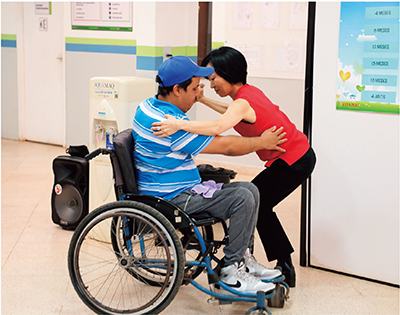
A JICA expert conducting tango therapy in Paraguay, aiming to promote independent living and social participation for persons with disabilities (Photo: JICA)
Due to the underdeveloped medical system, non-communicable diseases, infectious diseases such as HIV/AIDS and tuberculosis, and tropical diseases are still serious public health concerns for the Latin American and the Caribbean region. Therefore, establishing a system enabling rapid and accurate diagnosis and treatment is needed.
In Bolivia, improving medical equipment was a particularly urgent issue. In June 2023, Japan decided to provide Bolivia with a grant of ¥300 million and has installed medical equipment utilizing its advanced medical technology in the country’s national medical institutions.
Japan makes continuous effort for the Nikkei communities in various countries in Latin America and the Caribbean, such as providing support for the welfare facilities of the Nikkei communities, accepting trainees, and dispatching JOCVs.
Assistance in the sector of education is extremely important for Latin American and the Caribbean countries, where poverty still persists and education is under-budgeted. Based on the idea that education is crucial as an “investment in people,” Japan has been providing El Salvador with technical cooperation in mathematics and arithmetic education for more than 15 years. Additionally, since the spread of COVID-19, Japan has provided El Salvador, which prioritizes the promotion of digitalization in the education sector from the perspective of improving the quality of education and ensuring access to learning opportunities regardless of location, with equipment to promote the production of digital teaching materials.
■Assistance for Central American Migrants and Venezuelan Refugees and Migrants
The Central American region faces the problem of migrants who seek to immigrate to the United States and Mexico, fleeing poverty and insecurity in their country. Japan provides support for the measures to address the root causes of their migration such as poverty, insecurity, and disasters. Moreover, in cooperation with the International Organization for Migration (IOM) and the World Food Programme (WFP), Japan provides El Salvador, Guatemala, Honduras, and Mexico with assistance for the promotion of voluntary repatriation of migrants, prevention of outflow of migrants, and social reintegration of returnees.
Under the “Diplomatic Initiative toward Latin America and the Caribbean,” Japan has been providing protection services against gender-based violence and other issues to 20,000 migrant women in Panama, Costa Rica, and Honduras through UN Women from the perspective of addressing migration issues and gender equality, including Women, Peace and Security (WPS). In addition, Japan has implemented programs for 3,500 men and women, including both local residents of communities hosting the migrants and the migrants themselves, on the importance of social cohesion and problem-solving from a gender perspective (see Note 93 regarding WPS. Also, see “Japan’s Development Cooperation Initiatives to Promote WPS” for Japan’s WPS initiatives).
Due to the deterioration of the economic and social conditions in Venezuela, approximately 7.77 million refugees and migrants have fled mainly to neighboring countries as of May 2024. The lack of adequate response has been a challenge, causing deterioration of the living conditions for the host community residents and regional instability. Therefore, in October 2024, Japan decided to provide assistance totaling approximately ¥1.3 billion through the United Nations High Commissioner for Refugees (UNHCR) to Ecuador, Colombia, Brazil, and Peru, which have been hosting displaced persons from Venezuela. This assistance is aimed at providing humanitarian assistance and promoting economic and social inclusion of refugees and migrants by strengthening their protection and supporting the establishment of their livelihoods.
■Support for Haiti in Response to its Worsening Security Situation
In Haiti, especially since 2021, there have been frequent occurrences of violence and kidnappings against civilians by armed groups, which have become more influential. Nevertheless, the Haitian National Police (HNP), which should play a central role in improving security in the country, is short of both personnel and equipment. In view of this situation, the dispatch of the Multinational Security Support (MSS) Mission to Haiti was decided at the United Nations Security Council in October 2023, and Japan supported this decision.
In Haiti, the influx of weapons and illegal drugs, human trafficking, and the emergence of irregular migrants have combined to make the deterioration of security and humanitarian situations recognized not only as a domestic problem but also as a serious international concern. Japan has been assisting in improving the security and humanitarian situation in Haiti, in cooperation with the United States and other G7 countries, the Organization of American States (OAS), and the Caribbean Community (CARICOM). As part of these efforts, in November 2023, with the aim of strengthening the capacity of the Haitian National Police, Japan decided to provide police vehicles and police ambulances to the Haitian National Police in cooperation with the United Nations Development Programme (UNDP).
■South-South Cooperation / Triangular Cooperation
There are countries in Latin America and the Caribbean which have built a strong track record in South-South cooperation.Glossary Japan has developed partnership programs on triangular cooperationGlossary with Argentina, Brazil, Chile, and Mexico. Under the “Diplomatic Initiative toward Latin America and the Caribbean,” Japan is developing “diplomacy through diverse networking” by triangular cooperation. Japan collaborated with Argentina in 2024, for example, to provide assistance to small and medium-sized enterprises (SMEs) in Latin America and the Caribbean. In addition, Japan cooperated with Mexico in introducing production systems for non-traditional tropical fruits in northern countries of Central America. In Chile, Japan implements the KIZUNA Project (Disaster Risk Reduction Training Program). This project aims to develop Chile as a hub for disaster risk reduction training in the Latin American and Caribbean region, building on Japan-Chile disaster risk reduction cooperation that has continued since 1960. Over five years, more than 5,000 people from 27 countries have participated in training programs with experts dispatched from Japan. In Brazil, many years of cooperation from Japan resulted in the widespread use of the Japanese-style community police system. Building on this experience and the framework of triangular cooperation, Brazilian experts are currently dispatched to Central American countries to pass on their know-how in the field of community policing. Furthermore, Japan and Brazil are collaborating to conduct training programs, including vocational training, for Portuguese-speaking African countries.
In order to provide more effective and efficient assistance, Japan works with regional organizations such as the Central American Integration System (SICA) and the CARICOM to formulate regional projects related to common development issues in the Latin American and the Caribbean region.
Glossary
- South-South cooperation / Triangular cooperation
- South-South cooperation refers to cooperation implemented among developing countries, utilizing knowledge, skills, resources, technology, and other assets. When such South-South cooperation is supported by developed countries, donors, or international organizations, it is referred to as triangular cooperation.
- Note 17: World Bank website (as of December 2024) https://data.worldbank.org/indicator/SP.POP.TOTL?end=2023&locations=ZJ&start=1989
- Note 18: World Bank website (as of December 2024) https://data.worldbank.org/indicator/NY.GDP.MKTP.CD?end=2023&locations=ZJ&start=1989
- Note 19: Agroforestry: a form of agriculture and forestry that involves planting trees and raising livestock and growing crops in the spaces between the trees.
- Note 20: See Note 19.