
(2) Digital, Information and Communications Technology, and Science and Technology
The growth of developing countries and the development of the international community cannot proceed properly without responding to the digitalization of economic and social activities. Digital technology has become well integrated in people’s lives and industrial activities, and the benefits of cyberspace, which is an important foundation for daily lives and socio-economic activities, are expanding. On the other hand, the threat of cyber-attacks is becoming more serious, including damage caused by leaks of personal and corporate information and risks to national security from attacks on critical infrastructure. Therefore, it is becoming increasingly important to help developing countries reap the benefits of digitalization while mitigating its risks. Furthermore, since the impact of events in cyberspace can easily cross borders and cyber incidents occurring in other countries can also affect Japan, it is important to implement multi-layered cooperation and collaboration at various levels, including among governments and the private sector.
●Japan’s Efforts
■Promotion of Digital Transformation (DX)
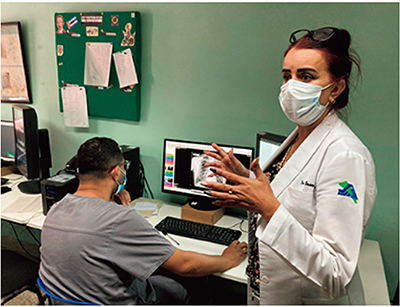
A doctor explaining the benefits of digitalizing medical imaging as part of the technical cooperation in Cuba, “Project to Promote Hospital Digitalization in Image Diagnosis” (Photo: JICA)
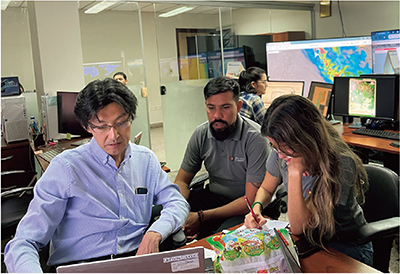
A JICA expert discussing with counterparts during the “Project for Management of Space Programs applied to the Socioeconomic Development,” a technical cooperation project in Paraguay (Photo: JICA)
The spread of COVID-19 has led to a period of disruption in the movement of people and goods, resulting in further promotion of the digitalization of socio-economic activities. Digital transformation (DX)Note 15 is directly linked to all development challenges and is the key to achieving “quality growth.”
In order to realize an inclusive and prosperous society in which developing countries and their people can benefit from digitalization in a safe, equitable, and stable manner, Japan has identified the promotion of digitalization and DX as one of the areas in which Japan will strategically implement ODA through the “Co-creation for common agenda initiative” (see Part I, Section 2 (2) and Part V, Section 2 (2) for details on the “Co-creation for common agenda initiative”). Through collaboration with various entities including international organizations and private companies, Japan supports the development of legal systems, human resources, and information and communication environments, as part of establishing foundations for promoting digitalization based on the concept of “Data Free Flow with Trust (DFFT),”Note 16 which Japan advocates. By doing so, Japan is promoting cooperation aimed at solving issues and enhancing development outcomes through the promotion of digitalization.
Areas where development benefits are expected to increase through DX include smart agriculture, remote medical care, smart cities, mobile banking, and the digitalization of government administration. As an example of Japan’s new cooperation initiative, Japan has been working with the Ministry of Industry, Commerce and Employment and the Ministry of Health of Bhutan since 2023 to expand and improve the quality of healthcare services in the country, by formulating strategies and plans for utilizing the health and medical data of Bhutanese citizens, developing data linkage infrastructure, and promoting data utilization. Additionally, under a yen loan project implemented by the Forest Department of West Bengal in India, efforts were made to utilize digital technologies such as artificial intelligence (AI) to address the pressing issue of avoiding collisions between elephants and humans.
In order to advance DX in ODA projects in more concrete terms, the JICA DXLab was launched in 2022 as an initiative to enable rapid and timely demonstration experiments with digital partners possessing excellent technology. JICA opens up its assets, such as the sites of its ODA projects in 150 countries and the networks it has cultivated, as a place for co-creation to support the resolution of challenges in developing countries through digital technology and data utilization together with its digital partners. By November 2024, a total of 15 projects had been implemented in Bangladesh, Ethiopia, India, and Indonesia (see “Stories from the Field” for a case in Mongolia on building a drone-based blood delivery network, and “Master Techniques from Japan to the World 1” and “Master Techniques from Japan to the World 4” for cases on crime prediction and prevention using AI technology in Brazil as well as weather forecasting and disaster risk reduction using the power of science in Argentina).
■Information and Communications Technology (ICT)
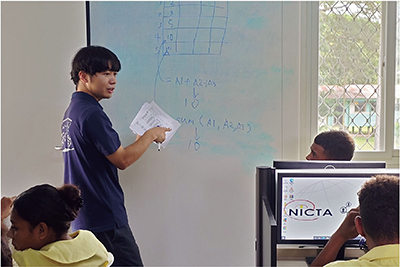
A Japan Overseas Cooperation Volunteer (JOCV) in Papua New Guinea giving a lecture on basic computer software usage and practical spreadsheet functions (Photo: JICA)

Displaced Ukrainian children gathered at an educational facility in Moldova. A Japanese NGO set up learning spaces allowing them to take online classes conducted from Ukraine. (Photo: Peace Winds Japan)
The dissemination of Information and Communications Technology (ICT)Note 17 contributes to the upgrading of industry and improvement of productivity as the establishment of a foundation for DX. It also contributes to solving social issues of medical care, education, energy, environment, disaster risk reduction and other areas, and helps promote democratization by encouraging information disclosure and establishing broadcasting media.
Japan promotes “quality infrastructure investment” in the ICT sector in developing countries.Note 18 It actively supports the establishment of telecommunications and broadcasting equipment and facilities, the introduction of the technology and systems they require, and relevant human resources development. Specifically, Japan actively works to support the overseas promotion and the introduction of the Integrated Services Digital Broadcasting-Terrestrial (ISDB-T),Note 19 which has been adopted in a total of 20 countriesNote 20 in Latin America and the Caribbean, Asia, Africa, and other regions as of April 2024. Japan also conducts training programs through JICA every year for countries adopting or considering ISDB-T. The Ministry of Internal Affairs and Communications (MIC) also promotes assistance that offers ICT solutions to resolve social issues through dialogues and joint projects with partner governments.
Japan works with the International Telecommunication Union (ITU)Note 21 to provide a variety of development assistance in the fields of telecommunications and ICT for developing countries. The internet usage rate in Least Developed Countries (LDCs)Note 22 is estimated to be at 36%. Since October 2020, Japan has cooperated with the ITU to launch the Connect2Recover (C2R) Initiative, which supports developing countries, mainly in Africa, to draft national strategies for strengthening digital infrastructure and improving their usage environments. Among the pilot projects in the “Giga” initiativeNote 23 jointly implemented by ITU and the United Nations Children’s Fund (UNICEF), Japan has provided support for introducing internet connectivity to schools in Rwanda. Starting in 2022, Japan has supported Zimbabwe and Mauritania in evaluating the resilience of their network infrastructure, developing maps that show the connection status of telecommunications networks before and after natural disasters, and formulating national strategies for the dissemination of ICT. Additionally, as a result of reaching out to various countries to expand the C2R projects, the Governments of Australia, the Czech Republic, and Lithuania have decided to provide funding, and the area of activities expanded to countries in Asia, the Caribbean, and the Commonwealth of Independent States (CIS). Since 2023, Japan has also extended its support to a total of 11 countries in Africa, with a focus on initiatives related to early warning systems.
In the Asia-Pacific region, the Asia-Pacific Telecommunity (APT)Note 24 contributes to the balanced development of the telecommunication services and information infrastructure in the region. In order to promote human resources development related to telecommunications, Japan finances a number of training programs conducted by the APT every year. In FY2023, 10 training programs including on broadband networks and cybersecurity were implemented and attended by approximately 125 people from the APT member states. The trainees utilize Japanese technology for the development of their own countries’ ICT, and Japanese companies’ expansion into the Asia-Pacific region is also expected through introducing Japanese technology systems.
In the Asia-Pacific region, over two billion people do not have internet access due to factors including fragile infrastructure and the unaffordable usage costs. In the Southeast Asian region and Pacific Island countries, Japan is developing an environment to make low-cost, high-speed internet available even in remote islands and areas.
■Cybersecurity
In recent years, it has become a pressing task to take measures against threats to a free, fair, and secure cyberspace. It is thus necessary for diverse entities in each country to work together in order to respond to this issue. The lack of security-related awareness and response capacity in some countries, including developing countries, poses a significant risk to the entire world, including Japan. Therefore, strengthening cooperation for ensuring the security in cyberspace of countries around the world and providing capacity building support to developing countries not only contributes to the recipient countries, but also benefits the entire world including Japan.
Japan has strengthened cooperation with ASEAN on cyber security through the ASEAN-Japan Cybercrime Dialogue and the Japan-ASEAN Information Security Policy Meeting. At the Japan-ASEAN Information Security Policy Meeting in 2024, Japan and ASEAN member states advanced initiatives on public-private partnerships, capacity building, awareness raising, and the protection of critical infrastructure, with the purpose of enhancing collaboration on cybersecurity. In addition, through the International Criminal Police Organization (INTERPOL), Japan supported the strengthening of the investigative capacity of officials at law enforcement related agencies to deal with crimes committed in cyberspace, which increased under the COVID-19 pandemic.
Japan and ASEAN have concurred to further strengthen their cooperation on the issues related to cyber-attacks. As a specific initiative, since 2017, Japan has been conducting training for staff engaged in combatting cybercrimes at the Ministry of Public Security of Viet Nam, with the aim of helping them acquire the knowledge and skills for dealing with cybercrimes, as well as strengthening cooperative relations between the security agencies of Japan and Viet Nam. Japan also conducts cybersecurity exercises and other programs at the “ASEAN-Japan Cybersecurity Capacity Building Centre (AJCCBC),” which was established in Bangkok, Thailand, through the Japan-ASEAN Integration Fund (JAIF).Note 25 In March 2023, support for the operation of the AJCCBC began as technical cooperation through JICA under the “Project for Enhancing ASEAN-Japan Capacity Building Program for Cybersecurity and Trusted Digital Services.” As of November 2024, a total of 2,395 people had taken part in training and other programs.
At the AJCCBC, Japan provides the Cyber Defense Exercise with Recurrence (CYDER), a practical exercise targeting cybersecurity personnel of government agencies and critical infrastructure operators in ASEAN countries, and promotes cooperation in capacity building in the area of cybersecurity in ASEAN. Since March 2023, Japan has been working to further enhance the content by adding new training for exercise trainers and exercises based on needs surveys in ASEAN countries. In October 2024, the Cyber SEA Game 2024 was held and young engineers and students selected from ASEAN countries competed using their cybersecurity skills.
Japan also contributed to the World Bank’s Cybersecurity Multi-Donor Trust Fund and works on capacity building assistance in the field of cybersecurity for low and middle-income countries.
■Promoting Science, Technology and Innovation, and Research and Development
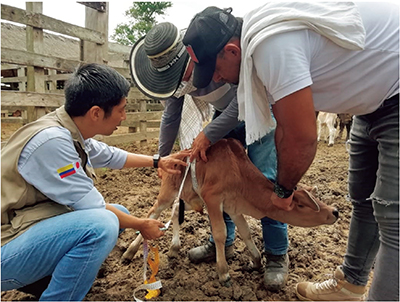
A Japanese researcher instructing local livestock farmers in Colombia on confirming calf (beef cattle) development using a digital platform as part of SATREPS (Photo: JICA)
In the world today, social changes are occurring, with information and communication technology (ICT), artificial intelligence (AI), and robotics being utilized in diverse industries, including not only the manufacturing industry and the service industry but also in agriculture and construction.
Based on “the 2030 Agenda for Sustainable Development (2030 AgendaNote 26)” (Paragraph 70), the UN has established the UN Inter-agency Task Team on STI for the SDGs (UN-IATT) and promotes Science, Technology, and Innovation for SDGs (STI for SDGs) on a global scale, in cooperation with other countries. The UN Multi-Stakeholder Forum on Science, Technology, and Innovation for the Sustainable Development Goals (STI Forum) was held again in 2024. Expectations for STI are internationally increasing as a key to achieve the SDGs while optimizing limited resources.
In the process of Japan’s economic development, Japan has overcome its own challenges in fields such as health and medical care, environment, and disaster risk reduction, fully utilizing STI. Based on these experiences, Japan is engaged in science and technology cooperation through the “Science and Technology Research Partnership for Sustainable Development (SATREPS) program”Glossary and others in order to resolve challenges faced by developing countries. SATREPS, which links Japan’s science and technology with ODA, was launched in 2008 to support joint research between research institutions and researchers in science and technology fields in Japan and in developing countries. A total of 202 research projects in 58 countries around the world have been adopted as of FY2024. In 2024, 12 new projects were selected in fields such as environment and energy, bioresources, disaster prevention and mitigation, and infectious diseases control (see also “Master Techniques from Japan to the World” for a SATREPS project in Argentina).
The UN-IATT conducts the “Global Pilot Programme” to promote the development of an STI roadmap for SDGs in countries worldwide, including six pilot countries: Ethiopia, Ghana, India, Kenya, Serbia, and Ukraine.Note 27 Under this Programme, Japan has supported Kenya in the agricultural sector from FY2020 to FY2024 through contributions to the World Bank. In addition, since FY2020, Japan has supported Japanese companies that are considering launching projects to resolve social challenges in developing countries through STI, through contributions to the United Nations Development Programme (UNDP), and made efforts to share expertise gained through this support among developing countries.
In terms of support for research and development, Japan is building a next-generation network based on cooperation in human resources development, by strengthening assistance for overseas engineering universities.
In Asia, Japan supports the Malaysia-Japan International Institute of Technology (MJIIT), which was founded with the aim of establishing Japanese-style engineering education. The support includes procuring educational and research equipment and supplies, and developing curriculum designs. In partnership with Japanese universities, Japan also helps MJIIT embed the characteristics of Japanese-style engineering education in its teaching and research activities. In 2023, Japan launched cooperation to establish and expand the Malaysia-Japan Linkage Office within MJIIT as a liaison office to further strengthen collaboration between MJIIT and Japanese universities and industries. As of 2024, a consortium of 29 universities and 2 research institutes, among others, has been organized to promote people-to-people exchanges between Japan and Malaysia through joint research, joint degrees, and student exchanges.
Since 2012, Japan has provided scholarships to students studying remote sensing (satellite image analysis) in courses taught by Japanese instructors at the Asian Institute of Technology (AIT) located in Thailand, contributing to the development of the human resources constituting the crux of the space industry development in the Asian region.
In Africa, Japan has been cooperating under the Egypt-Japan University of Science and Technology (E-JUST) project since 2008. Established based on the principles of Japanese-style engineering education, E-JUST has received support from Japanese universities through curriculum development and the dispatch of faculty. E-JUST has been highly praised for its achievements, including joint research and joint supervision with Japanese researchers, exchange student programs and internationalization undertaken by both Japanese and Egyptian governments, and collaboration with Japanese companies. E-JUST was ranked as the top university in Egypt and sixth on the African continent in the World University Rankings published by the UK’s Times Higher Education (THE) in 2024. In September 2024, JICA and the Government of Egypt signed an agreement to strengthen the academic network between Japanese and African universities in the field of science, technology, and innovation, with E-JUST serving as one of the hubs on the African continent. E-JUST is expected to play a key role in promoting international joint research and education by university researchers from Japan and within Africa.
Glossary
- Science and Technology Research Partnership for Sustainable Development (SATREPS) program
- Through the collaboration of Japan’s advanced science and technology with ODA, SATREPS aims to resolve global issues in the fields of environment and energy, bioresources, disaster prevention and mitigation, and infectious disease control. Under this program, research institutes both in developing countries and Japan work together to conduct international joint research with the following objectives: (1) enhancing international cooperation in science and technology, (2) acquiring new knowledge and technologies that lead to the resolution of global issues, and through this process, creating innovations, (3) promoting capacity development. The Ministry of Foreign Affairs (MOFA) and JICA, in collaboration with the Ministry of Education, Culture, Sports, Science and Technology (MEXT), the Japan Science and Technology Agency (JST), and the Japan Agency for Medical Research and Development (AMED), provide support to research institutes and researchers in Japan and the developing countries.
- Note 15: Making people’s lives more convenient and enriching them through the introduction of new information technologies, and generating new value by recreating existing business structures with the introduction of new digital technologies, etc.
- Note 16: DFFT is an abbreviation of Data Free Flow with Trust. The concept of DFFT aims to promote the free international flow of data, where data that is useful for business and solving social issues can flow freely without regard for borders, while ensuring trust in terms of privacy, security, and intellectual property rights. DFFT was proposed by then Prime Minister Abe at the World Economic Forum Annual Meeting (Davos Conference) held in Geneva, Switzerland, in January 2019 and was included in the Leaders’ Declaration at the G20 Osaka Summit in June 2019 with the support of the leaders of participating countries.
- Note 17: ICT is a technology that integrates computers and other information technology with digital communication technology, as represented by the Internet and mobile phones.
- Note 18: In 2017, Japan formulated the Playbook for Investment in “Quality ICT Infrastructure” for ICT policymakers and procurement managers of the respective countries and regions.
- Note 19: A terrestrial digital broadcasting system that was developed in Japan. Its functions, such as an emergency alert broadcast system, TV broadcasting reception on mobile terminals, and data broadcasting, etc., give the system advantages in disaster response and the provision of diverse services.
- Note 20: The 20 countries are Japan, Angola, Argentina, Bolivia, Botswana, Brazil, Chile, Costa Rica, Ecuador, El Salvador, Guatemala, Honduras, Maldives, Nicaragua, Paraguay, Peru, the Philippines, Sri Lanka, Uruguay, and Venezuela.
- Note 21: A UN specialized agency that covers the fields of telecommunications and broadcasting. To ensure that people around the world are able to make use of telecommunications technologies, ITU organizes the following: (i) international allocation of radio frequencies used in mobile phones, satellite broadcasting, and other technologies, (ii) international standardization of telecommunications technologies, and (iii) support for development in the field of telecommunications in developing countries.
- Note 22: See the glossary.
- Note 23: An initiative launched by UNICEF and ITU in 2019 with the aim of enabling internet access in schools around the world, focusing on developing countries.
- Note 24: An international telecommunication organization established in the Asia-Pacific region. Aiming for a balanced development of telecommunication services and information infrastructure in the Asia-Pacific region, it implements human resources development through training courses and seminars, and coordinates regional policies on standardization, radio communications, and other telecommunication issues.
- Note 25: See Note 5.
- Note 26: See the glossary.
- Note 27: India, Ethiopia, Ghana, Kenya, and Serbia since 2020; Ukraine since 2021.