
(3) Quality Infrastructure
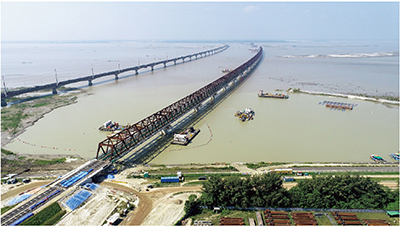
The “Jamuna Railway Bridge Construction Project” in Bangladesh, supported by Japan’s loan aid, expected to enhance transportation networks within the country and with neighboring countries. (Photo: Obayashi-Toa-JFE (OTJ) Joint Venture)
For the autonomous development of developing countries, infrastructure that supports people’s lives and economic activities serving as the foundation for their national development is essential. However, developing countries still have enormous demand for infrastructure and the investment gap between infrastructure demand and supply is estimated to be approximately $15 trillion by 2040.Note 28 In order to achieve “quality growth”Note 29 in developing countries, it is necessary to meet this enormous demand for infrastructure. It is very important not only to develop a large amount of infrastructure but also to consider openness, transparency, economic efficiency in view of life-cycle costs, and debt sustainability, etc.
Japan has strengths related to maritime and aviation safety management, disaster risk reduction and resilience technologies, urban development that contributes to addressing climate change and environmental issues, safe transportation systems, electricity and energy infrastructure, and water supply. In order to leverage these strengths to solve social issues in partner countries, Japan promotes the development of “Quality Infrastructure”Glossary by combining structural and non-structural support. For structural support, it provides infrastructure development in line with the economic and development strategies of each developing country, while for non-structural support, it provides cooperation for institutional development, management and maintenance, and human resources development.
●Japan’s Efforts
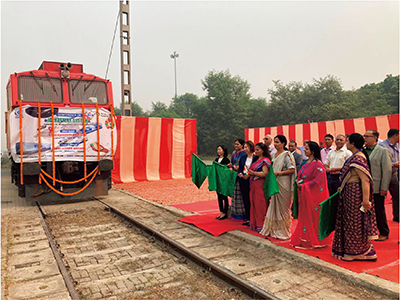
Opening ceremony of a refrigerated rail freight service in India using refrigerated containers developed by a Japanese company under a public-private partnership project aimed at building a cold chain (Photo: JICA)
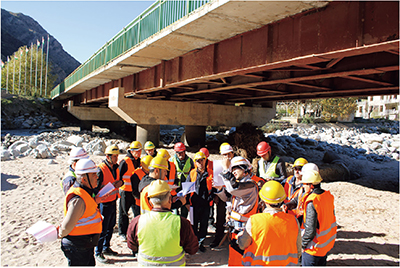
Human resources development support for bridge inspection, diagnosis, repair, and maintenance in Tajikistan (Photo: JICA)
Japan has been working with the international community to disseminate the notion of “Quality Infrastructure,” and to standardize it internationally, aiming to ensure broader access for people around the world. The “G7 Ise-Shima Principles for Promoting Quality Infrastructure Investment,” endorsed at the G7 Ise-Shima Summit under the Japanese Presidency in May 2016, was the initial step for sharing the fundamental elements of “Quality Infrastructure Investment.” In addition, at the G20 Osaka Summit under the Japanese Presidency in June 2019, the “G20 Principles for Quality Infrastructure Investment,”Note 30 which indicate a strategic direction for promoting Quality Infrastructure Investment, were endorsed. Japan cooperates with various countries and international organizations to promote and implement these Principles, and the importance of “Quality Infrastructure Investment” has been confirmed at various bilateral and multilateral meetings.
At the G7 Elmau Summit in June 2022, the Partnership for Global Infrastructure and Investment (PGII),Note 31 an initiative for the G7 to work together to promote Quality Infrastructure Investment to narrow the global investment gap, was launched. Under the PGII, the G7 leaders announced their aim to collectively mobilize up to $600 billion in public and private investment over five years, with a particular focus on Quality Infrastructure. At a side event on PGII held during the G7 Apulia Summit in June 2024, each country introduced their respective initiatives to strengthen connectivity in Africa and expressed their expectations for the promotion of infrastructure investment, including private capital, under the PGII. Then Prime Minister Kishida introduced Japan’s initiatives for strengthening connectivity in Africa and Asia, and announced that Japan would continue to support Africa’s growth through Quality Infrastructure so as to be able to link the outcomes of the PGII to the Ninth Tokyo International Conference on African Development (TICAD 9), which is scheduled to be held in 2025.
The Blue Dot Network (BDN),Note 32 a framework for internationally certifying Quality Infrastructure projects, is also an important initiative in promoting “Quality Infrastructure Investment.” In April 2024, the BDN Secretariat was established in the Organisation for Economic Co-operation and Development (OECD). The Ministerial Council Statement adopted at the OECD Ministerial Council Meeting chaired by Japan in May of the same year, committed to promoting Quality Infrastructure Investment in line with the “G20 Principles for Quality Infrastructure Investment” and through initiatives such as the PGII, and welcomed efforts to operationalize the BDN and the establishment of its secretariat.
In ASEAN, Japan has promoted many projects to develop transport infrastructure such as the Sihanoukville Port in Cambodia, the Patimban Port and Jakarta Mass Rapid Transit in Indonesia, and the Metro Manila Subway in the Philippines. At the ASEAN-Japan Summit held in October 2024, then Prime Minister Ishiba stated that under the “Japan-ASEAN Comprehensive Connectivity Initiative” announced in 2023, various projects are underway in a wide range of areas including both structural and non-structural aspects, such as digital technology, transport infrastructure development, and electricity connectivity, as well as in promoting regional financial cooperation. He also expressed Japan’s willingness to promote cooperation to address emerging issues such as Green Transformation (GX) and Digital Transformation (DX)Note 33 in order to jointly shape a vibrant future of the region.
As for efforts in Pacific Island countries, Japan, the United States, Australia, Kiribati, Nauru, and the Federated States of Micronesia jointly announced Japan-U.S.-Australia joint support for the East Micronesia Cable (EMC) in December 2021, and an undersea cable contract was signed in June 2023. In May 2024, the fourth meeting of the six-country Project Executive Board was held to confirm the progress of the project. At the 10th Pacific Islands Leaders Meeting (PALM10) held in July 2024, then Prime Minister Kishida stated that Japan would contribute to the enhancement of connectivity on land, sea, air, and in the digital space through the development of “Quality Infrastructure” including undersea cables. Japan will continue to cooperate in developing Quality Infrastructure to strengthen connectivity in the Indo-Pacific region, including in the Information and Communications Technology (ICT) field, in cooperation with the United States, Australia, and other like-minded countries.
As for the African region, at the Eighth Tokyo International Conference on African Development (TICAD 8) held in Tunisia in August 2022, Japan announced initiatives that would promote enhancement in regional connectivity, in addition to improving social infrastructure development in Africa through the development of Quality Infrastructure and one-stop border posts at national borders. As a concrete example of cooperation to promote “connectivity and Quality Infrastructure Investment” in Africa, Japan signed and exchanged notes with Tanzania in October 2024 concerning a grant project for the construction and expansion of the inner ring road in Dodoma, the capital of Tanzania. This project is expected to contribute to infrastructure development supporting smoother logistics as well as economic and social development in Tanzania. In addition, it is also expected to facilitate logistics along the Central Corridor, as Dodoma is located on this corridor connecting Tanzania to Uganda, an inland country, and the Democratic Republic of the Congo.
The Government of Japan will continue to disseminate the “G20 Principles for Quality Infrastructure Investment” throughout the international community for quality growth around the world, and will further promote efforts to implement “Quality Infrastructure Investment” together with countries around the world including Asian countries as well as international organizations such as the World Bank, the Asian Development Bank (ADB), and the OECD.
Glossary
- Quality Infrastructure
- Infrastructure that genuinely contributes to “quality growth” that is “resilient” against natural disasters and other risks, “inclusive” so that no one is left behind, and “sustainable” taking into account its impact on society and the environment. The “G20 Principles for Quality Infrastructure Investment,” which incorporate key elements for investing in “Quality Infrastructure” such as (i) openness, (ii) transparency, (iii) economic efficiency in view of life-cycle costs, and (iv) debt sustainability, were endorsed at the G20 Osaka Summit in June 2019.
- Note 28: Forecasts by the G20 Global Infrastructure Hub (GIH).
- Note 29: See the glossary.
- Note 30: See the glossary “Quality Infrastructure”.
- Note 31: PGII is the G7’s commitment to promoting public and private investment in sustainable, inclusive, resilient and quality infrastructure.
- Note 32: Proposed by Japan, the United States, and Australia in November 2019. Since 2023, the United Kingdom, Spain, and Switzerland have joined and are discussing the specific institutional design.
- Note 33: See Note 15.