
MASTER TECHNIQUES from Japan to the World 4


Safeguarding Lives and Property in Argentina through the Application of Japan’s World-Class Weather Forecasting System
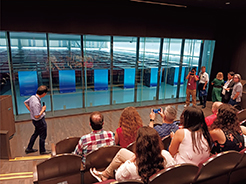
Argentine researchers visiting the “Fugaku” supercomputer (Photo: PREVENIR Project)
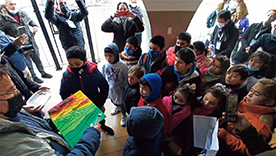
Disaster risk reduction education in a suburban area of Córdoba (Photo: PREVENIR Project)
Argentina grapples with flood damage due to heavy rainfall, exacerbated by climate change and other factors. Particularly in major urban areas such as Buenos Aires Province and Córdoba Province, rapid population growth and urbanization have caused the expansion of densely populated areas, increasing the country’s vulnerability to disasters. To mitigate disaster damage, it is essential to swiftly convey accurate information about when and where to evacuate, based on reliable weather data and forecasts. The development of accurate weather forecasting and disaster information systems is thus an urgent priority.
To address this situation through “the power of science,” RIKEN has been working since 2022 under the Science and Technology Research Partnership for Sustainable Development (SATREPS)Note 1 program, in collaboration with research institutions, including the national meteorological agencies of Japan and Argentina, to develop a comprehensive solution package for observation, prediction, warning, and communication, aimed at reducing meteorological and flood risks.
Several decades ago, Japan, like Argentina today, relied on forecasters making weather predictions based on their experience and knowledge, using limited observation tools. Japan now issues warnings and evacuation information with world-leading accuracy, enabled by cutting-edge equipment and forecasting technology, including the geostationary meteorological satellite “Himawari” and observation data from the Automated Meteorological Data Acquisition System (AMeDAS). This SATREPS project aims to tackle challenges by researching and developing forecasting technologies tailored to Argentina’s current circumstances. Dr. MIYOSHI Takemasa, Chief Scientist at RIKEN and leader of this project, reflects on its progress: “Although Argentina, like other developing countries, lacked sufficient equipment and technical resources, efforts were already underway to modernize its weather radar. By focusing on flood control measures in Buenos Aires Province and Córdoba Province, we strive to enhance weather forecasting accuracy through the integration of Argentina’s existing infrastructure and observation data with Japan’s technological expertise. Installation and operation of observational equipment and large-scale computing systems have already begun, laying the foundation for generating higher-quality information, including high-precision simulations.”
Preventing disaster damage requires not only delivering collected information to residents in a timely and accurate manner but also ensuring their understanding. As part of this project, smartphone applications and websites are being developed to communicate flood forecasts and warnings. In parallel, initiatives to raise disaster awareness among the public, who are the recipients of disaster-related information, are ongoing, such as special classes at local schools and workshops for community members. For example, educational materials on flood preparedness were created and distributed to schools to support disaster education. Training sessions are also being held for primary school students, teachers, and disaster management officials of local governments in the target areas. These sessions introduce the project and offer opportunities to explore flood control measures from an educational perspective. Feedback from participants, such as their impressions of the applications and websites, is gathered to support the development of more user-friendly systems.
Regarding the significance of the SATREPS project, Dr. Miyoshi explains, “This project allows us to study whether the systems we have developed can be applied in environments different from Japan, such as on a continental scale or within a Southern Hemisphere climate. Damage caused by disasters is inherently unjust, and economically vulnerable regions often bear the brunt of their impacts. The system being developed in Argentina does not require state-of-the-art facilities or vast amounts of high-quality data, making it suitable for deployment in other developing countries facing similar challenges. In this way, we can give back to society by helping to minimize disaster damage through the development of weather forecasting and disaster information systems.”
Additionally, drawing on his own research journey—sparked by an encounter with an Argentine mentor during his graduate studies—Dr. Miyoshi highlights the deeper personal and professional rewards of the project that go beyond its academic and social significance, “By allowing young Japanese researchers to spend extended periods working on-site, the project enables fostering connections with their international counterparts. These relationships lay the groundwork for continued research collaboration even after the project ends. SATREPS also plays a vital role in bridging generations of researchers.”
Dr. Miyoshi also shares his hopes for the future: “Forecasting severe weather is directly tied to saving lives. I hope this project will bear fruit and help protect as many people as possible. I want to contribute to ensuring that the power of science can serve to mitigate the devastating impact of these unjust disasters, even if only to a small extent.”
Note 1 See the glossary.
<< Previous Page
Main Text | Reference Statistics | Stories from the Field | Master Techniques from Japan to the World | ODA Topics