
Part IV Regional Profiles
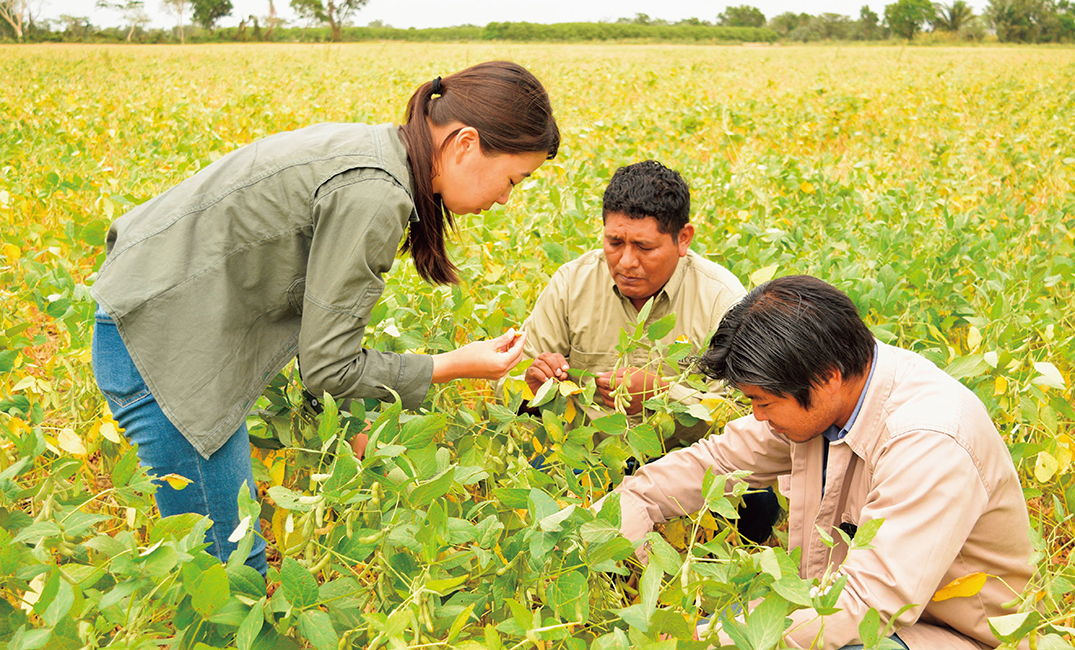
A Japan Overseas Cooperation Volunteer (JOCV) conducting a soybean growth survey with fellow agricultural engineers in the Okinawa Settlement, home to many Japanese descendants in Bolivia (Photo: JICA)
1 East Asia
East Asia consists of countries with diverse economic circumstances, including least developed countries (LDCs),Note 1 such as Cambodia and Laos, and countries like Indonesia, the Philippines, and Viet Nam, which have achieved significant economic growth but still face various domestic challenges.
The stability and development of these countries at the heart of the Indo-Pacific region are directly connected to Japan’s own security and economic prosperity. From this perspective, Japan engages in development cooperation, responding to the diverse socio-economic contexts and the shifting needs of development projects of the East Asian countries.
●Japan’s Efforts
Japan has contributed to the remarkable economic growth of East Asia through development cooperation that integrates ODA with trade and investment. This includes developing socio-economic infrastructure through “quality infrastructure investment,”Note 2 supporting institutional and human resources development, promoting trade, and stimulating private investment. In recent years, Japan has sought to further enhance open regional cooperation and integration based on shared fundamental values. At the same time, it has worked to foster mutual understanding and sustained regional stability through youth and cultural exchanges, as well as the promotion of Japanese language. In order to establish Asia as “a growth center open to the world,” Japan provides support to strengthen the region’s capacity for growth and expand domestic demand in each country.
■Support for Southeast Asia
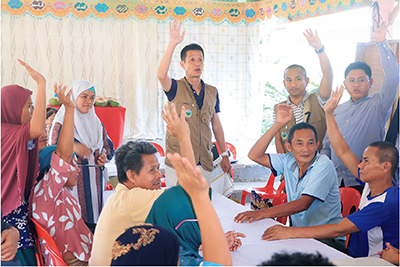
A JICA expert engaging in active dialogue with local stakeholders in the Bangsamoro Autonomous Region in Mindanao, Philippines (Photo: Ministry of Agriculture, Fisheries, and Agrarian Reform, Bangsamoro Transition Authority)
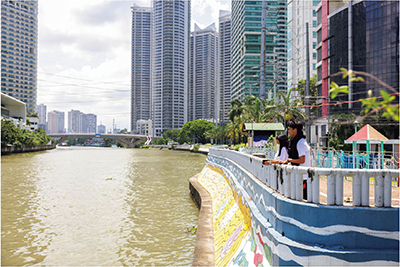
A loan aid project “Pasig-Marikina River Channel Improvement Project” in the Philippines. Japan has long contributed to regional flood control efforts. (Photo: JICA)
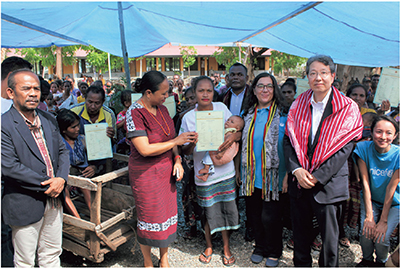
A family who completed registration through the mobile birth registration system established in a rural area of Timor-Leste (Photo: JICA)

Then Parliamentary Vice-Minister for Foreign Affairs Komura (right) visiting the Red Line (Mass Transit System) and Bang Sue Grand Station developed through Japan’s yen loans to Thailand
Most of the ASEAN member statesNote 3 are key to a “Free and Open Indo-Pacific (FOIP)” and have strong economic ties with Japan, with approximately 15,800 Japanese-affiliated company offices operating in the region as of October 2023. The region is of great importance to Japan, both politically and economically. ASEAN has adopted the “ASEAN Community Vision 2025” in 2015, and has been making efforts to further deepen its integration through strengthening connectivity and narrowing the development gaps within the region. Moreover, the “ASEAN Outlook on the Indo-Pacific (AOIP)”Glossary (2019) advocates openness, transparency, inclusivity and other principles as ASEAN’s guiding principles of action, and the “Joint Statement of the 23rd ASEAN-Japan Summit on Cooperation on ASEAN Outlook on the Indo-Pacific,” adopted at the ASEAN-Japan Summit in November 2020, affirmed that AOIP shares fundamental principles with FOIP. The leaders also concurred on further reinforcing the ASEAN-Japan Strategic Partnership through enhanced practical cooperation and synergy in the four areas outlined in the AOIP (maritime cooperation, connectivity, the Sustainable Development Goals (SDGs), and economic and other possible areas of cooperation). In the year of 2023, which marked the historic milestone of the 50th Year of ASEAN-Japan Friendship and Cooperation, the ASEAN-Japan Comprehensive Strategic Partnership (CSP) was established at the ASEAN-Japan Summit in September. Moreover, the Joint Vision Statement on ASEAN-Japan Friendship and Cooperation was adopted at the Commemorative Summit for the 50th Year of ASEAN-Japan Friendship and Cooperation, held in December of the same year, outlining a new vision for cooperation, along with its Implementation Plan, which outlines 130 specific cooperation items.
Building on ASEAN’s initiatives, Japan implements ODA across a wide range of areas, such as infrastructure development, the rule of law, maritime safety, disaster risk reduction, health and medical care, and peacebuilding. Moreover, in light of the increasing importance of leveraging the financial resources of the private sector and Multilateral Development Banks in the area of development, Japan presented a policy at the ASEAN-Japan Commemorative Summit in December 2023 to mobilize $35 billion in public and private funds for the ASEAN region over the next five years as a new initiative in public-private partnership for finding solutions through co-creation. Japan is working to advance cooperation in collaboration with various actors, including the private sector, and in 2024, it convened a public-private roundtable to promote the Co-creation for Common Agenda Initiative to support the development of Cambodia.
With regard to strengthening connectivity, Japan promotes cooperation based on the “Master Plan on ASEAN Connectivity 2025,”Glossary which aims to strengthen “physical connectivity,” “institutional connectivity,” and “people-to-people connectivity” in the region. In 2019, Japan signed the Japan-ASEAN Technical Cooperation Agreement to support the reinforcement of ASEAN unity and centrality. In accordance with the Agreement, by FY2023 Japan conducted human resources development and training in areas such as cyber security (see Part III, Section 1 (2) for details), marine plastic litter management, public international law, treatment of criminal offenders, disaster medical management, food value chain development,Note 4 promotion of local industries, customs administration, and prevention and control of infectious diseases. Under the “Japan-ASEAN Comprehensive Connectivity Initiative” announced in September 2023 to further promote both structural and non-structural aspects of connectivity, Japan supported infrastructure projects such as the Metro Manila Subway and Jakarta Mass Rapid Transit. Japan also provided capacity-building support in the field of digital connectivity through the ASEAN-Japan Cybersecurity Capacity Building Centre (AJCCBC). Furthermore, Japan is also advancing cooperation that strengthens human and knowledge connectivity, such as arranging acceptance of trainees for the Expo 2025 Osaka, Kansai, Japan.
In terms of infrastructure development, Japan works to promote “quality infrastructure” investment based on its past experiences of assisting Southeast Asian countries and in accordance with the “G20 Principles for Quality Infrastructure Investment.” For example, since 2017, Japan has been advancing the development of the first subway in Metro Manila in the Philippines, aiming to meet the growing transportation demand in Metro Manila, to relieve serious traffic congestion, as well as to ease atmospheric pollution and climate change. In response to the decision of the Government of the Philippines to establish the Philippine Railway Institute (PRI) for human resources development related to railway operation and maintenance, Japan also provides assistance for the development of PRI facilities, provision of training equipment such as simulators, and assistance in organizational management and capacity building. In March 2024, Japan decided on new financial cooperation for the development of a bypass road in Dalton Pass, which is the main trunk road directly connecting Metro Manila and the north-central part of Luzon Island. The construction of an alternative road that is resilient to disasters and has excellent driving performance is expected to improve access between north-central Luzon Island and Metro Manila, thereby strengthening connectivity and contributing to the revitalization of the Philippine economy. Through such efforts, Japan provides ODA that strategically combines loan aid, grants, and technical cooperation to realize “quality infrastructure” in the Philippines.
In regard to disaster risk reduction, Japan has continued its efforts since 2009 to enhance disaster management and disaster response capacity in ASEAN with support for the ASEAN Coordinating Centre for Humanitarian Assistance on disaster management (AHA Centre) through the Japan-ASEAN Integration Fund (JAIF).Note 5 These efforts include the establishment of the Disaster Emergency Logistic System for ASEAN (DELSA), capacity building of the ASEAN-Emergency Response and Assessment Team (ASEAN-ERAT), and the AHA Centre Executive (ACE) Leadership in Emergency and Disaster Management Programme (ACE-LEDMP).
In the field of health, Japan fully supports the establishment of the ASEAN Centre for Public Health Emergencies and Emerging Diseases, including approximately ¥5.5 billion ($50 million) in contributions to JAIF in 2020. Through these efforts, Japan has been contributing to strengthening the capacity of the ASEAN region to address public health emergencies and to prepare for, prevent, detect, and respond to emerging infectious diseases. In Timor-Leste, Japan contributes to the development of medical systems, including improving maternal and child health, through the provision of facilities and equipment for the national hospital and the establishment of basic emergency obstetric and newborn care facilities at community health centers.
With regard to the area of human resources development, Japan has been working on developing approximately 80,000 people over five years from 2019, including in the digital sector such as artificial intelligence (AI), under the “Industrial Human Resource Development Cooperation Initiative 2.0” announced at the ASEAN-Japan Summit in 2018. In Thailand, Japan supports the establishment of two “Kosen schools (Technical Colleges),” that incorporate Japan’s unique “Kosen education” system, providing education at the same level as in Japan to develop engineers who will lead innovation. Currently, five departments are operating at these two Kosen schools, and in March 2024, the first cohort of 24 students graduated. In addition, Japan implements the “Innovative Asia” initiative, which supports the circulation of competent human resources in Asian countries including ASEAN through studying abroad at Japanese graduate schools or other institutions, internships at Japanese companies, etc., with the aim of promoting innovation in Asia including Japan. Over the five years from FY2017, Japan accepted a total of 908 people from across Asia for both long-term and short-term programs. Under the “Japan-Singapore Partnership Programme for the 21st Century (JSPP21),” a joint initiative through which Japan and Singapore cooperate to provide technical assistance to third countries, the two countries jointly conducted training in FY2023 with focus on the priority areas of (i) connectivity, (ii) maritime cooperation, (iii) urban governance and smart initiatives, (iv) economic development, and (v) resilience building. Moreover, as part of Japan’s efforts to share its expertise more widely, the Mass Rapid Transit (MRT) operator, which accumulated sufficient Japanese expertise in Phase 1 of the project, is now conducting training for capacity building of MRT operators in other countries, such as those in Ho Chi Minh City and Dhaka.
Japan also engages in economic cooperation, holding investment seminars, invitation programs, and the “BIMP-EAGA+Japan” dialogue for the East ASEAN Growth Area (BIMP-EAGA).Note 6 For Indonesia, Japan has been developing local fishing ports and markets as part of its maritime and remote island development cooperation. Since 2022, tuna landed at the fishing port on Biak Island in Papua Province, which was developed through Japanese ODA, has been exported to Japan. In addition, since 2023, the development of fishing ports and markets has been undertaken on other remote islands, namely Sabang (Aceh Province), Morotai (North Maluku Province), Moa (Maluku Province), and Saumlaki (Maluku Province).
With regard to the Mekong region,Note 7 which has great potential for development among the ASEAN countries, the Mekong-Japan Foreign Ministers’ Meeting was held in July 2024, where the “Mekong-Japan Cooperation Strategy 2024” was adopted to succeed the “Tokyo Strategy 2018 for Mekong-Japan Cooperation” (“Tokyo Strategy 2018”).Note 8 It was decided to steadily implement Mekong-Japan cooperation projects based on three pillars: (i) Resilient and connected society in the post-COVID-19 world, (ii) Digitalization, and (iii) Proactive responses to non-traditional security issues
Japan places strong emphasis on strengthening connectivity, which is critical for economic growth in the Mekong region. Under the “Tokyo Strategy 2018,” Japan has been steadily implementing projects including the development of Sihanoukville Port and the rehabilitation of National Road No. 5 connecting the capital Phnom Penh and the Thai border in Cambodia, the improvement of Vientiane International Airport and the “Monsoon Wind Power Project” to promote cross-border electricity sales in Laos, the construction of the Ho Chi Minh City urban railway in Viet Nam, and the development of the Mass Transit System (Red Line) in Bangkok, Thailand.
Regarding Cambodia, during the visit of then Foreign Minister Kamikawa in July 2024, Japan announced the “three new cooperation approaches,” focusing on human resources development and the application of Japanese technology in the fields of social infrastructure, maritime connectivity, and mine action. These initiatives aim to promote cooperation toward strengthening the sustainability of Cambodia’s development and further co-creation of social value, and Japan is advancing these cooperative efforts.
Regarding Thailand, during his visit in July 2024, then Parliamentary Vice-Minister for Foreign Affairs Komura reaffirmed the commitment to advancing various cooperative initiatives with Thailand, as a “Comprehensive Strategic Partner” of Japan. He also visited project sites such as the Mass Transit System in Bangkok.
Regarding Thailand, during his visit in July 2024, then Parliamentary Vice-Minister for Foreign Affairs Komura reaffirmed the commitment to advancing various cooperative initiatives with Thailand, as a “Comprehensive Strategic Partner” of Japan. He also visited project sites such as the Mass Transit System in Bangkok.
■Assistance for Myanmar
In Myanmar, since the coup d’état in February 2021, the Government of Japan has consistently urged the Myanmar military to take concrete actions to (i) immediately stop the violence, (ii) release those who are detained, including State Counsellor Aung San Suu Kyi, and (iii) swiftly restore Myanmar’s democratic political system. In view of the current situation in the country, Japan decided not to initiate new bilateral ODA projects with the military regime.
Meanwhile, the humanitarian situation in Myanmar continues to deteriorate, and delivering humanitarian assistance is an urgent issue. According to the Humanitarian Needs and Response Plan for Myanmar announced by the United Nations Office for the Coordination of Humanitarian Affairs (OCHA) in December 2023, 18.6 million people, including 6 million children, are still in need of humanitarian assistance. Therefore, in March 2024, Japan decided to implement additional ODA projects through multiple international organizations and NGOs for the distribution of food and medical supplies, water and sanitation infrastructure, nutrition improvement for pregnant women and infants, medical services, access to education, support for female victims of human trafficking, and drug countermeasures and rehabilitation support for those affected by the coup. These projects are being implemented not only within Myanmar but also in the neighboring country of Thailand. Japan proactively provides humanitarian assistance via international organizations, NGOs, and other organizations, directly benefiting the people of Myanmar, and has provided a total of more than $152 million in humanitarian assistance since the coup. In addition, in 2024, projects rooted in emergency humanitarian assistance and transitioning to medium-term development are being implemented in Myanmar and Thailand through the Japan Platform (JPF)Note 9 for humanitarian activities carried out by Japanese NGOs. Japan will continue to strongly urge Myanmar to ensure safe and unhindered humanitarian access and will remain committed to delivering humanitarian assistance that reaches the people of Myanmar in coordination with international organizations, NGOs, and other partners, based on the on-the-ground situation as well as the urgency of humanitarian needs.
Featured Project 6
CambodiaPublic nomination


Project for Capacity Development on Comprehensive Traffic Management Planning and Traffic Control Center Operation and Maintenance
in Phnom Penh Capital City (PPTMIC)
Technical Cooperation (January 2022 – December 2024)
Developing Signal Systems for Safe and Comfortable Urban Transportation
Phnom Penh, the capital of Cambodia, has seen rapid urbanization driven by strong economic growth. This has led to increased traffic, chronic congestion, and a rise in traffic-related deaths. One major challenge was that, although traffic signals and other equipment had been installed, the signals at each intersection and the control system were not operated in a coordinated manner. For example, traffic signals would change regardless of traffic volume, which hindered improvements to the flow of traffic.
To address this challenge, Japan has provided grants to install intersection signals and a Traffic Control Center (TCC). With traffic volume expected to increase in the future, there is a need for sustainable maintenance and more effective use of facilities and equipment.
This project involves a variety of technology transfers to enable TCC staff to independently and properly maintain and manage the traffic control system, collect and analyze traffic information in a timely manner, and manage traffic effectively. In addition, traffic safety campaigns based on the “3Es,” Engineering (signal installation), Education (traffic safety awareness), and Enforcement (traffic law enforcement), are being carried out at multiple intersections across the city targeting road users. Through these efforts, Ms. Pheng Pharinet, the head of the TCC, remarks, “Public awareness of traffic management among Phnom Penh residents has changed. We hope to contribute to the city’s better development through this traffic control system.”
Years of cooperation between Japan and Cambodia, grounded in Japanese technology and expertise, is now poised to bear significant fruit. This collaboration seeks to help the approximately 2.28 million residents of Phnom Penh to commute to work and school and engage in socioeconomic activities without the burdens of traffic congestion and accidents.
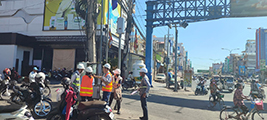
TCC staff and JICA experts working together to install traffic signal equipment (Photo: METS Research & Planning, INC.)
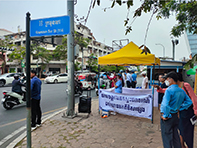
A traffic safety campaign incorporating the “3Es”: Engineering (signal installation), Education (traffic safety awareness), and Enforcement (traffic law enforcement) (Photo: METS Research & Planning, INC. / International Development Center of Japan)
Glossary
- ASEAN Outlook on the Indo-Pacific (AOIP)
- An initiative to create a vision for closer cooperation in the Indo-Pacific and strengthen ASEAN-centered regional architecture. It is not aimed at creating new mechanisms or replacing existing ones; rather, it is intended to enhance ASEAN’s community building process and to better face challenges arising from the current and future regional and global environments. The initiative shares fundamental principles with a “Free and Open Indo-Pacific (FOIP)” promoted by Japan.
- Master Plan on ASEAN Connectivity 2025 (MPAC 2025)
- An action plan for strengthening ASEAN connectivity that was adopted at the ASEAN Summit in 2016 to succeed the “Master Plan on ASEAN Connectivity” (adopted in 2010). It is positioned as a part of “ASEAN 2025: Forging Ahead Together” (adopted in 2015). The document outlines five strategic areas of “sustainable infrastructure,” “digital innovation,” “seamless logistics,” “regulatory excellence,” and “people mobility,” under which key initiatives are identified.
- Note 1: See the glossary.
- Note 2: See Part III, Section 1 (3).
- Note 3: The 10 ASEAN member states are Brunei, Cambodia, Indonesia, Laos, Malaysia, Myanmar, the Philippines, Singapore, Thailand, and Viet Nam.
- Note 4: See Note 2.
- Note 5: A fund established in 2006 to support ASEAN’s endeavors to advance integration by narrowing the development gap within the region, in pursuit of the establishment of an ASEAN Community. Japan announced its contribution of a total of ¥7.5 billion (approximately $70.1 million) at the 2005 ASEAN-Japan Summit, and later contributed a total of $100 million to the “JAIF 2.0” in 2013. Japan provided additional contributions in 2019, 2020, 2021, and 2022.
- Note 6: A regional framework established in 1994 by Brunei, Indonesia, Malaysia, and the Philippines to promote economic growth in the developing regions of these four countries.
- Note 7: A region including the five countries of Cambodia, Laos, Myanmar, Thailand, and Viet Nam.
- Note 8: Adopted at the 10th Mekong-Japan Summit Meeting in Tokyo in 2018. It outlines the direction of Japan’s cooperation with Mekong.
- Note 9: See the glossary.