
(7) Culture and Sports
Cultural heritage that symbolizes a country can help improve the livelihoods of local communities when developed as a tourism resource, for example, by creating employment opportunities. Heritage sites that attract international visitors can also provide an important source of foreign currency for the national economy. At the same time, many cultural assets are in danger of disappearing due to shortages of funding, equipment, and technical expertise, underscoring the need for preservation support. The World Heritage Convention,Note 99 an international framework for safeguarding sites of universal value as the shared heritage of humanity, affirms that protecting such heritage and fostering international cooperation for this purpose are responsibilities of the entire international community. The preservation and promotion of culture, including the invaluable cultural heritage of developing countries, is therefore a challenge to be addressed collectively, not only by the countries where the heritage is located.
Furthermore, sports not only help maintain and improve health, but are also regarded as an important form of education—an “investment in people” that promotes “human security.” Sports foster respect for others, a spirit of mutual understanding, and an awareness of social norms. In addition, the influence and positive power of sports can serve as a “catalyst” for development and progress in developing countries.
●Japan’s Efforts
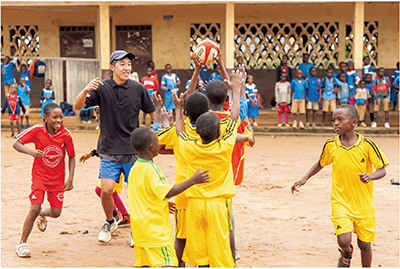
A JOCV teaching rugby to children in Cameroon (Photo: JICA)
Since 1975, Japan has provided support through the Cultural Grant AssistanceGlossary to promote culture, including sports, and higher education, as well as preserve cultural heritage in developing countries. Facilities established under this program also serve as hubs for disseminating information about Japan and facilitating cultural exchanges, thereby deepening understanding of Japan and fostering a sense of affinity toward Japan. In 2024, Japan implemented 17 Cultural Grant Assistance projects, covering education, including Japanese language education, cultural heritage preservation, and sports.
Moreover, Japan provides support for the restoration and preservation of cultural heritage through the Japanese Funds-in-Trust established in the United Nations Educational, Scientific and Cultural Organization (UNESCO). In FY2024, it contributed approximately ¥500 million, enabling multiple projects in cultural heritage preservation. Japan places particular emphasis on human resources development and capacity building in developing countries, transferring preservation and restoration techniques and knowledge through the dispatch of experts, mainly Japanese, and the organization of workshops, so that developing countries can safeguard their cultural heritage independently in the future. In addition, it implements comprehensive support to address contemporary challenges facing cultural heritage, such as disaster prevention and climate change. Japan also supports the safeguarding of intangible cultural heritage, including traditional dance, music, craft techniques, and oral traditions, through successor training, documentation and conservation, and the establishment of protective frameworks under the Japanese Funds-in-Trust.
Japan also conducts training programs to enhance the capacity for cultural heritage protection by inviting young experts from the Asia-Pacific region as part of the “Project for the Promotion of Cooperation for the Protection of World Heritage and Other Cultural Properties in the Asia-Pacific Region.” The biennial training covers both the preservation and restoration of wooden structures and the documentation of archaeological sites. In 2024, an online program was held for Laotian experts engaged in cultural heritage protection, focusing on the recording, preservation, and utilization of archaeological artifacts using digital technology.
In the field of sports, Japan has continued “Sport for Tomorrow,”Note 100 an international cooperation program launched in 2014 to build momentum for the Tokyo 2020 Olympic and Paralympic Games, even after the Games concluded. The program seeks to advance initiatives that highlight Japan’s presence through international exchange and cooperation in sports, while also contributing to the SDGs through international cooperation projects that leverage Japan’s strengths. In 2024, 173 Japan Overseas Cooperation Volunteers (JOCVs) were dispatched to developing countries in the field of sports. Additional initiatives include providing sports facilities and equipment, dispatching and inviting coaches and athletes, and carrying out projects for technical cooperation, promotion of Japanese culture, and human resources development.Note 101
Featured Project 5
Ecuador

Project for the Improvement of Seismic Isolation Equipment for Museums in the Province of Manabi
General Cultural Grant Assistance (April 2022 – March 2024)
Conservation of Cultural Properties through Japan’s Disaster Prevention Technologies
Ecuador possesses a great deal of diverse and invaluable cultural heritage that illustrates the history of the ancient Andes. In recent years, the Government of Ecuador has reaffirmed the importance of preserving these cultural properties, actively reorganizing national museums, and promoting greater public engagement and awareness in the conservation of cultural properties.
On the other hand, Ecuador is an earthquake-prone country, and in 2016, the country was struck by a 7.8-magnitude earthquake. The damage extended to the cultural properties, with those exhibits in the museums near the epicenter falling off from toppled display cases and shelves due to a lack of proper anti-seismic measures.
Immediately after the earthquake, Japan dispatched experts to assess the damage to cultural properties and has continued to provide support towards the prevention of further damage to cultural properties by sharing empirical knowledge from Japan’s disaster risk management efforts for cultural properties with Ecuadorian engineers through invitation programs.
In this project, Japan supported the Manta National Museum and Cultural Center, as well as the Hojas-Jaboncillo Archaeological Museum, both of which were damaged in the 2016 earthquake, by providing seismic-isolation display cases and mobile shelves utilizing Japanese disaster prevention technology. The project is expected to significantly reduce the risks of damage to 1,726 cultural properties that previously lacked sufficient anti-seismic measures.
President Noboa of Ecuador, who was present at the handover ceremony for the equipment, expressed his gratitude to Japan, noting that the installation of the country’s first anti-seismic exhibition equipment is a significant milestone that would contribute not only to the conservation of cultural properties, but also to the promotion of understanding of history by future generations of Ecuador.
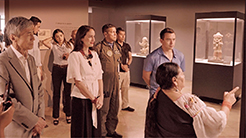
Ecuadorian President Noboa (back right) receiving an explanation on the exhibits at the Manta National Museum and Cultural Center (Photo: JICA)
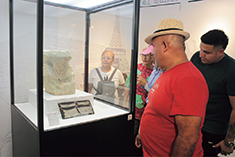
Visitors appreciating cultural heritage items displayed in anti-seismic showcases provided by the Government of Japan at the Manta National Museum and Cultural Center (Photo: Ministry of Culture and Heritage of Ecuador)
Glossary
- Cultural Grant Assistance
- Cultural Grant Assistance is a form of grant that supports the procurement of equipment and supplies as well as the construction and improvement of facilities for the promotion of culture (including sports), higher education, and the preservation of cultural heritage in developing countries. The program seeks to promote cultural and educational development in these countries and to foster friendly relations and mutual understanding through cultural exchanges with Japan. It consists of two schemes: “Cultural Grant Assistance,” which targets governmental organizations in developing countries, and “Grant Assistance for Cultural Grassroots Projects,” which supports small-scale projects implemented by NGOs and local public entities.
- Note 99: The official title of the Convention is the “Convention Concerning the Protection of the World Cultural and Natural Heritage.” Its purpose is to establish a framework of international cooperation and assistance to safeguard cultural and natural heritage, recognized as the heritage of all humankind, from threats such as damage or destruction. The Convention was adopted by the United Nations Educational, Scientific and Cultural Organization (UNESCO) General Conference in 1972 and entered into force in 1975. Japan became a State Party in 1992.
- Note 100: Sport for Tomorrow official website: https://www.sport4tomorrow.jpnsport.go.jp/
- Note 101: MOFA sports diplomacy initiatives: https://www.mofa.go.jp/policy/culture/people/sports/index.html