
(3) Cooperation with Japanese NGOs
Japanese NGOs implement development cooperation activities that directly benefit local communities in various fields in developing countries and regions. In addition, in places affected by natural disasters, such as earthquakes and typhoons, or conflicts, they provide prompt and effective emergency humanitarian assistance. Being close to different local populations in developing countries, NGOs are capable of carefully responding to the needs of local communities. They implement assistance at the grassroots level, which can be hard to reach through the support of governments and international organizations. The Government of Japan positions Japanese NGOs that engage in “visible development cooperation” as strategic partners in development cooperation, and its collaboration with NGOs is centered around three pillars: financial cooperation for NGO development cooperation projects, support to enhance NGO capabilities, and dialogues with NGOs (see the MOFA website on international cooperation and NGOsNote 9).
■Financial Cooperation for NGOs’ Projects
The Government of Japan cooperates with Japanese NGOs in various ways and helps them smoothly and effectively carry out projects in development cooperation and emergency humanitarian assistance in developing countries and regions.
(Grant Assistance for Japanese NGO Projects)
The Government of Japan, through the Grant Assistance for Japanese NGO Projects, provides financial support to socio-economic development projects that Japanese NGOs implement in developing countries. The projects cover a wide range of fields, such as health, medical care and sanitation, rural development, assistance for persons with disabilities, education, disaster risk reduction, and landmine and unexploded ordnance (UXO) disposal. In FY2023, 62 Japanese NGOs received grants under this scheme to implement 109 projects in 39 countries and one region, amounting to approximately ¥7 billion (see “Featured Projects 10” and “Featured Projects 13”).
(Japan Platform (JPF))
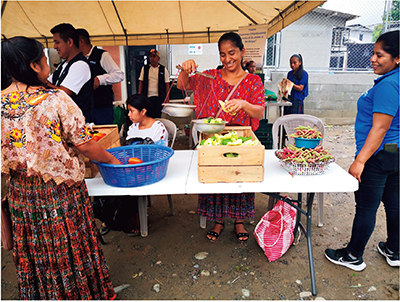
Indigenous women selling chili peppers harvested with support from Japan in Guatemala (Grant Assistance for Japanese NGO Projects) (Photo: Plan International Japan)
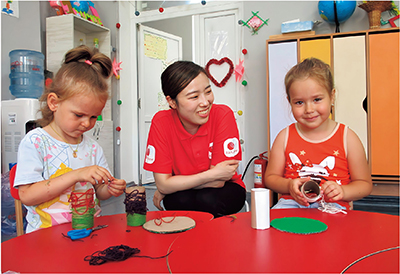
Japanese NGO staff working in Moldova to provide opportunities for children from Ukrainian refugee families and host communities to interact and deepen mutual understanding (Japan’s emergency humanitarian assistance through JPF) (Photo: Association for Aid and Relief, Japan (AAR Japan))
Japan Platform (JPF)Glossary supports and coordinates emergency humanitarian activities of NGOs in cooperation with Japanese NGOs, the business community, and the government. As of December 2024, 47 NGOs are registered with JPF. In FY2023, JPF implemented 145 projects under 20 emergency humanitarian assistance programs in response to disasters and conflicts in Afghanistan, Yemen, Iraq, Syria, Ukraine, Ethiopia, Gaza, Türkiye, Pakistan, South Sudan, Myanmar, Mozambique, and other locations (see “Featured Project”).
(NGO Project Subsidies)
NGO Project Subsidies is another form of financial support from the Government of Japan available to Japanese NGOs. The scheme supports three types of projects: “research projects” that identify and formulate development cooperation projects and conduct post-project evaluations, “international cooperation-related projects in Japan” and “international cooperation-related projects based overseas,” which support the organization of and participation in training sessions and lectures in Japan and abroad with the aim of helping applicant NGOs expand and strengthen their international cooperation operations. In FY2023, the Government of Japan provided NGO Project Subsidies to four Japanese NGOs, supporting project formulation studies, and organization of seminars and workshops, including those held online, in Japan or abroad.
(JICA Partnership Program (JPP))
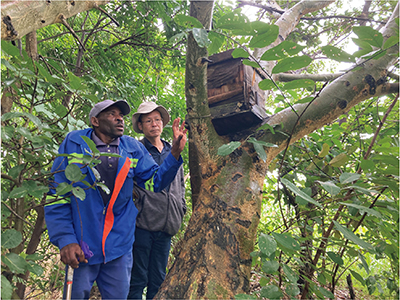
A beekeeper from Marumori Town teaching beekeeping techniques to small-scale farmers in Zambia (JICA Partnership Program) (Photo: Marumori Town and Kouya Development Association)
The JICA Partnership Program (JPP) is an effort in international cooperation where interested entities such as Japanese NGO/Civil Society Organizations (CSOs), other private organizations, local public entities, or universities assist local citizens in developing countries in getting involved in the economic and social development or reconstruction in their own areas. Leveraging their own technologies, knowledge, and experience, applicant organizations propose projects to JICA. Then, upon the approval of JICA, the organizations are contracted to implement the projects (see the JICA websiteNote 10 for information on program details among others). Through JPP, approximately 200 projects are implemented every year. The number of the countries where JPP operates has reached a cumulative total of approximately 80.
■NGOSupport to Improve the Enabling Environment for NGOs
In international cooperation, MOFA carries out the following programs with the objective of further strengthening the organizational structures and project implementation capabilities of Japanese NGOs and developing their human resources.
(NGO Consultant Scheme)
Under this scheme, MOFA commissions highly experienced Japanese NGOs throughout Japan as “NGO Consultants” who are tasked to address inquiries and respond to requests for consultation from citizens and NGOs on such topics as international cooperation activities by NGOs, procedures to establish an NGO, organizational management and operation, and approaches for providing development education. In FY2023, MOFA commissioned 10 organizations that handled more than 5,600 questions and inquiries and provided approximately 70 on-site services.Note 11
Featured Project 13
Madagascar Public nomination


Project for Improvement of Nutrition among Under-5 Children in Atsimondrano District
Grant Assistance for Japanese NGO Projects (March 2023 – March 2024)
Aiming to Improve Nutrition in Newborns, Infants and Young Children
In Madagascar, a significant number of children under the age of five suffer from malnutrition, primarily due to poverty, lack of knowledge among caregivers, and unsanitary living conditions. Chronic malnutrition severely impairs both physical and cognitive development, raising concerns about its long-term effects on health as well as its economic impacts.
AMDA Multisectoral and Integrated Development Services (AMDA-MINDS), a Japanese NGO, has been working since 2022 to improve the nutritional status of children in the Atsimondrano District of the Analamanga Region, where chronic malnutrition has caused serious growth and development disorders among children. In order to improve child nutrition, the organization implemented training for caregivers and developed over 700 trainers. It also conducted more than 10,000 training sessions over the course of one year for local residents on knowledge related to child nutrition improvement, including nutrition, health, water and sanitation, as well as livelihood enhancement. In addition, it provided necessary tools and seeds for home gardens to 1,000 households, installed over 400 sanitary latrines, and broadcasted more than 400 radio programs on the importance of nutrition, implementing a multifaceted approach.
These efforts helped caregivers become more aware of the importance of child nutrition, and many reported improved household finances through home gardening. One trainer commented, “Mothers who used to feed their babies solid food from as early as three months now exclusively breastfeed until six months. By making their own insecticides and compost, and managing household finances, they learned to save money.” AMDA-MINDS will continue to support community-led efforts to ensure the healthy growth of children.
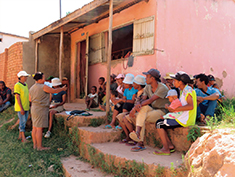
Trainers conducting a session for local residents (Photo: AMDA-MINDS)
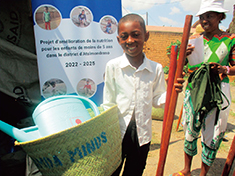
A boy receiving agricultural tools for home gardening (Photo: AMDA-MINDS)
(NGO Internship Program/NGO Study Program)
MOFA implements the NGO Internship Program and NGO Study Program in support of organizational development through human resources development. The NGO Internship Program is designed to train younger generations who can play a leading role in Japanese NGOs in international cooperation in the future. A total of seven interns were accepted by NGOs through this program in FY2023.
Under the NGO Study Program, mid-career staff from Japanese NGOs in international cooperation undergo domestic and overseas training. Upon completion of training, they are expected to share their experience and learning widely within their organization and with other NGOs, and contribute to enhancing the capacity of Japanese NGOs as a whole. In FY2023, nine people received training.
(NGO Study Group)
MOFA supports research activities conducted by NGOs to improve their own project implementation capacity and expertise. The NGO Study Group hosted by MOFA aims to strengthen the organization and capacity of NGOs. Under specific themes facing the NGO community, each study group is organized to undertake a range of activities, including joint studies and research, seminars, workshops, symposiums, etc., and produce reports and make specific recommendations for performance improvement. In FY2023, the NGO Study Group focused on two themes: (i) “Analysis on Development Cooperation issues in the G7 / C7 and Ideal Roles of Japanese NGOs based on the Discussions at the G7 Hiroshima Summit” and (ii) “Past achievements in strengthening the foundation of NGOs (strengthening measures taken by NGOs themselves, governments, companies, etc.) and the methods and measures required in the new era.” The reports and outputs of these activities are available on the MOFA websiteNote 12 (in Japanese only).
■Dialogue with NGOs (NGO-Ministry of Foreign Affairs Regular Consultation Meetings and NGO-JICA Dialogue Meeting)
In FY2023, the Plenary of the NGO-Ministry of Foreign Affairs Regular Consultation MeetingGlossary was held in August. The meeting of a subcommittee, namely the “Partnership Promotion Committee,” took place in July and December 2023 and March 2024, and the “ODA Policy Council” met in July and November 2023 and March 2024, featuring lively exchanges of views (see the MOFA websiteNote 13 for more information on the NGO-Ministry of Foreign Affairs Regular Consultation Meeting, meeting minutes, and other details).
JICA holds the NGO-JICA Dialogue Meeting to engage in dialogue and collaboration with NGOs. Two meetings took place in FY2023, with 93 participants in the first meeting and 73 participants in the second meeting (see the JICA websiteNote 14 for more information on the NGO-JICA Dialogue Meeting, meeting minutes, and other details).
Glossary
- Japan Platform (JPF)
- An emergency humanitarian aid organization established in 2000 in partnership with NGOs, the business community, and the government. JPF aims to support and coordinate with Japanese NGOs to ensure their rapid and effective emergency humanitarian aid activities in the event of a large-scale natural disaster or conflict that causes a vast number of refugees or displaced persons, etc. JPF utilizes ODA funds from the Government of Japan, as well as donations from companies and citizens to provide emergency humanitarian assistance, including the distribution of food/non-food items, and support to rebuild lives, in the situation of a large-scale natural disaster or a vast number of refugees or displaced persons fleeing from conflicts.
- NGO-Ministry of Foreign Affairs Regular Consultation Meeting
- In order to promote a stronger partnership and dialogue between NGOs and MOFA, the NGO-Ministry of Foreign Affairs Regular Consultation Meeting was launched in 1996 for sharing information on ODA and regularly exchanging opinions on measures for improving partnerships with NGOs. It comprises the Plenary and two subcommittees: the “ODA Policy Council” and the “Partnership Promotion Committee.”
- Note 9: Cooperation with NGOs https://www.mofa.go.jp/policy/oda/page_000025.html
- Note 10: JICA Partnership Program https://www.jica.go.jp/english/activities/schemes/partner/partner.html
- Note 11: Consultation and lecture services at events related to international cooperation, provided in cooperation with local governments and partner organizations.
- Note 12: The reports of NGO Study Group https://www.mofa.go.jp/mofaj/gaiko/oda/shimin/oda_ngo/houkokusho/kenkyukai.html (in Japanese only)
- Note 13: NGO-Ministry of Foreign Affairs Regular Consultation Meetings https://www.mofa.go.jp/mofaj/gaiko/oda/shimin/oda_ngo/taiwa/kyougikai.html (in Japanese only)
- Note 14: Regular meetings with NGOs https://www.jica.go.jp/partner/ngo_meeting/index.html (in Japanese only)