
6 Central Asia and Caucasus
The Central Asian and Caucasus region, located in a geopolitically important place linking East Asia, South Asia, the Middle East, Europe, and Russia, is also an important region from the strategic perspective of energy security, being positioned on an important route for energy transportation which produces abundant natural resources, such as oil, natural gas, uranium, and rare earths. In particular, since Russia’s aggression against Ukraine in February 2022, it has been attracting attention as a point of connectivity between Europe and East Asia without passing through Russia.
Central Asian and Caucasus countries have been working toward transitioning to a market economy and economic development since their independence in 1991. However, they still face challenges such as the aging economic infrastructure dating back to the former Soviet Union era, the expansion of business human resources for further market economy development, and the establishment of social service delivery systems including health and medical care. Additionally, this landlocked region, which is vulnerable to the geopolitical influence of major countries in its vicinity and the security situations in neighboring countries, faces concerns about social unrest associated with the reintegration of returnees from conflict areas such as Afghanistan. Furthermore, there is a need to strengthen border control and customs procedures against cross-border trafficking of illegal drugs and other items.
Cooperation with the Central Asian and Caucasus region, which continues to experience high economic growth and population increase, is becoming increasingly important in terms of maintaining and strengthening a free and open international order based on the rule of law amid rapidly changing global circumstances.
●Japan’s Efforts
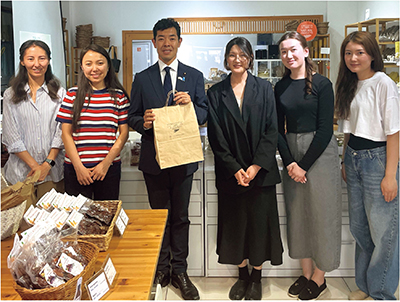
Then State Minister for Foreign Affairs Tsuji (third from left) visiting a store supported by the technical cooperation project “One Village One Product Movement” during his visit to the Kyrgyz Republic in June 2024
Japan launched the “Central Asia plus Japan” dialogue in 2004, recognizing that regional cooperation is essential for the development of Central Asia, and celebrated its 20th anniversary in 2024. With the aim of contributing to peace and stability in Central Asia, which is a partner in maintaining and strengthening the free and open international order, Japan acts as a catalyst to promote regional cooperation led by the Central Asian countries. Within the framework of the “Central Asia plus Japan” dialogue, nine Foreign Ministers’ Meetings have been held to date, fostering partnership based on friendship and mutual trust and mutually beneficial cooperation. Furthermore, Japan promotes cooperation in various fields including politics, economy, and people-to-people exchanges by organizing Senior Officials Meetings (SOM) and business dialogues, expert meetings on themes such as anti-drug measures, border management, and tourism, as well as Tokyo Dialogues (open symposiums by experts) on themes such as Connectivity with Central Asia and the Caucasus.
Along with these initiatives, Japan provides cooperation toward the free, open, and sustainable development of the Central Asian and Caucasus region, including supporting democracy and market economy development, developing economic and social infrastructure, strengthening connectivity, managing borders, and implementing anti-drug measures.
Regarding strengthening connectivity, Japan is working on the development of the Trans-Caspian International Transport Route. For example, in the Central Asian and Caucasus region, customs systems differ from country to country, and crossing borders requires considerable time for complicated procedures and inspections. To reduce such costs, in 2024, Japan began cooperation with the World Customs Organization (WCO), which is involved in international cooperation in the customs sector, to improve customs clearance efficiency for customs officials in the region. In addition, under the framework of the Partnership for Global Infrastructure and Investment (PGII),Note 27 the G7, including Japan, is cooperating on the development of the Trans-Caspian International Transport Route.
With regard to human resources development, since 1993, Japan has accepted approximately 13,220 trainees from Central Asian and Caucasus countries in fields such as health, agriculture, and education, while dispatching approximately 3,380 experts to those countries. Moreover, since the transition to market economies, Japan has been providing cooperation to develop the human resources necessary for nation-building by supporting young government officials from these countries to study in Japan through the Project for Human Resource Development Scholarship (JDS), by launching the JICA Development Studies Program, and providing business human resource training through the Japan Center for Human Resources Development.
Regarding the provision of social services, Japan has implemented projects to strengthen health and medical care systems and to improve sanitary conditions in these countries. For example, in Uzbekistan, Japan decided to provide medical containers equipped with medical devices for performing CT scans and X-ray examinations to enable the provision of mobile medical services in rural areas. In the Kyrgyz Republic, where the proportion of deaths caused by non-communicable diseases is higher than the world average, Japan decided to provide medical equipment for the diagnosis and treatment of cardiovascular diseases and breast cancer, with the aim of providing timely and appropriate medical services. In Tajikistan, Japan decided to construct wells, elevated water tanks, and water supply and drainage networks to establish safe and reliable water supply services.
In recent years, a flashpoint for ethnic tensions has become apparent in the Caucasus region. In September 2023, in response to Azerbaijan’s military activities in Nagorno-Karabakh, more than 100,000 persons were displaced to Armenia. The following month, the Government of Japan decided to extend an Emergency Grant of a total of $2 million to support displaced persons in Armenia and Azerbaijan through international organizations. Subsequently, Japan has been supporting recovery and reconstruction in Armenia through the United Nations Development Programme (UNDP), by developing infrastructure such as electricity and water in temporary shelters and local medical services.
Additionally, Japan assists in strengthening the system of public order in the areas near the Tajik border with Afghanistan through establishing border security offices, delivering equipment for the digitalization of border control, and organizing personnel training. Furthermore, in the five countries of Central Asia, which neighbor Afghanistan, Japan provides support to promote social stability by providing skills training and employment support for youths returning from conflict areas or migrant work, as well as by encouraging social participation through community activities so that they can reintegrate into society.
Featured Project 10
Tajikistan

Developing Curricula of Teacher Training Course at Higher Education for Promotion of Inclusive Education
Grant Assistance for Japanese NGO Projects (February 2024 – February 2025)
Creating a Safe and Supportive Learning Environment for People with Disabilities
In Tajikistan, although access to education in public schools for children with disabilities is legally guaranteed, actual attendance remains limited. This is due to factors such as a lack of awareness and prejudice regarding disabilities, insufficient barrier-free facilities in school buildings, and inadequate progress in creating an appropriate educational environment, including teacher training and teaching materials tailored to individual needs.
The Association for Aid and Relief, Japan (AAR Japan), has been promoting inclusive educationNote 1 since 2014 in collaboration with public schools and higher education institutions. Under this project, teacher training on inclusive education and the development of a collection of practical teaching examples were carried out at a teacher training college in Tursunzoda City in western Tajikistan. Eight teachers who underwent the training delivered lectures to 202 students aspiring to become teachers. In turn, these trainee teachers conducted lessons on disability inclusive-related topics during their practicum at public schools. Including the students who participated in these lessons, a total of approximately 800 individuals have so far deepened their understanding of inclusive education through this project.
A public school teacher who attended a trainee teacher’s lecture commented, “I was not sure how to interact with students with Down syndrome, but I was able to learn practical examples of how to give lessons and speak to children with disabilities, so I want to apply these in my own classes.” Changes are beginning to take place on the ground.
In addition, the project supported improvements to barrier-free facilities at the teacher training college and carried out awareness-raising activities for local residents to deepen their understanding on disabilities.
Japan will continue to promote inclusive education through partnerships with NGOs, with the aim of creating an environment where everyone, regardless of having disability or not, can receive quality education, and hence support nation-building in Tajikistan.
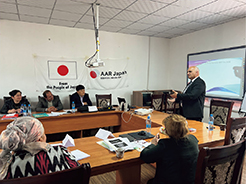
Teachers at Pedagogical College in Tursunzoda City learning about teaching methods and sign language for people with hearing impairments from a local expert on hearing impairments (Photo: Association for Aid and Relief, Japan)
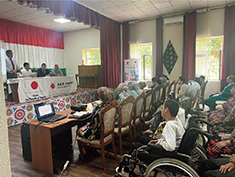
Information session on admission to Pedagogical College in Tursunzoda City, held for persons with disabilities and their families (Photo: Association for Aid and Relief, Japan)
Note 1 Education where people with and without disabilities learn together, with the aim of enhancing respect for human diversity, and enabling people with disabilities to develop their mental and physical abilities to the maximum extent possible and to participate effectively in a free society.
- Note 27: See Note 31.