
5 Europe
Russia’s aggression against Ukraine, which began in February 2022, continues to this day, worsening the humanitarian situation in Ukraine and its neighboring countries and destabilizing Ukraine’s economy and society. It has also disrupted global supply chains, highlighting challenges for the entire international community such as food and energy security—which are fundamental for people to live with dignity—as well as the maintenance and strengthening of a free and fair trading system. These compound crises are by no means “someone else’s problem” for Japan; they have had serious impacts on the daily lives of Japanese citizens and on the business activities of Japanese companies.
Taking the consistent position that Russia’s outrageous aggression must not be tolerated and that support for Ukraine and its neighboring countries is essential, Japan has collaborated with the international community, including the G7, from the outset of Russia’s aggression against Ukraine. Japan also continues to advance public- and private-sector support for Ukraine’s recovery and reconstruction, including through the Japan-Ukraine Conference for Promotion of Economic Growth and Reconstruction held in February 2024.
Many countries in Central and Eastern Europe, as well as those that were formerly part of the Soviet Union, that were once under communist regimes are now pursuing market-based economic development. Japan regards European countries as important partners that share fundamental values such as human rights, democracy, a market economy, and the rule of law, and supports their efforts in areas such as reconstructing economic infrastructure and addressing environmental challenges. Japan also works to strengthen comprehensive relations with the European Union (EU) and other Europe-based international organizations through continued dialogue and cooperation, as well as the development of human networks.
●Japan’s Efforts
■Support for Ukraine and Neighboring Countries
(Overview)
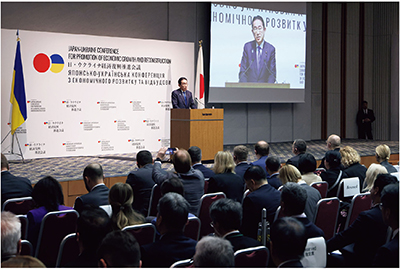
Then Prime Minister Kishida delivering the keynote address at the Leaders’ Session of the Japan-Ukraine Conference for Promotion of Economic Growth and Reconstruction (Photo: Cabinet Public Relations Office)
In February 2024, the Japan-Ukraine Conference for Promotion of Economic Growth and Reconstruction was held in Tokyo, with participation from government officials and business representatives from both countries.
At the conference, then Prime Minister Kishida emphasized that support for Ukraine is “investing in the future” for Ukraine, Japan, and the world. He announced that, based on three principles—“inclusiveness,” “partnership,” and “knowledge and technology”—Japan would make what he called “Japan’s unique contribution” through public-private collaboration and through five actions (including support through international financial institutions, public-private partnership projects through ODA, and JICA’s Private Sector Investment Finance for Ukrainian venture capitalists, etc.). He also stated that Japan would closely follow up on the joint communiqué and 56 cooperation documents signed by both public and private sectors, which were presented as concrete outcomes, and continue collaborating with G7 countries, other partners, and international organizations.
On the occasion of the Japan-Ukraine Conference for Promotion of Economic Growth and Reconstruction, a WPS session was held to explore concrete ways to integrate a Women, Peace, and Security (WPS)Note 21 perspective into Ukraine’s recovery and reconstruction efforts. Then Foreign Minister Kamikawa presented Japan’s approach to supporting Ukraine’s self-sustaining development in a manner that is responsive to the needs of the Ukrainian people, aiming at the “reintegration” of families, communities, and the nation as a whole. She emphasized that this support is carried out through an all-Japan effort in coordination with the international community, including the G7, and introduced Japan’s WPS-related initiatives in its assistance for Ukraine (see “Japan’s Development Cooperation Initiatives to Promote WPS” for details).
In April, then Foreign Minister Kamikawa visited Italy to attend the G7 Foreign Ministers’ Meeting and met with then Ukrainian Foreign Minister Kuleba. She expressed Japan’s intention to steadily follow through on the outcomes of the Japan-Ukraine Conference for the Promotion of Economic Growth and Reconstruction held in February, and the two ministers concurred to continue close coordination.
From June 11 to 12, then Parliamentary Vice-Minister for Foreign Affairs Fukazawa attended the Ukraine Recovery Conference co-hosted by the governments of Germany and Ukraine in Germany, where he presented Japan’s initiatives in support of Ukraine’s reconstruction. He stressed the importance of the international community working together to support Ukraine, particularly in light of the severe situation with ongoing attacks across the country. At the women’s leadership session, he underscored the need to integrate a WPS perspective into every phase of Ukraine’s recovery and reconstruction, and announced Japan’s participation in an alliance, initiated by the host country Germany, that emphasizes gender equality and women’s rights.
On June 13, then Prime Minister Kishida attended the G7 Apulia Summit, where he stated that Japan would continue to strongly promote support for Ukraine. He highlighted that Japan had been providing financial assistance since the beginning of the year to meet Ukraine’s urgent funding needs, and emphasized Japan’s focus on mine action, including the provision of large Japanese-made mine-clearing machines, and plans to host an international conference on mine action for Ukraine in 2025 (see “From the Field of International Cooperation” for details on mine action support). He furthermore underscored Japan’s commitment to supporting Ukraine’s reconstruction over the medium to long term, noting that in addition to the 56 cooperation documents signed with Ukraine in February, another 23 were signed during the reconstruction conference in Berlin. The G7 leaders reaffirmed their commitment to jointly addressing the situation in Ukraine and concurred to launch the “Extraordinary Revenue Acceleration Loan for Ukraine,”Note 22 utilizing Russia’s frozen assets. On the margins of the summit, then Prime Minister Kishida also held talks with President Zelenskyy of Ukraine, during which they signed the “Accord on Support for Ukraine and Cooperation between the Government of Japan and Ukraine,” outlining cooperation including humanitarian assistance and recovery and reconstruction support.
Subsequently, then Prime Minister Kishida attended the Summit on Peace in Ukraine, held in Switzerland from June 15 to 16. He welcomed the fact that representatives from about 100 countries and international organizations had gathered, building on the discussions at the 2023 G7 Hiroshima Summit, with the aim of bringing peace to Ukraine. He stated that Japan, as a co-chair, would actively contribute to the discussions on nuclear safety, one of the main themes of the Summit, and stressed the importance of humanitarian issues, noting Japan’s intention to strengthen its efforts in fields such as mine clearance. Furthermore, at the Japan-Ukraine Summit Meeting in September, then Prime Minister Kishida explained that steady follow-up was being undertaken on the Japan-Ukraine Conference for Promotion of Economic Growth and Reconstruction, and announced that the Japan External Trade Organization (JETRO) Kyiv office was scheduled to open in October.
On October 17, then State Minister for Foreign Affairs Tsuge took part in the Ukraine Mine Action Conference held in Switzerland. He outlined Japan’s role as the host of the 2025 conference and reaffirmed Japan’s commitment to mine action support for Ukraine, while engaging with partner countries and international organizations to enhance coordination.
Furthermore, on October 25, the G7 Finance Ministers reached agreement on the details of the “Extraordinary Revenue Acceleration Loan for Ukraine.” On the same day, a G7 Leaders’ Statement was issued confirming agreement on how approximately $50 billion would be provided under this facility. Japan announced that, within this framework, it would extend a yen loan of ¥471.9 billion (approximately $3.3 billion),Note 23 as part of the $50 billion commitment by the G7.
Japan will continue to provide support that is closely attuned to the needs of the Ukrainian people facing difficulties, while working in coordination with the international community, including the G7.
(Humanitarian Assistance and Support for Recovery and Reconstruction)
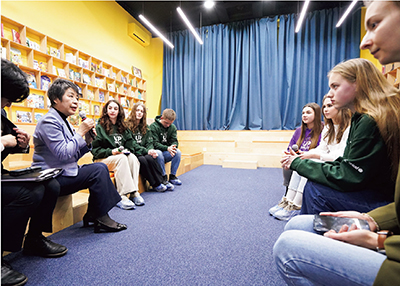
Then Foreign Minister Kamikawa exchanging views at the Spilno Spot, a facility established by UNICEF at Kyiv Central Railway Station, Ukraine, to provide support for women and children
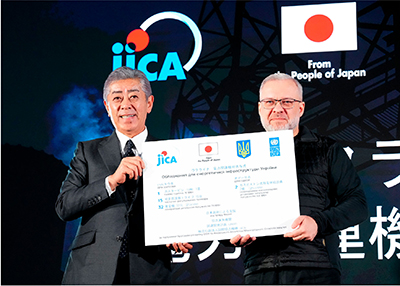
Then Foreign Minister Iwaya and Ukrainian Minister of Energy Galushchenko attending the handover ceremony for power-related equipment in Ukraine
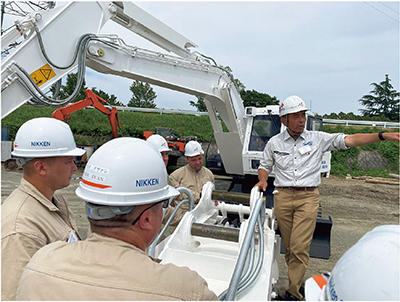
Training on the operation and maintenance of demining machines for the State Emergency Service of Ukraine (SESU). Participants are gaining practical experience using actual demining equipment (Photo: JICA)
As Russia’s aggression against Ukraine continues, the war has damaged infrastructure and facilities that support daily life—including energy, transportation, housing, and schools—placing the Ukrainian people in a dire situation. Even as the aggression continues, Japan is providing support that is responsive to the needs of the Ukrainian people, including women and children, integrating perspectives such as WPS across all phases, from humanitarian assistance to livelihood reconstruction to recovery support, economic revitalization, and industrial advancement, so that Ukrainians can envision a better future.
As part of emergency recovery efforts aimed at restoring daily life to near-peacetime conditions, Japan provides assistance that improves humanitarian conditions and livelihoods—including in electricity, healthcare, education, and temporary infrastructure—in cooperation with international organizations, Japanese NGOs, and NGOs in Ukraine and neighboring countries (see “Featured Projects”). For instance, in response to the widespread destruction of energy infrastructure and large-scale power outages across Ukraine, Japan has supplied generators and solar lanterns. In January 2024, when then Foreign Minister Kamikawa visited Ukraine, Japan provided support for the transportation of autotransformers and the provision of gas turbine generators through the United Nations Development Programme (UNDP). In November, then Foreign Minister Iwaya visited Ukraine to provide additional gas turbines and power-related equipment for water pumping facilities through UNDP, as well as small generators through JICA. By supporting damaged energy infrastructure facilities, these efforts contribute to restoring and strengthening electricity and heating supplies, helping the people of Ukraine endure the winter.
In addition, Japan has supported the country’s recovery and reconstruction from an early stage in areas such as mine action and debris clearance, restoration of basic services, including infrastructure, the revival of agricultural production and industrial development, and the strengthening of democracy and governance. Building on ¥75.51 billion in grant aid approved in March 2023 to support the emergency recovery plan, in February 2024 Japan decided to provide an additional ¥15.8 billion in grant aid under “the Programme for Emergency Recovery Phase 3.” This assistance covers mine and unexploded ordnance clearance, the power and energy sectors, the transport sector, and other priority areas, thereby contributing to the country’s rapid recovery and reconstruction.
The removal of mines and unexploded ordnance is not only essential for ensuring the safety and security of residents, but also a prerequisite for recovery and reconstruction, underpinning the rebuilding of livelihoods, agriculture, and industry. In July 2024, as part of its mine and unexploded ordnance clearance efforts in Ukraine, Japan provided four large demining machines to the State Emergency Service of Ukraine (SESU). From July to August, it also conducted training for SESU personnel on the operation and maintenance of these demining machines. This training was carried out with the cooperation of the Cambodian Mine Action Centre (CMAC), which Japan has been supporting since the 1990s (see “Stories from the Field”). In this way, Japan is providing comprehensive support for mine and unexploded ordnance clearance in Ukraine, drawing on the expertise it has developed through its long-standing demining assistance in Cambodia.
Regarding support for economic recovery and industrial advancement, despite the impact of Russia’s aggression, the ICT sector, an export-oriented industry, has remained strong in both Ukraine and Moldova. In February 2024, Japan decided to invest up to $200 million in Horizon Capital Growth Fund IV, L.P., an investment fund targeting the two countries, through JICA’s overseas investment and loan project. This investment is intended to further promote the growth of the ICT sector, a key contributor to the economies of both countries.
In addition, Japan launched the Ukraine Business Support Project in April 2024 to accelerate the country’s recovery and reconstruction by mobilizing private sector funding and technology and revitalizing the economy through private sector participation. Building on the framework of the existing SDGs Business Supporting Survey,Note 24 the project is designed to reduce risks in the initial stages of market entry by supporting activities such as information gathering and market research, which are particularly difficult in wartime Ukraine. In July, fourteen projects were selected. With a view to promoting future investment in Ukraine, Japan will continue to actively support the country’s economic development by assisting Japanese companies in formulating business expansion plans.
(Support for Poland and Moldova)
Russia’s prolonged aggression against Ukraine has placed a sustained burden on neighboring countries. In this context, Japan provides support to these countries to help alleviate their burdens while delivering effective humanitarian, recovery, and reconstruction assistance to Ukraine.
For Poland, which has been at the forefront of support for Ukraine, serving as a hub for both military and humanitarian assistance, Japan has provided humanitarian assistance through international organizations and NGOs. This includes support for temporary housing and social integration projects for displaced Ukrainians, as well as the provision of school buses for displaced children and educational equipment for displaced children with disabilities, helping support the daily lives of Ukrainian evacuees over the long term. In January 2024, then Foreign Minister Kamikawa visited Poland and concurred with Polish Foreign Minister Sikorski to continue working closely on future support for Ukraine, including the involvement of the private sector in reconstruction efforts. The two Foreign Ministers also held a telephone conversation in July, during which then Foreign Minister Kamikawa reaffirmed Japan’s commitment to cooperating with Poland, which has accepted a large number of evacuees from Ukraine, and expressed her intention to promote collaboration between Polish and Japanese companies in the field of reconstruction. Both sides confirmed their continued partnership.
Moldova provides shelters, food, medical services, and other assistance to evacuees who have fled from Ukraine, and many of them continue to live as displaced persons with support from Moldova. As these efforts place a significant economic burden on the country, Japan has been extending assistance to help mitigate the impact of Russia’s aggression against Ukraine and reduce Moldova’s vulnerability to economic crises. In December 2023, Japan decided to provide grant aid of ¥300 million to support improvements in agricultural management, as the country has faced difficulties in purchasing fertilizers and other agricultural inputs. In November 2024, Moldovan Deputy Prime Minister and Foreign Minister Popsoi visited Japan and held a Japan-Moldova Foreign Ministers’ Meeting with then Forign Minister Iwaya, during which he expressed appreciation for Japan’s support. The two Foreign Ministers concurred to continue working closely together in light of the tense international situation, including the war in Ukraine.
■Support for the Western Balkans
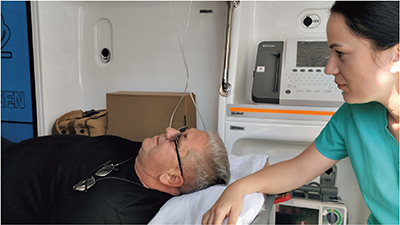
An ambulance provided by Japan to the Pelagic´evo Clinic in Bosnia and Herzegovina being used for emergency transportation of patients (Photo: Pelagic´evo Clinic)
Reforms in the Western Balkan countriesNote 25 were once stalled due to the conflicts of the 1990s. As a result of reconstruction assistance from donor countries and international organizations, as well as the countries’ own reform efforts, they have now moved beyond the reconstruction phase and require support to achieve sustainable economic development. In support of a united Europe, Japan provides development cooperation to these countries in collaboration with the EU and other partners. Under the 2018 “Western Balkans Cooperation Initiative,”Note 26 Japan assists the Western Balkan countries in implementing the socio-economic reforms necessary for EU accession.
Regarding Serbia, in April 2024, then Parliamentary Vice-Minister for Foreign Affairs Hosaka attended the completion ceremony of the flue gas desulfurization facility at the Nikola Tesla Thermal Power Plant, which was constructed with support from Japan’s yen loans. The facility is also significant in promoting Serbia’s green transition as the country moves from coal toward renewable energy. Japan will continue to support Serbia’s efforts toward decarbonization.
Japan also supports the development of human resources who will play a key role in the future of Bosnia and Herzegovina. In recent years, this has included assistance to strengthen medical and health systems aimed at improving the quality of life of the people, support for enhancing border management capabilities essential for progress in the EU accession process, and the sharing of knowledge on disaster prevention and mitigation.
In July of the same year, then Foreign Minister Kamikawa visited Serbia, Bosnia and Herzegovina, and Kosovo, and presented Japan’s efforts under the “Western Balkans Cooperation Initiative” in these countries. She highlighted the importance of gender equality and the Women, Peace, and Security (WPS) perspective for promoting peace and stability in the Western Balkans, a region that has been working toward reconciliation and development after the conflicts, and expressed Japan’s commitment to continue cooperating with countries in the region. (See “Japan’s Development Cooperation Initiatives to Promote WPS” for details on Japan’s WPS initiatives.)
Featured Project 9
Ukraine


Project for the Distribution of Cash, Food, and Daily Necessities to Internally Displaced Persons and Vulnerable Non-Displaced Residents in the Izmail City Area of Odesa Oblast
Japan Platform (JPF) (March – July 2024)
Support for the People of Ukraine Facing Humanitarian Crisis
Russia’s aggression against Ukraine that began in February 2022 continues even now, after more than two and a half years. Izmail City and its surrounding areas in Odesa Oblast in southern Ukraine have become a haven for many displaced persons. Both displaced persons and local residents who host them face dire living conditions, resulting from shortages of daily necessities due to soaring prices and disrupted supply chains, as well as disruptions to financial services such as banks and ATMs.
In response to this situation, Nippon International Cooperation for Community Development (NICCO), one of the member organizations of Japan Platform (JPF),Note 1 a platform for emergency humanitarian assistance, established a base in neighboring Romania. To alleviate the plight of displaced persons and local residents in Izmail City and its surrounding areas, NICCO, in cooperation with CHIC, a Ukrainian civil society organization, distributed food, daily necessities, and cash.
Specifically, NICCO, despite limited available resources, provided relief supplies tailored to the specific needs of approximately 1,000 people who particularly required support. The beneficiaries included single-parent and elderly households in urban areas, economically disadvantaged people living in remote areas with limited logistical access, and elderly and disabled persons. The support enabled their access to food, daily necessities, hygiene products, and medicines.
The beneficiaries shared their feedback as follows: “Previously, I had to reduce the number of meals or rely on support from relatives and friends, but thanks to this assistance, my food situation improved,” and “Amid the disruption of food and supply distribution due to the turmoil of the conflict, it was extremely helpful to have daily necessities delivered to numerous households, including those that have difficulty going out shopping.” NICCO will continue to provide support that contributes to improvements in humanitarian situations and living conditions, standing in solidarity with people facing difficulties.
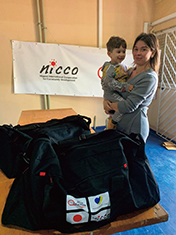
Displaced persons receiving food and daily necessities (Photo: NICCO)
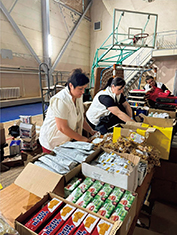
Staff of the partner organization CHIC packaging food and daily necessities for distribution at the civic hall in Izmail City (Photo: NICCO)
Note 1 See the glossary.
- Note 21: See Note 93.
- Note 22: A G7 framework under which loans are provided to Ukraine, with repayment sourced from future “special revenues” generated by the immobilization of assets owned by the Russian state, in order to address Ukraine’s financing needs.
- Note 23: Based on the exchange rate published by the EU on September 19, 2024.
- Note 24: See the glossary.
- Note 25: The six countries: Albania, Bosnia and Herzegovina, Kosovo, Montenegro, North Macedonia, and Serbia.
- Note 26: An initiative aimed at supporting the socio-economic reforms of the Western Balkan countries toward EU accession and promoting reconciliation and cooperation among different ethnic groups.