
(6) Gender Equality and an Inclusive Society
It is often the case that the social norms and systems in developing countries are generally shaped by men’s perspectives, leaving women in vulnerable positions in many areas. At the same time, women are key actors in development, and their participation benefits not only themselves but also enhances the overall effectiveness of development efforts. For example, when women who have previously had little or no access to education acquire literacy skills, they are better able to obtain accurate information on public health and the prevention of infectious diseases such as HIV/AIDS. This, in turn, supports appropriate family planning, promotes women’s social participation and economic empowerment, and ultimately contributes to sustainable and inclusive economic growth in developing countries.
The SDGs emphasize that “realizing gender equality and the empowerment of women and girls will make a crucial contribution to progress across all the Goals and targets.” Specifically, Goal 5 sets out to “achieve gender equality and empower all women and girls.” Promoting gender equality and women’s empowerment is indispensable for realizing “quality growth.” Through gender mainstreaming,Note 89 it is essential to ensure that women and men participate equally in all stages of development cooperation and share its benefits equitably.
Challenges such as poverty, conflicts, infectious diseases, terrorism, and disasters affect people differently depending on their circumstances, including their country and region, and whether they are women or children. Due to infectious diseases, armed conflicts, large-scale disasters, and other factors, the number of people living in poverty worldwide has begun to rise. In some countries, widening disparities and deteriorating humanitarian conditions have also been observed, creating an even further need for support for those in vulnerable situations. The concept of human security, which emphasizes the protection and empowerment of each individual, is therefore indispensable for realizing the SDGs’ guiding principle of “leaving no one behind.”
●Japan’s Efforts
■Promoting Women’s Capacity Enhancement and Participation
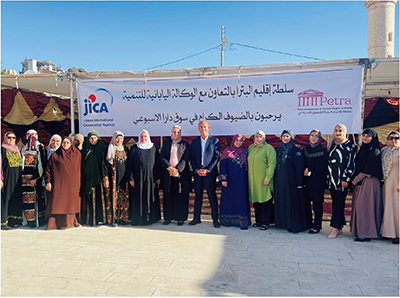
Women selling handicrafts and processed food products from the Petra region through the “The Project for Formulating Tourism Development Master Plan in Petra Region” currently being implemented in Jordan (Photo: Petra Development and Tourism Region Authority)
In the “Development Strategy for Gender Equality and Women’s Empowerment,”Note 90 Japan established three basic principles: (i) respecting women’s rights, (ii) building the capacity of women to reach their full potential, and (iii) advancing women’s participation and leadership in political, economic, and other public spheres. Based on this strategy, Japan advances its efforts within the international community to promote gender mainstreaming, gender equality, and the empowerment of women and girls.
Japan contributed $50 million to the Women Entrepreneurs Finance Initiative (We-Fi)Note 91 in 2018, followed by an additional $5 million in June 2023. As of June 2023, We-Fi has supported 149,256 women-owned/led small and medium enterprises (WSMEs) in 67 countries. Of these, in concrete figures, 127,428 WSMEs have received financial assistance, while 28,404 participated in training programs to acquire the skills and knowledge necessary for business management. According to the World Bank, 70% of WSMEs in developing countries are either unable to secure financing from financial institutions or are subject to unfavorable borrowing terms. To address this challenge, Japan, through We-Fi, promotes the development of gender-equal legal frameworks and supports female entrepreneurs in gaining equal access to financing and markets.
The Leaders’ Communiqué of the G7 Apulia Summit, held in June 2024, reiterated the commitment to collectively increase ODA for gender equality. It also emphasized that the G7 leaders will explore ways to increase ODA for climate change measures, particularly in Africa, in a gender-responsive manner, thus contributing to the further advancement of gender equality and women’s empowerment.
Japan also provides support through UN Women, contributing approximately $21 million in 2023 and $22 million in 2024. These contributions have supported initiatives such as promoting women’s political participation and economic empowerment, eliminating sexual and gender-based violence against women and girls, strengthening women’s role in peace and security, and advancing gender-responsive policies and budgets. In 2024, Japan provided emergency assistance and livelihood support to women who have been economically and socially affected by conflicts and disasters in Africa, the Middle East, Asia, and Eastern Europe, including Afghanistan and Ukraine. For example, in Pakistan, 60 women’s community centers were established during the six-month period from February to August to promote women’s independence. A total of 6,609 women and 1,131 girls used these centers, while 7,000 women were assisted in obtaining identity documents. In addition, 280 men and community leaders received support to improve their knowledge of gender-based violence prevention and gender equality.
Japan regards sexual violence in conflict as an issue that cannot be overlooked. From this standpoint, Japan prioritizes cooperation with the UN Office of the Special Representative of the Secretary-General on Sexual Violence in Conflict (OSRSG-SVC).Note 92 In 2024, it contributed approximately $660,000 to the OSRSG-SVC to support activities in Sudan, including protection and prevention measures against sexual and gender-based violence, as well as health, psychological, and legal support for refugees and internally displaced women.
In 2024, Japan contributed an additional €2 million to the Global Survivors Fund (GSF),Glossary bringing its total contributions to €10 million so far. Japan, as its board member, actively contributes to supporting survivors of conflict-related sexual violence in conflict-affected areas, including Afghanistan, Ukraine, and the Democratic Republic of Congo.
■Women, Peace and Security (WPS)
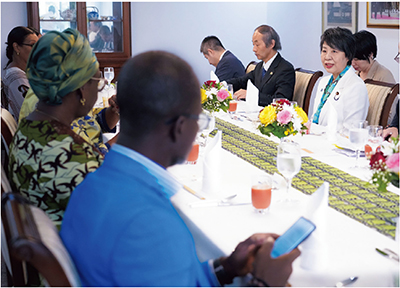
Then Foreign Minister Kamikawa meeting with women leaders in Côte d’Ivoire, April 2024
Japan has formulated its National Action Plans since 2015 to implement UN Security Council (UNSC) resolution 1325 on Women, Peace and Security (WPS),Note 93 adopted in 2000 as the first Security Council resolution to explicitly link women to the peace and security agenda, and the related resolutions. In April 2023, the Government of Japan formulated the Third National Action Plan (2023-2028)Note 94 based on exchanges of opinions with relevant ministries and agencies, experts, NGOs, civil society, and public comments. Specifically, Japan, with the cooperation of relevant ministries and agencies, supports women in conflict-affected and fragile countries, mainly through international organizations and bilateral assistance (see “Japan’s Development Cooperation Efforts for the Promotion of WPS”).
In September 2024, then Foreign Minister Kamikawa announced at the “WPS Focal Points NetworkNote 95 High-Level Side Event” that Japan would co-chair the Network in 2025 together with Norway and host the Network’s capital-level meeting in Tokyo in February 2025, with a view to further advancing the WPS agenda in cooperation with other countries.
In January 2024, the Taskforce on WPS was established to provide coordination across the Ministry of Foreign Affairs (MOFA) In June, the second WPS Taskforce meeting was held to share policies incorporating a WPS perspective in disaster risk reduction, disaster response, and reconstruction across relevant ministries and agencies, and to discuss how these policies can be leveraged in diplomatic efforts.
At the TICAD Ministerial Meeting held in August, Japan and many African countries reaffirmed the role of WPS and the importance of incorporating women’s and youth perspectives.
■Assistance for People at Risk of Vulnerability
(Disability and Development)
Persons with disabilities are often placed in disadvantaged positions in society. Japan’s ODA gives due consideration to the circumstances of people whose equal participation in society is hindered, including persons with disabilities. Article 32 of the Convention on the Rights of Persons with DisabilitiesNote 96 also requires States Parties to take measures for international cooperation and its promotion.
Policies for persons with disabilities span a wide range of fields, including welfare, health and medical care, education, and employment. Drawing on its accumulated expertise and experiences in these areas, Japan supports developing countries’ disability-related measures and policies through ODA.
For example, Japan carefully responds to diverse local needs by incorporating barrier-free design in railway and airport construction, developing rehabilitation and vocational training facilities, and providing minibuses to improve mobility for persons with disabilities. In addition, it extends broad technical cooperation to strengthen the capacity of organizations and personnel involved in disability and development. Such efforts include accepting trainees from developing countries, as well as dispatching experts and JOCVs to promote social participation and employment opportunities.
(Assistance for Children)
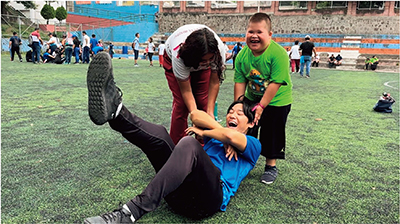
A JOCV teaching sports to children with disabilities in El Salvador (Photo: JICA)
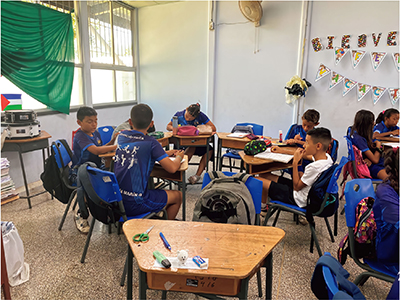
Children in Costa Rica studying in a school building reconstructed with Japan’s assistance after it was damaged by a major earthquake
Children are generally highly vulnerable, and today many around the world face harsh conditions due to conflicts, natural disasters, and other challenges. In response, Japan provides humanitarian and development assistance for children through various channels, including bilateral cooperation and international organizations. In 2024, through the United Nations Children’s Fund (UNICEF), Japan assisted children being affected by poverty, conflict, and climate change-related natural disasters in 40 countries across Asia, Eastern Europe, the Middle East, and Africa.
Under the Grant Assistance for Grass-Roots Human Security Projects,Note 97 which supports initiatives for economic and social development at the community level, Japan carried out projects that help improve children’s living environments. These include the construction and renovation of schools, the provision of medical equipment to hospitals, and the development of water supply facilities.
For example, in Samoa, Japan supported the reconstruction of an elementary school that had been demolished due to aging facilities, and handed over a new single-story concrete building in November 2024. Through this cooperation, children attending the school are now provided with a safe and suitable learning environment, which is expected to contribute to enhancing the quality of basic education in the community.
In Nepal, where it is estimated that about one in every 6.5 children aged 5 to 17 is engaged in child labor,Note 98 Japan supports a project implemented through a Japanese NGO in Makwanpur District—an area known for both sending and receiving child laborers. The project aims to reduce child labor through education and social work. (For initiatives in the Philippines that support the social reintegration of children from impoverished families, see “Featured Project”).
(Support for People in Conflict Situations)
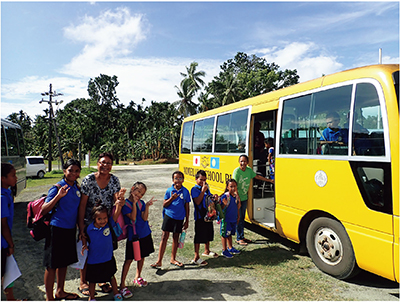
Children of Aimeliik Elementary School in Palau taking a school bus provided by Japan
It should also be noted that in situations of conflict, not only women and girls but also people in vulnerable social positions, including persons with disabilities and children, are particularly affected. Socially disadvantaged groups such as persons with disabilities caused by conflict or landmines, orphans, widows, and ex-combatants including child soldiers, and the rapidly increasing number of child refugees and internally displaced persons are especially vulnerable to the impacts of conflict. Nevertheless, the reality is that in post-conflict recovery, assistance is often delayed, making it difficult for them to share in the benefits of peace and reconstruction.
From this perspective, Japan provides support for the social reintegration of child soldiers and the protection of the most vulnerable children in conflict-affected areas through UNICEF. In the Gaza Strip of Palestine, this includes mental healthcare and explosives risk reduction education for children, as well as the distribution of identification wristbands to help reunite children with their families if they become separated. Japan also supports newborn care in Sudan, continued learning in Ukraine, assistance for former child soldiers in the Central African Republic, and protection of children and women who are victims of sexual violence in South Sudan and Somalia.
Through the Office of the United Nations High Commissioner for Refugees (UNHCR), Japan carries out protection activities for refugees and displaced persons, while providing humanitarian assistance tailored to the needs of those most likely to be in vulnerable situations. For example, in Uganda, this includes psychosocial support for children in refugee settlements to protect them from violence, abuse, and exploitation. In Ukraine, assistance is provided to vulnerable groups, such as elderly people who have lost their homes due to conflict and female-headed households including the provision of non-food items (NFIs), shelter support, and legal assistance (see also Part III, Section 3 (5) for educational support in conflict-affected areas).
Featured Project 4
Philippines


Project to Strengthen the Support Systems for Children in Residential Care Facilities and Communities in 11 Regions in the Philippines
JICA Partnership Program (JPP) (March 2021 – March 2024)
Foster Resilience and Support the Social Reintegration of Children in Vulnerable Situations
The Philippines has achieved high economic growth in recent years, yet the pace of poverty reduction remains slow, leaving many children in vulnerable situations. A considerable number of children fall into delinquency and end up in residential care facilities or juvenile rehabilitation facilities. Unfortunately, these children often fail to acquire adequate life skills to thrive in society during their time spent at these facilities, and some return to delinquency behavior or repeat criminal activities after being released.
In order to support the stable reintegration of such children into society, ACTION (A Child’s Trust Is Ours to Nurture), a Japanese NGO, developed the “Life SkillsNote 1 Intervention Program” and the “Capacity Building Training on House-parenting,” which aim to teach facility staff (house-parents) how to appropriately interact and care for these children. With the cooperation of the Government of the Philippines, these initiatives were institutionalized, and the “Life Skills Intervention Program” was introduced in 116 juvenile rehabilitation facilities across the country. Approximately 80% of the children who participated in the program showed improvement in life skills, with feedback indicating that they “started to consider others’ feelings when acting” and that they “are now able to control their anger.” In addition, through the “Capacity Building Training on House-parenting,” 240 trainers were developed, who then provided training sessions to more than 1,000 facility staff nationwide.
The organization, which also supports children within Japan, recognized the limited availability of Japanese-language materials in the field of childcare. Building on the outcomes of this project, they developed the “Life Skills Intervention Program” materials for Japanese elementary, lower secondary, and upper secondary school students, with plans to introduce them to child welfare facilities across Japan.
While supporting better social lives for children in the Philippines, the organization will also share knowledge and experience gained through these activities for the benefit of Japanese society.
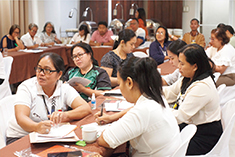
During a Capacity Building Training session on House-parenting (Photo: ACTION)
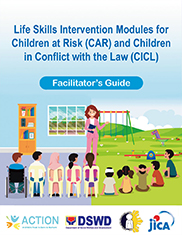
Textbook for “Life Skills intervention Program” in Tagalog (Photo: ACTION)
Note 1 WHO defines life skills as the abilities for adaptive and positive behavior that enables individuals to deal effectively with the demands and challenges of everyday life.
Glossary
- Global Survivors Fund (GSF)
- Fund launched by Dr. Denis Mukwege and Ms. Nadia Murad, Nobel Peace Prize laureates 2018. It aims to facilitate access to reparations and support for survivors of conflict-related sexual violence against the backdrop that many of them do not receive public reparations. GSF conducts awareness-raising activities regarding the development of the judicial system to support and give relief to survivors.
- Note 89: Gender mainstreaming means integrating a gender perspective into all policies, programs, and projects in order to achieve gender equality across all fields. In the context of development, it refers to the process of identifying the distinct challenges, needs, and impacts for both women and men at every stage—planning, implementation, monitoring, and evaluation—of all development policies, programs, and projects, based on the premise that such initiatives affect women and men differently.
- Note 90: A thematic policy formulated in 2016 to promote women’s active participation in development cooperation.
- Note 91: The Women Entrepreneurs Finance Initiative (We-Fi) was launched at the G20 Hamburg Summit in 2017. By supporting women entrepreneurs and women-owned or women-led small and medium-sized enterprises (WSMEs) in developing countries to overcome obstacles such as limited access to finance and institutional or regulatory barriers, the initiative aims to foster women’s rapid economic empowerment and their active participation in economic and social life, thereby contributing to regional stability, reconstruction, and peacebuilding.
- Note 92: For details on Japan’s efforts to prevent sexual violence in conflict, see also the Ministry of Foreign Affairs website (https://www.mofa.go.jp/fp/hr_ha/page23e_000466.html)
- Note 93: The concept promotes sustainable peace by protecting women while enabling them to participate in conflict prevention, recovery, and peace-building in leadership roles. In 2000, the United Nations Security Council unanimously adopted resolution 1325 on Women, Peace and Security (WPS), the first resolution in the Council’s history to explicitly recognize that equal participation of women, protection from sexual violence in conflict, and gender equality are essential for international peace, conflict prevention, and conflict resolution.
- Note 94: The Third WPS Action Plan (FY2023-2028) is structured around five pillars: (1) Promoting women’s participation and integrating a gender perspective in peacebuilding; (2) Preventing and responding to sexual violence and gender-based violence; (3) Disaster risk reduction, disaster response, and climate change initiatives; (4) Implementing WPS within Japan; and (5) Monitoring, evaluation, and review framework.
- Note 95: The largest WPS-related network among UN member states, which serves as a platform to share lessons learned and good practices. In addition to governments, regional organizations such as the North Atlantic Treaty Organization (NATO), the Organization for Security and Co-operation in Europe (OSCE), the African Union (AU), and the Association of Southeast Asian Nations (ASEAN) are also members. As of December 2024, the network brings together 103 members from 93 countries and 10 regional organizations.
- Note 96: A convention that sets out measures to realize the rights of persons with disabilities, with the aim of ensuring their enjoyment of human rights and fundamental freedoms, and of promoting respect for their inherent dignity. Japan ratified the Convention in 2014.
- Note 97: See Part V, Section 2 (2).
- Note 98: “Nepal Child Labour Report 2021” https://www.ilo.org/publications/nepal-child-labour-report-2021