
(5) Quality Education for All
There are an estimated 58 million children worldwide who are unable to attend primary school. When secondary education is included, the number of out-of-school children rises to approximately 244 million.Note 83 Since 2000, the proportion of out-of-school children has particularly increased in sub-Saharan Africa. Children in vulnerable situations, such as those with disabilities, refugee and internally displaced children, and children from ethnic minorities or remote communities, are at the highest risk of being left behind. The COVID-19 pandemic further exposed the fragility of education systems around the world. Moreover, Russia’s aggression against Ukraine and ongoing conflicts in various parts of the world, including the Middle East where the humanitarian situation in Gaza continues to worsen, have resulted in the destruction of numerous educational facilities. This has deprived children and students of their right to education and disrupted international educational exchange.
Education is a vital “investment in people” and is indispensable for promoting human security. SDG 4 aims to “ensure inclusive and equitable quality education and promote lifelong learning opportunities for all,” and the international community is working towards achieving the targets set out in the “Education 2030 Framework for Action.”Glossary The Summit of the Future, held in 2024, underscored the importance of education in addressing a wide range of challenges, including poverty reduction (see “Development Cooperation Topics” for details on the Summit of the Future). Japan will continue to advance educational initiatives with a focus on quality education for all, the empowerment of women, children, and youth, and the provision of educational opportunities in conflict and disaster situations.
●Japan’s Efforts
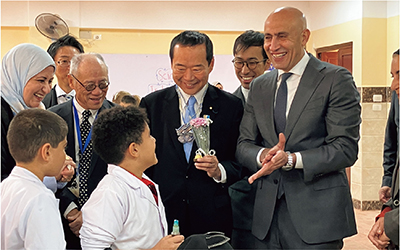
Then State Minister Fujii visiting one of the Egypt-Japan Schools (EJS), accompanied by Minister of Education and Technical Education Dr. Abdel Latif, in December 2024
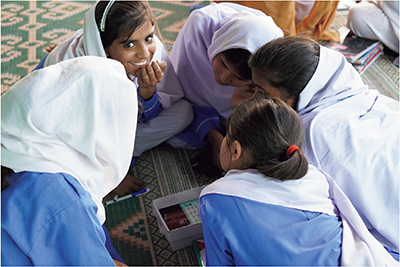
Female students learning through the “Advancing Quality Alternative Learning Project Phase 2,” which supports the provision of non-formal education in Pakistan, where many children are out of school (Photo: JICA)
Japan supports developing countries in a wide range of fields, including efforts to enhance basic educationNote 84 and higher education.
In El Salvador, Japan has been developing and revising textbooks and teachers’ guides for primary and secondary education, as well as providing teacher training since 2006, to help students acquire essential literacy, reading comprehension, and numeracy skills. These teaching materials are continuously distributed nationwide. Since 2021, Japan has also supported efforts to use findings from learning assessments and academic performance surveys to revise curricula and textbooks, as well as to improve teaching methods. Japan has carried out similar textbook and teachers’ guide development in Laos, Mozambique, Nicaragua, Niger, Papua New Guinea, and other countries. The materials designed for developing countries are made available on the JICA website,Note 85 and their use is also encouraged within Japan to help children who face learning difficulties due to insufficient Japanese language skills.
In Africa, at the TICAD 8 held in August 2022, Japan announced that it will work on initiatives in education aimed at improving children’s learning by promoting school enrollment, enhancing inclusiveness, and providing school meals. Through these efforts, it has committed to delivering quality education, including STEMNote 86 education, to 9 million children and enhancing access to quality education for 4 million girls. At the TICAD Ministerial Meeting in August 2024, Japan and its partners affirmed the steady progress of these initiatives. By November 2024, the “School for All”Note 87 project, launched in Niger in 2004 as an initiative to build trust among schools, parents, and local communities, to support schools through community involvement, and to improve children’s learning environments, had been introduced in approximately 70,000 primary schools across 11 countries. Furthermore, the “Peacebuilding and Community Reconciliation Model,” which is a development model proposed by Japan, is being piloted in regions affected by prolonged conflicts, where children’s education has been disrupted by school closures due to the increase of refugees and displaced populations caused by events such as prolonged conflicts. Additionally, at TICAD 8, Japan has committed to developing highly skilled human resources through various means, including the Japan-Africa university network that accepts and provides training programs to African students as well as to advancing research cooperation in science and technology.
Japan also collaborates with more than 20 Japanese universities to establish a university network centered at Jomo Kenyatta University of Agriculture and Technology (JKUAT)/the Pan-African University Institute of Basic Sciences, Technology and Innovation (PAUSTI) in Kenya, among others. By strengthening cooperation in education, research, and industry-academia partnerships, Japan aims to address social challenges across the African region through research collaboration. As of March 2024, this initiative has contributed to the development of 3,261 highly skilled professionals.
As an example of cooperation leveraging Japanese-style education, Japan has supported the establishment of the Egypt-Japan University of Science and Technology (E-JUST) since 2008. E-JUST offers practical engineering education at international standards, contributing to the development of researchers in Egypt as well as the broader Middle East and Africa region. Additionally, under the “Egypt-Japan Education Partnership” launched in 2016, 55 Egypt-Japan Schools (EJS) delivering Japanese-style education have been opened. At EJS, students engage in “Tokkatsu”Note 88 (special activities), such as class meetings, day duties, club activities, and cleaning, that encourage children to take an active role in school management alongside their academic studies. In June 2024, 904 children graduated from 51 EJS schools across Egypt. Moreover, Japan supports human resources development in developing countries through diverse initiatives, including strengthening networking among higher education institutions between Japan and ASEAN, fostering collaboration with the industrial sector, participating in joint research projects with neighboring countries, and accepting international students to Japanese universities.
In addition to these efforts, Japan supports children often in vulnerable situations, including girls excluded from schooling, children with disabilities, and children in conflict-affected areas, as well as refugee and displaced children and those of their host communities. For example, in Ukraine, as a means of supporting regions affected by conflict, Japan assists internally displaced children who can no longer attend their former schools, by providing distance learning equipment and mental healthcare, enabling them to continue learning safely in their places of refuge. In Palestine, where unstable security conditions have restricted school attendance, Japan signed and exchanged notes in February 2024 for the grant “Project for the Improvement of E-learning Equipment,” with the aim of ensuring children’s access to learning opportunities. Through this cooperation, audiovisual production equipment will be provided to a television station in the West Bank, and primary schools in the area will be equipped with audiovisual and ICT devices to support remote classes, which is expected to improve the overall learning environment. In Afghanistan, Japan builds temporary classrooms and public libraries, to create safe learning spaces for girls. It also promotes inclusive education that accommodates children with disabilities, as well as education integrating perspectives on climate change and disaster risk reduction. For instance, in Uzbekistan, Japan helps strengthen the capacity of personnel responsible for training teachers, to ensure that pre-school children with disabilities can access quality education.
In the Asia-Pacific region, as part of its collaboration with international organizations, Japan supports initiatives toward achieving SDG 4 through contributions to a funds-in-trust within the United Nations Educational, Scientific and Cultural Organization (UNESCO). These efforts include the organization of the Asia-Pacific Meeting on Education 2030 (APMED 2030) and the Asia-Pacific Regional Education Ministers’ Conference (APREMC-II). In addition, the initiative “Education for Sustainable Development:Glossary Towards achieving the SDGs (ESD for 2030),” led by UNESCO, began in January 2020. It aims to support progress towards achieving all the SDGs by fostering the builders of a sustainable society. As the country that first proposed ESD, Japan continues to promote the initiative and contributes to its global dissemination and advancement through the aforementioned funds-in-trust. Through this mechanism, Japan and UNESCO jointly organize the “UNESCO-Japan Prize on Education for Sustainable Development,” which recognizes organizations and institutions with outstanding practices in ESD implementation. To date, 21 organizations have received this award, leading to the active promotion of ESD.
Japan has contributed a total of approximately $55.89 million to the Global Partnership for Education (GPE) from 2008 to 2023.Glossary At the Global Education Summit held in July 2021, Japan pledged to provide over $1.5 billion in support for the education sector over five years (2021 to 2025), including continued assistance to GPE, as well as support for the education and capacity building for 7.5 million girls in developing countries. Over the three-year period beginning in FY2021, more than 4.1 million girls have received support, and this commitment will continue going forward. Furthermore, in March 2024, an additional $3 million was provided to the global fund for education in crises, Education Cannot Wait (ECW)Glossary to help ensure that children in Ukraine can learn in safer environments.
Glossary
- Education 2030 Framework for Action (FFA)
- A framework that succeeds “The Dakar Framework for Action: Education for All,” which aimed to achieve education for all and was adopted at the World Education Forum held in Dakar, Senegal in 2000. The FFA was adopted at the Education 2030 High-Level Meeting, held alongside the UNESCO General Conference in 2015.
- Education for Sustainable Development (ESD)
- Education that fosters builders of sustainable societies. ESD was recognized as a key to achieving all the SDGs in the resolutions of the 72nd Session of the UN General Assembly in 2017. This was reaffirmed in “ESD for 2030,” adopted by the resolution of the 74th Session of the UN General Assembly in 2019. “ESD for 2030” succeeds the “United Nations Decade of Education for Sustainable Development (UNDESD)” (2005-2014) and the “Global Action Program (GAP) on ESD” (2015-2019), serving as a new international framework for implementation from 2020 to 2030.
- Global Partnership for Education (GPE)
- An international partnership established in 2002 under the leadership of the World Bank to support the education sector in developing countries. Its members include developing countries, donor countries and organizations, civil societies, and private-sector corporations and foundations. The partnership was renamed the Global Partnership for Education (GPE) in 2011, succeeding the Fast Track Initiative (FTI).
- Education Cannot Wait (ECW)
- A fund established at the World Humanitarian Summit convened by the UN in Istanbul in May 2016, aimed at supporting children and young people in emergency situations—such as conflicts and natural disasters—by enabling their access to education.
- Note 83: See pages 211 and 214 of the “Global Education Monitoring Report 2023,” https://www.unesco.org/gem-report/en/technology
- Note 84: Educational activities aimed at enabling individuals to acquire knowledge, values, and skills necessary for life. These mainly include primary education, lower secondary education (equivalent to Japanese junior high school), pre-school education, and adult literacy education.
- Note 85: Education Materials: https://www.jica.go.jp/activities/issues/education/materials/index.html
- Note 86: STEM is an acronym for Science, Technology, Engineering, and Mathematics, and refers collectively to these four fields.
- Note 87: A community-wide school management initiative in which “everyone,” including parents, teachers, and local residents, forms a School Management Committee and works with the government to manage the school. It supports children’s learning by sharing the importance of education with the entire community, not only parents and teachers. It began in 23 primary schools in Niger in 2004 and has now expanded to multiple countries in Africa.
- Note 88: An abbreviation of the Japanese term for “special activities.” This initiative seeks to shift learning from a knowledge-heavy, theory-centered approach to one focused on acquiring life skills—such as problem-solving abilities, independence, social competence, and self-management—by incorporating activities like cleaning, class meetings, and day duty, which foster discipline, ethics, and cooperation.