
(4) Mainstreaming Disaster Risk Reduction and Building Sustainable Cities
With concerns over climate change expected to increase, the frequency, and scale of disasters, as well as their economic and social impacts are becoming more severe, especially in developing countries that are vulnerable to such events. Disaster risk reduction efforts are essential to eradicating poverty and achieving sustainable development. There is a need to build disaster-resilient and adaptable societies, protect people’s lives from disasters, and pursue sustainable development. A critical priority is to mainstream disaster risk reduction by integrating such perspective into all policies and plans.
In recent years, growing attention has been paid to a range of challenges related to urban management. These challenges include the disposal of large volumes of waste generated in urban and suburban areas, air and water pollution, the development of infrastructure such as sewage and waste treatment systems, and rapid population growth accompanied by accelerated urbanization. Addressing these challenges and working toward realizing sustainable cities have become key priorities in development cooperation.
Accordingly, the SDGs include Goal 11: “Make cities and human settlements inclusive, safe, resilient and sustainable.” This reflects increasing international attention to the challenges of human settlements, including the pursuit of sustainable cities.
●Japan’s Efforts
■Cooperation in Disaster Risk Reduction
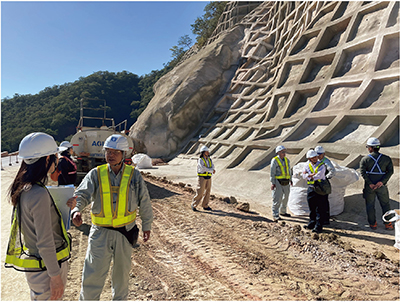
Engineers from Japan and Bolivia working on the Grant Project for “Road Disaster Prevention of National Road No. 7,” which incorporates Japan’s latest disaster prevention technologies, such as slope stabilization and debris flow control (Photo: JICA)
Japan leverages the extensive knowledge and expertise it has developed through its past experiences of addressing natural hazards, such as earthquakes and typhoons, to provide proactive support not only in emergency relief, but also in disaster risk reduction and post-disaster recovery. (See “Master Techniques from Japan to the World 2” and “Master Techniques from Japan to the World 4” for disaster risk reduction efforts in Indonesia and Argentina, and “Featured Projects” for the initiative in Ecuador). The “Sendai Framework for Disaster Risk Reduction 2015-2030 (Sendai Framework),” adopted at the Third UN World Conference on Disaster Risk Reduction (2015), reflects many of Japan’s proposals. These include the mainstreaming of disaster risk reduction, the development of appropriate disaster risk reduction strategies by national and local governments, the importance of investment in disaster risk reduction, the concept of “Build Back Better,” which aims to create communities more resilient than before the disaster, and the promotion of women’s leadership in disaster risk management.
In October 2024, the Asia-Pacific Ministerial Conference on Disaster Risk Reduction (APMCDRR) was held in Manila. At the conference, Japan highlighted key priorities, including strengthening disaster response, promoting investment in disaster risk reduction, and developing early warning systems. Japan also expressed its commitment to further advancing international cooperation in disaster risk reduction. In November, the first-ever G20 Ministerial Meeting on Disaster Risk Reduction was held in Brazil, where the G20 Disaster Risk Reduction Ministerial Declaration was adopted. The G20 reaffirmed the importance of disaster risk reduction, and in the G20 Rio de Janeiro Leaders’ Declaration also emphasized the need to promote international cooperation in line with the Sendai Framework and the importance of investment in people and infrastructure, while recognizing the inequalities exacerbated by disasters.
In addition, in response to Japan’s initiative, the UN General Assembly adopted a resolution in 2015 designating November 5 as “World Tsunami Awareness Day.” Since 2016, the High School Students Summit on “World Tsunami Awareness Day” has been held five times across various locations in Japan. The sixth summit took place in Kumamoto City in October 2024, bringing together a total of 526 high school students—313 from Japan and 213 from 43 other countries and regions. The participants deepened their mutual understanding and friendship while learning about disaster risk reduction and mitigation, including tsunami countermeasures. As an outcome of the summit, the “Kumamoto ‘Kizuna’ Declaration” was announced, expressing the students’ determination to become future leaders in the field of disaster risk reduction.
Moreover, in close cooperation with the United Nations Development Programme (UNDP), Japan has been implementing projects to support the development of tsunami evacuation plans and the implementation of tsunami evacuation drills in countries with high tsunami risk in the Asia-Pacific region. Since the inception of the projects in 2017, notable progress has been made. For example, in Indonesia, the introduction of a mobile phone application (STEP-A) has improved access to tsunami preparedness information at the school level. The app has also been integrated with InaRISK, a digital tool for disaster monitoring and information provision developed by the National Agency for Disaster Countermeasure, contributing to mainstreaming and institutionalizing disaster risk reduction at both community and national levels. As of the end of 2024, tsunami preparedness plans have been developed or updated and tsunami education programs have been implemented at 799 schools in 24 countries, with around 220,000 students, teachers, local government and community stakeholders participating in evacuation drills.
Since 2016, Japan has collaborated annually with the Hiroshima Office of the United Nations Institute for Training and Research (UNITAR) to support capacity building for female government officials and other stakeholders from developing countries vulnerable to natural disasters. The program places particular emphasis on women’s roles and leadership in the context of tsunami preparedness and response. By the end of 2024, a total of 714 participants from 39 countries had taken part in the initiative.
Japan also engages in the overseas deployment of ICT systems for disaster risk reduction. These systems enable the integrated collection, analysis, and dissemination of disaster-related information, allowing for timely and accurate communication of detailed information down to the community level, thus contributing to the strengthening of disaster risk reduction capacities in developing countries.
■Realizing Sustainable Cities
Japan is actively working to address global challenges directly related to human settlements, including disaster risk reduction, post-disaster recovery, and the promotion of a sound water cycle. Drawing on its knowledge and experience, Japan supports the development of infrastructure such as water supply and sewage systems, waste management, and energy facilities. It also implements disaster risk reduction projects as well as human resources development initiatives, based on the concept of “Build Back Better.” In addition, Japan promotes sustainable urban development through cooperation with the United Nations Human Settlements Programme (UN-Habitat). For example, in collaboration with the UN-Habitat Regional Office for Asia and the Pacific (ROAP) in Fukuoka, Japan supports the introduction of disaster prevention technologies developed in Fukuoka Prefecture to developing countries.
Following the first meeting held in Potsdam, Germany, in 2022, the second G7 Sustainable Urban Development Ministers’ Meeting took place in Takamatsu City, Kagawa Prefecture, in July 2023 under Japan’s Presidency. With the theme “Achieving Sustainable Urban Development Together,” the ministers affirmed the need to address key issues such as achieving net-zero and resilient cities, inclusive cities, and digitalization in cities. The outcome of the meeting was presented as the “Kagawa-Takamatsu Principles.” In November 2024, the third Ministers’ Meeting took place in Rome, Italy, where discussions built on the outcomes of the previous meetings. Participants shared insights on emerging challenges, common principles, and best practices. The outcome document introduced a new commitment for “Joint Action,” reaffirming the intention to establish an ever-closer network for dialogues within and outside the G7, and to continue supporting the exchange between the G7 governments on matters of common interest and practice regarding sustainable urban development, with the involvement of key international partners such as the Organisation for Economic Co-operation and Development (OECD) and UN-Habitat.