
(3) Water and Sanitation
Water and sanitation are vital issues linked to human life. Around the world, approximately 2.2 billion people cannot access safely-managed drinking water, and approximately 3.5 billion people live without safely-managed sanitation facilities such as toilets.Note 76 In particular, in developing countries where piped water is not widely available, women and children are often forced to spend hours fetching water, which limits women’s participation in society and children’s access to education. Water and sanitation issues are therefore also important for promoting gender equality and an inclusive society. Furthermore, an unreliable water supply has a negative impact on healthcare and agriculture. The development of water and sanitation infrastructure will also help create an environment that is resistant to infectious diseases, and is necessary for achieving more resilient, equitable, and sustainable universal health coverage (UHC).Note 77 In recognition of these needs, SDG 6 sets forth the objective to “Ensure availability and sustainable management of water and sanitation for all.”
●Japan’s Efforts
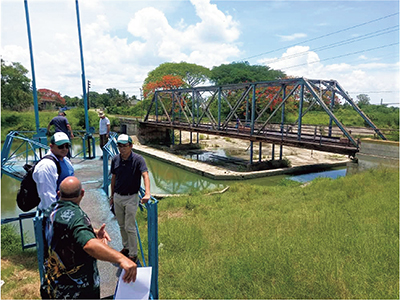
A JICA expert and their counterparts visiting a site as part of the “Project for Enhancement of Capacities for Integrated Water Resources Management” in Cuba (Photo: JICA)
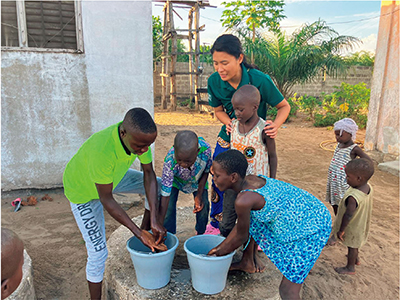
A JOCV teaching children how to effectively wash hands in the provincial city of Ouidah, Benin (Photo: JICA)
As a follow-up to the UN 2023 Water Conference held in May 2023, the Third High-Level International Conference on the International Decade for Action “Water for Sustainable Development” was held in Dushanbe, Tajikistan, in June 2024. Then Foreign Minister Kamikawa participated through a video message, stating that Japan is engaged in various activities in cooperation with a number of international organizations through water-related action plans of the international community, including the “Kumamoto Initiative for Water.”Note 78
Japan continues to support the expansion of access to safe water in developing countries by leveraging its extensive domestic experience, knowledge, and technology, and has been the top donor in the water and sanitation sector since the 1990s in terms of cumulative total assistance. For example, in South Sudan, where the development of basic infrastructure has been delayed since its independence, Japan provides grants for the development of water supply facilities, as well as technical cooperation to strengthen capacities for the operation and maintenance of such facilities, in addition to water fee collection. In Cambodia, Japan supports the improvement of living environments and tourism development in the tourist city of Siem Reap through the expansion of water supply facilities (water intake facilities, water treatment plants, distribution pipes, etc.) and human resource development for service expansion. In Madagascar, Japan decided in October 2024 to provide grants for the expansion and renewal of existing water treatment plants and water transmission and distribution facilities in Toamasina, the country’s second-largest city where its largest port is located.
Japan also cooperates with Japanese and local private companies and research institutions. For example, in Kenya, the “SDGs Business Verification Survey with the Private Sector for the Measures against Non-Revenue Water of the Water Supply System by Utilizing Mechanical Joint Connections” is implemented utilizing JICA’s SDGs Business Supporting Surveys.Note 79 To address the issue of water leakage from distribution pipes in the country, a pilot project is being implemented, utilizing a Japanese company’s technology on water pipe joint connections.Note 80 In Viet Nam, in response to the rising demand for water supply due to the country’s rapid economic growth, faculty from Nagasaki University and Hanoi University of Civil Engineering are working on developing an advanced water purification system using nanofiltration membrane technology that is more cost-effective than conventional systems, under the Science and Technology Research Partnership for Sustainable Development (SATREPS).Note 81
To address the lack of local information and knowledge with regard to the problem of serious water contamination in many Asian countries, the Ministry of the Environment (MOE) of Japan implements the Water Environment Partnership in Asia (WEPA). Through cooperation among 13 participating countriesNote 82 from Asia, WEPA aims to enhance water environment governance in Asia through building human networks, gathering and sharing information, and strengthening capacity. At the 19th WEPA Annual Meeting and International Workshop held in Kanagawa Prefecture from January 30 to February 1, 2024, based on previous discussions on domestic and industrial wastewater management, participants exchanged information about current challenges in each country with a focus on the water environment itself. During the meeting, in regard to legal frameworks and compliance, Japan, the Republic of Korea, and Sri Lanka presented examples of water environment-related policies that have recently been enacted or amended. Furthermore, at the 10th World Water Forum held in Bali, Indonesia in May of the same year, initiatives to improve water quality through the exchange of knowledge and experience were shared.
As a leading donor in the water and sanitation sector, Japan continues to contribute to ensuring access to safe water and sustainable water resources for people in developing countries, drawing on its accumulated expertise.
- Note 76: According to United Nations Children’s Fund (UNICEF) survey (as of 2022). https://data.unicef.org/resources/jmp-report-2023/
- Note 77: See Note 66.
- Note 78: An initiative announced by then Prime Minister Kishida at the 4th Asia-Pacific Water Summit held in Kumamoto in April 2022. It actively addresses water-related social issues through quality infrastructure development and other means, in cooperation with various countries and international organizations.
- Note 79: See the glossary.
- Note 80: A part used at the joints that connect pipes together. An important component of water infrastructure to use water efficiently.
- Note 81: See the glossary.
- Note 82: The 13 countries are Cambodia, China, Indonesia, Republic of Korea, Laos, Malaysia, Myanmar, Nepal, the Philippines, Sri Lanka, Thailand, Viet Nam, and Japan.