
Part V Promotion of Effective and Strategic Development Cooperation
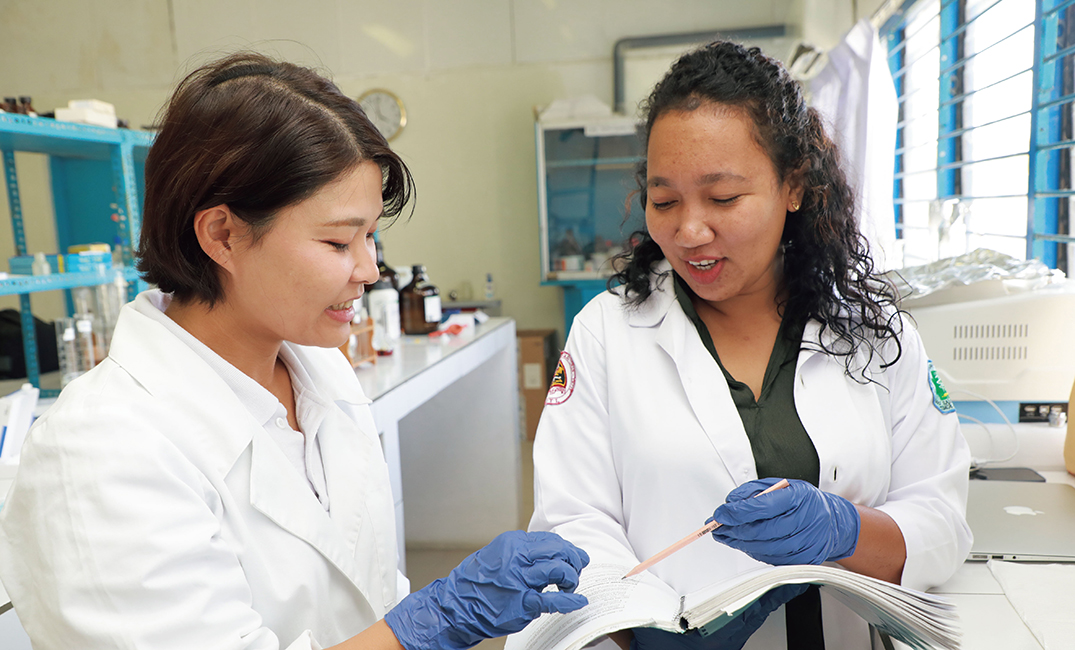
A Japan Overseas Cooperation Volunteer (JOCV) conducting an experiment with local staff at a pharmaceutical storage facility in Timor-Leste (Photo: JICA)
1 Solidarity with Various Partners to Realize Co-Creation
The Development Cooperation Charter sets forth the basic policy of “co-creation” whereby various actors, such as the private sector and public financial institutions, bring their respective strengths and create new social values through dialogue and collaboration in relation to various development challenges for which there are as yet no defined solutions.
(1) Partnership with the Private Sector
In recent years, private sector investment activities have been playing an increasingly important role in the economic growth of developing countries. Various business activities conducted by the private sector contribute significantly to the socio-economic development of developing countries through job creation, human resources development, and technological advancement. The Government of Japan promotes effective and strategic development cooperation through such partnerships with the private sector.
Since 2012, JICA has been partnering with private companies to dispatch their employees as JICA Volunteers (see Part V, Section 2 (2) for details on the JOCV (Partnership Program)). Through their assignments, these volunteers are expected to draw on their professional experiences to contribute to the growth of developing countries, while learning unique business practices and identifying market needs in the countries of their assignment, and to apply such knowledge to their business activities in Japan upon their return.
■SDGs Business Supporting Survey
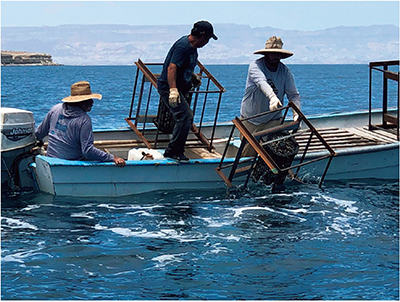
A demonstration experiment in Mexico by a Japanese company on enhancing ecosystem function by submerging a “Shell Nurse” artificial reef (Photo: Ocean Construction Co., Ltd./SDGs Business Supporting Survey)
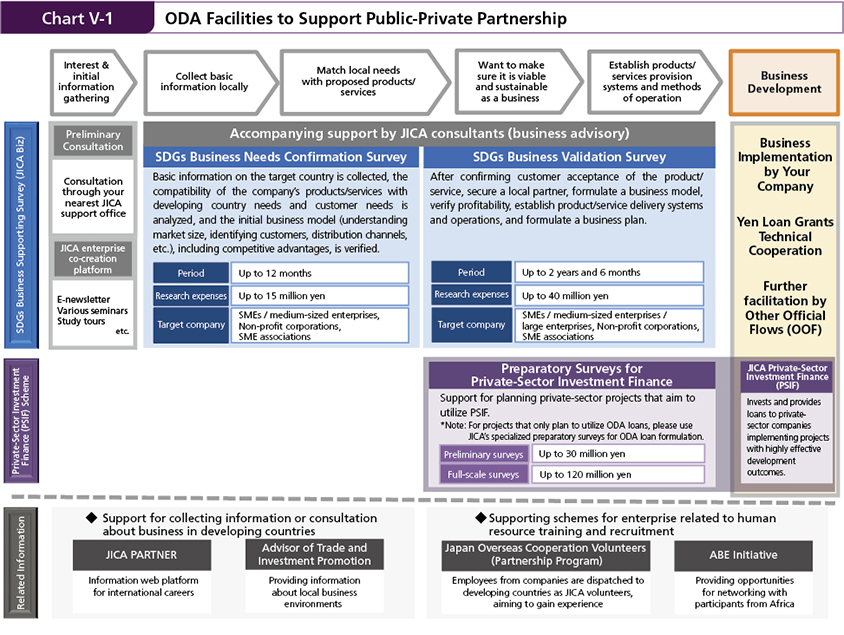
Japanese companies’ refined products, technologies, and know-how have the potential to contribute to solving challenges in developing countries. The SDGs Business Supporting Survey (JICA Biz)Glossary is a program that examines the compatibility of Japanese companies’ products, technologies, and know-how with the development needs of developing countries, and supports overseas business development by such companies, including small and medium-sized enterprises (SMEs). Through this type of public-private partnership, Japanese companies’ business contributes to the socio-economic development of developing countries (see JICA’s websiteNote 1 for the overview of the program and its benefits). In FY2024, a total of 57 businesses were selected to receive support for their operations in 21 developing countries (see Chart V-1, “Stories from the Field”, and “Master Techniques from Japan to the World 1” and “Master Techniques from Japan to the World 3” as well).
■Private-Sector Investment Finance (PSIF)
Private-Sector Investment Finance (PSIF)Glossary refers to a type of ODA financing scheme in which JICA provides investments and loans to the private sector carrying out projects in developing countries that are considered highly effective from a development perspective but not able to attract sufficient funding from private financial institutions. As of the end of FY2023, the cumulative amount of commitments since FY2011 has reached approximately 985.5 billion yen, with many Japanese companies participating (see JICA’s websiteNote 2 for more information about the program’s framework, target areas, conditions, and other details). Recent examples of successful PSIF projects include the Export-Oriented Industry Support Project for Ukraine and Moldova, and the Agricultural Sector Support Project in Brazil, both signed in 2024. The former was signed in February 2024 in conjunction with the Japan-Ukraine Economic Recovery Promotion Conference, and aims to promote foreign currency acquisition and job creation in both countries through investments in export-oriented ICT companies in Ukraine and Moldova. This project is expected to contribute to the reconstruction and socio-economic development of both countries. Additionally, investment destinations of at least 30% of the fund are to be companies owned by female managers and entrepreneurs, thereby adding the promotion of gender equality and women’s empowerment to the project’s agenda. The latter aims to improve financial access for Brazil’s agricultural sector and micro, small, and medium-sized enterprises through support for lending operations conducted by Brazil’s largest credit union, with the goal of expanding agricultural production and increasing farmers’ income.
At the side-event on the Partnership for Global Infrastructure and Investment (PGII) held during the G7 Hiroshima Summit in May 2023, then Prime Minister Kishida expressed Japan’s commitment to contributing to the sustainable development of partner countries through public and private infrastructure investment. Based on this commitment, Japan newly established three financing facilities: the Facility for Accelerating Climate Change Resilient and Sustainable Society (ACCESS), the Facility for Supporting Agricultural supply chain and Food security Enhancement (SAFE), and the Facility for Accelerating Financial Inclusion (FAFI). New projects under these facilities were signed recently, including the Climate Change Action Support Project in Nigeria (in November 2023) under ACCESS and the Project for Rural Financial Access Improvement in India (in December 2023) under FAFI.
■Preparatory Survey for Private-Sector Investment Finance
Recent years have seen a growing trend of infrastructure development through public-private partnerships in developing countries and of socio-economic development through private-sector projects. JICA conducts Preparatory Surveys for Private-Sector Investment Finance (PSIF) to formulate projects that utilize private-sector funds on the premise that public support is provided. JICA supports feasibility studies for the formulation of business plans and calls for proposals widely from the companies that explore the possibility of participating in projects in developing countries (see JICA’s website for more information about the program’s framework, target areas and countries, and other details).Note 3 The total number of projects adopted from 2010 to 2024 has reached 92, and in 2024, three projects were adopted in Asia.
■Grant for Supporting Business and Management Rights
The Government of Japan provides grants for public works projects in which Japanese companies are expected to be involved in facility development, as well as subsequent operation and maintenance. The Grant for Supporting Business and Management Rights is designed to support Japanese companies in leveraging their technologies and know-how in the socio-economic development efforts of developing countries through the acquisition of business and management rights in infrastructure projects under public-private partnerships (PPP) in developing countries. In February 2024, an Exchange of Notes was signed in Tunisia for a grant project to construct an advanced wastewater treatment plant that enables the reuse of wastewater as industrial water, utilizing Japanese companies’ technologies.
■Collaboration with Public Financial Institutions
Japan’s development cooperation takes place in partnership with diverse actors. In implementing development cooperation, it is important for the Government to strengthen collaboration between JICA and other agencies responsible for handling other official flows (OOF) such as Japan Bank for International Cooperation (JBIC),Glossary Nippon Export and Investment Insurance (NEXI), the Japan Overseas Infrastructure Investment Corporation for Transport and Urban Development (JOIN), the Fund Corporation for the Overseas Development of Japan’s ICT and Postal Services (JICT), and the Japan Organization for Metals and Energy Security (JOGMEC) and to serve as a catalyst for mobilizing and assembling a wide range of resources, including private sector ones.
Glossary
- SDGs Business Supporting Survey (JICA Biz)
- One of the private-sector partnership programs implemented by JICA that supports Japanese companies in expanding their businesses overseas to contribute to solving challenges in developing countries. The program offers two types of support: “SDGs Business Needs Confirmation Survey” and “SDGs Business Validation Survey.” Applications from Japanese companies are accepted once a year.
- Private-Sector Investment Finance (PSIF)
- A type of ODA financing scheme implemented by JICA that provides the private sector carrying out projects in developing countries with necessary financing in the form of investments and loans. Projects in developing countries entail various risks, and high returns cannot often be expected. Thus, private financial institutions are often reluctant to provide these companies with sufficient financing. By providing investments and loans through PSIF to private-sector projects that, despite risks, have the potential to create jobs and revitalize the economy, JICA contributes to promoting economic and social development in developing regions. PSIF assists in the fields of (1) infrastructure development and growth acceleration and (2) SDGs including poverty reduction and climate change actions.
- Japan Bank for International Cooperation (JBIC)
- A policy-based financial institution wholly owned by the Japanese government. While its primary purpose is to supplement the services of general financial institutions, its goal is to contribute to the sound development of Japan and the international economy and society. To this end, JBIC operates in the fields of (1) promoting the overseas development and securement of resources that are important for Japan, (2) maintaining and improving the international competitiveness of Japanese industries, (3) promoting overseas businesses that also work to preserve the global environment, such as preventing global warming, and (4) preventing disruptions to international financial order or taking appropriate measures with respect to damages caused by such disruptions.
- Note 1: SDGs Business Supporting Surveys (JICA Biz) https://www.jica.go.jp/priv_partner/activities/sme/index.html (in Japanese only)
- Note 2: Private-Sector Investment Finance https://www.jica.go.jp/activities/schemes/finance_co/loan/index.html (in Japanese only)
- Note 3: Preparatory Surveys for Private-Sector Investment Finance https://www.jica.go.jp/priv_partner/activities/psiffs/index.html (in Japanese only)