
(2) Partnership with Other Countries and International Organizations
■Partnership in the G7 and G20
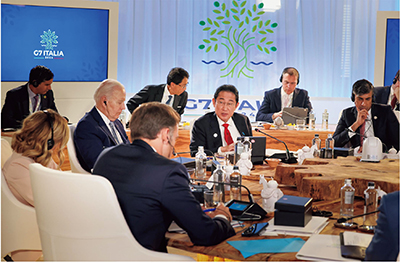
Then Prime Minister Kishida speaking at the G7 Apulia Summit (Photo: Cabinet Public Relations Office)
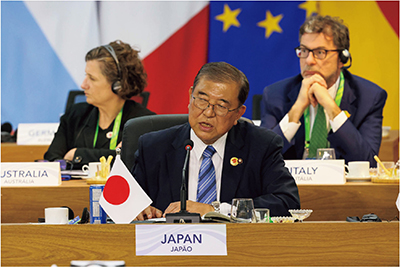
Then Prime Minister Ishiba speaking at the G20 Rio de Janeiro Summit (Photo: Cabinet Public Relations Office)
The G7 Apulia Summit was held in June 2024 under the Italian Presidency. Then Prime Minister Kishida represented Japan and attended the session on “Africa, Climate Change, and Development,” to discuss critical issues facing the international community, including climate change, development, and gender, with a focus on cooperation with Africa. Then Prime Minister Kishida stated that the G7 countries should try to attain synergy among their respective efforts while further promoting initiatives such as the G7 Partnership for Global Infrastructure and Investment (PGII) that meet Africa’s needs. He also emphasized the importance of continuing to focus on achieving the SDGs while respecting human dignity and human security. In addition, he expressed Japan’s intention to demonstrate tangible outcomes, through progress in the reform of Multilateral Development Banks (MDBs),Note 4 such as effectively allocating highly concessional development funds to developing countries.Note 5 During the session on “Africa, Climate Change, and Development,” the G7 leaders confirmed that the G7 would coordinate more closely in addressing various issues, including climate change and development, while staying attuned to the African voices.
In October, then State Minister for Foreign Affairs Tsuge attended the G7 Development Ministers’ Meeting held in Pescara. Discussions were held on the G7’s response to food security, which has been severely affected by Russia’s aggression against Ukraine, as well as conflicts, climate change, and natural disasters; the importance of advancing cooperation under PGII to fill the investment gap for infrastructure around the world; and measures to build and strengthen the Global Health Architecture (GHA) and achieve Universal Health Coverage (UHC). In the PGII session, then State Minister Tsuge shared the prospect that the G7’s ongoing efforts related to PGII would serve as a catalyst for new growth for partner countries and regions, and reiterated the importance of promoting fair and transparent development finance while complying with international rules and standards, such as the “G20 Principles for Quality Infrastructure Investment.” He also reaffirmed Japan’s resolve to continue strongly supporting each country’s autonomous growth through the promotion of quality infrastructure investment, in cooperation with the G7 and various partners (see Part III, Section 1 (3) for quality infrastructure). Furthermore, in the margins of the meeting, a humanitarian conference on the Middle East was held with the participation of relevant countries, regions, and international organizations in addition to the G7, and the participants discussed the importance of avoiding escalation of the situation in the Middle East and improving the humanitarian situation.
At the G20, the G20 Development Ministers’ Meeting and the Ministerial Meeting on the Establishment of the Global Alliance against Hunger and PovertyNote 6 were held in Rio de Janeiro, Brazil, in July, with then Parliamentary Vice-Minister for Foreign Affairs Hosaka representing Japan. During the Development Ministers’ Meeting, the participants discussed ensuring access to safe water and sanitation services, addressing inequality in a wide range of areas including climate change, digital technologies, and gender, as well as triangular cooperation.Note 7 Then Parliamentary Vice-Minister Hosaka presented Japan’s efforts with specific examples, in which Japan—one of the world’s leading donors in the water and sanitation sector—has provided a wide range of support, including the development of quality infrastructure and human resources, and, in so doing, fostered learning and co-creation of solutions with various partners for the overall improvement of access to water and sanitation. Regarding the challenges of inequality, he explained how Japan has consistently taken action toward investment in people, including the provision of quality education, over the seven decades of its history of ODA provision, and stated that accelerating collaboration among partners in the international community, including through triangular cooperation, is essential.
Then Prime Minister Ishiba represented Japan at the G20 Rio de Janeiro Summit in November. In Session 1, “Fight against Hunger and Poverty,” development issues were discussed with a focus on measures against hunger and poverty. Prior to this session, Japan also expressed its will to participate in the “Global Alliance against Hunger and Poverty,” which was launched on that occasion. Then Prime Minister Ishiba explained that Japan espouses the philosophy of human security and aims to eradicate hunger and poverty for the realization of a prosperous society where everyone can live happily with human dignity. Then Prime Minister Ishiba went on to state that, to that end, and in recognition of the importance of establishing food security and developing sustainable and resilient food systems, Japan is determined to actively contribute to the “Global Alliance against Hunger and Poverty.” Furthermore, regarding disaster risk reduction, he stated that Japan would continue to steadily implement the “Sendai Framework for Disaster Risk Reduction” and strengthen disaster prevention measures together with G20 members. In Session 2, “Reform of the Global Governance Institutions,” having emphasized the importance of MDB evolution, then Prime Minister Ishiba addressed developing countries’ debt issues, stating that it is necessary to expedite the debt restructuring process under the G20 “Common Framework” and further improve debt transparency. He also explained that Japan has led the debt restructuring process of Sri Lanka—the first case of coordination with emerging creditor countries in the debt restructuring of a middle-income country—and expressed Japan’s intention to continue to provide necessary support for solving challenges that developing countries face (see Part III, Section 1 (4) for efforts to address debt issues). Noting how the G20’s roles are increasingly important in leading international cooperation in many areas, then Prime Minister Ishiba also called for the development of a global governance regime where all countries go beyond confrontation and share responsibilities.
■Partnership with Major Donor Countries and Others
In 2024, which marked the 60th anniversary of Japan’s accession to the Organisation for Economic Co-operation and Development (OECD), Japan chaired the OECD Ministerial Council Meeting for the first time in 10 years. Then Prime Minister Kishida delivered the keynote speech as the chair, and Japan led discussions on multiple topics including sustainable development under the theme “Co-creating the Flow of Change: Leading Global Discussions with Objective and Reliable Approaches towards Sustainable and Inclusive Growth.” In the breakout session on sustainable development, then Foreign Minister Kamikawa pointed out the importance of mobilizing private finance catalyzed by ODA to meet the development financing needs of developing countries, and stated that Japan is actively contributing to reforming MDBs to ensure stable and sustainable financing necessary for development. In addition, she emphasized that OECD should mobilize technical expertise and human resources for sustainable development under the concept of “co-creation.”
In addition, Japan holds dialogues with major donors to exchange views on priority issues and policies. Following the Japan-U.S. Summit Meeting in April 2024, the Japan-U.S. Strategic Diplomacy and Development Dialogue (at the Vice-Ministerial level) was held in May, where wide-ranging discussions were held from a strategic perspective on Japan-U.S. cooperation in addressing various challenges for the international community and strengthening engagement with countries of the Global South through diplomatic and development efforts.
Furthermore, on the occasion of the G7 Development Ministers’ Meeting, then State Minister for Foreign Affairs Tsuge held separate meetings with Mr. Edmondo Cirielli, Deputy Minister of Foreign Affairs and International Cooperation of the Italian Republic; Ms. Isobel Coleman, then Deputy Administrator for Policy and Programming of the United States Agency for International Development (USAID); and Mr. Thani Mohamed Soilihi, Minister of State for Francophonie and International Partnerships of the French Republic, attached to the Minister for Europe and Foreign Affairs, and confirmed that Japan would further deepen cooperation in international arenas including the G7. In addition, on the occasion of the G20 Development Ministers’ Meeting, then Parliamentary Vice-Minister for Foreign Affairs Hosaka held meetings with Mr. Mauro Vieira, Minister of Foreign Affairs of the Federative Republic of Brazil; Mr. Ahmed Hussen, Minister of International Development of Canada; and Mr. Seiso Joel Mohai, Deputy Minister of Planning, Monitoring and Evaluation of the Republic of South Africa, and exchanged views on strengthening cooperation in the G20 in the field of development.
The member countries of the Development Assistance Committee (DAC) of OECD are traditionally engaged in development cooperation. However, emerging countries such as China, India, Indonesia, Saudi Arabia, Turkey, Brazil, and South Africa, have become active in providing assistance to developing countries in recent years. Through such assistance, these emerging countries have come to exercise considerable influence over development challenges. Japan coordinates with other countries, including emerging countries, and supports emerging countries’ effective provision of assistance to developing countries. At the 16th Japan–India Foreign Ministers’ Strategic Dialogue, held in March 2024, Japan and India concurred on establishing a forum for discussing bilateral development cooperation in third countries.
The “Global Partnership for Effective Development Cooperation (GPEDC)” is a multi-stakeholder platform for driving the effectiveness and efficiency of development cooperation, bringing together not only donor countries but also a wide range of stakeholders, including developing countries, international organizations, private sectors, civil society, and local public entities for discussions. Japan has been serving as a Steering Committee member of GPEDC since January 2024, and continues to cooperate with various countries to ensure that the four principles of GPEDC—country ownership, focus on results, inclusive partnerships, and transparency and mutual accountability—are practiced in development cooperation.
■Partnership with International Organizations
To address various developmental and humanitarian issues as well as global challenges, Japan promotes collaboration with international organizations. Then Foreign Minister Kamikawa held meetings with Ms. Amy Pope, Director General of the International Organization for Migration (IOM), who visited Japan in February, as well as with Mr. Philippe Lazzarini, Commissioner-General of the United Nations Relief and Works Agency for Palestine Refugees in the Near East (UNRWA), who visited Japan in March, and with Mr. Kamal Kishore, Special Representative of the Secretary-General for Disaster Risk Reduction and head of the United Nations Office for Disaster Risk Reduction (UNDRR), who visited Japan in June. Then Foreign Minister Iwaya held a meeting with Mr. Filippo Grandi, the United Nations High Commissioner for Refugees, who visited Japan in November.
In addition, in order to facilitate Japan’s assistance implemented by international organizations, Japan also holds dialogues with major international organizations, including UN agencies. In 2024, Japan engaged in regular policy dialogues with the United Nations Population Fund (UNFPA), the United Nations International Children’s Emergency Fund (UNICEF), the United Nations High Commissioner for Refugees (UNHCR), the International Committee of the Red Cross (ICRC), and others (see “Stories from the Field” for a Japanese officer who works for IOM).
■Partnership with Multilateral Development Banks (MDBs)
Multilateral Development Banks (MDBs)Note 8 is a collective term for international organizations that support the poverty reduction and sustainable socio-economic development of developing countries. As poverty worsens and inequality widens due to cross-border challenges such as the pandemic and climate change, the World Bank and other MDBs promote initiatives, including MDB evolution, toward strengthening their response to global issues and the use of existing capital to respond to increasing development financing needs (CAF Review).Glossary
The importance of MDB evolution for enhancing their functions was also addressed at the G7 Apulia Summit in June 2024 and the G20 Rio de Janeiro Summit in November, following the G7 Hiroshima Summit under Japan’s Presidency in 2023, where the leaders of each country expressed their support for advancing MDB evolution. The G20 Rio de Janeiro Leaders’ Declaration endorsed the “G20 Roadmap towards Better, Bigger and More Effective MDBs,” which is expected to accelerate MDBs’ progress toward the SDGs and enhance their capacity to address global challenges.
Glossary
- Capital Adequacy Framework (CAF) Review
- An independent review of the CAF of MDBs, a G20 initiative, which explores measures to maximize the use of MDBs’ existing capital. A roadmap featuring the progress and other information of the CAF review was formulated at the G20 Finance Ministers and Central Bank Governors Meeting in July 2023, and the importance of the continuous implementation of the review was recognized at the G20 Finance Ministers and Central Bank Governors Meeting in April 2024.
- Note 4: See the glossary.
- Note 5: See the beginning of Part II, Section 2.
- Note 6: A platform to support and accelerate efforts to eradicate hunger and poverty. It was established at the G20 Rio de Janeiro Summit in November 2024. As of January 2025, 90 countries, including Japan, and 76 organizations are participating.
- Note 7: See the glossary.
- Note 8: See the glossary.