
2 Overview of Official Development Assistance from Major Donors in Terms of Disbursement
The OECD-DAC establishes international rules on what cooperation constitutes ODA and how it should be reported. Under the rules set by the DAC, ODA must meet the following three requirements: (i) it is provided by official agencies or their executive agencies; (ii) its main objective is to promote the economic development and welfare of developing countries; and (iii) it is concessional in character (in the case of government loans, the terms of the loan [e.g. interest rate and repayment period] are set in favor of recipient countries).
DAC countries provide development cooperation under the rules set by the DAC. However, the content of ODA implemented by major donors varies by country. This section outlines the aid provided by DAC donors, focusing on the G7 countries, based on their disbursements in 2023.
■Aid Disbursements by Major Donors
ODA provided by DAC countries in 2023 (calculated by the GE system) amounted to approximately $223,314 million. By country (GE system, percentage out of total ODA of DAC countries), the United States ranked first (approximately $64,686 million, 29.0%), Germany second (approximately $37,905 million, 17.0%), Japan third (approximately $19,600 million, 8.8%), the United Kingdom fourth (approximately $19,073 million, 8.5%), France fifth (approximately $15,050 million, 6.7%), Canada sixth (approximately $7,965 million, 3.6%), the Netherlands seventh (approximately $7,361 million, 3.3%), Italy eighth (approximately $6,121 million, 2.7%), and Sweden ninth (approximately $5,622 million, 2.5%), with the G7 countries occupying the top positions.Note 7
■Sectors Aided by Major Donors
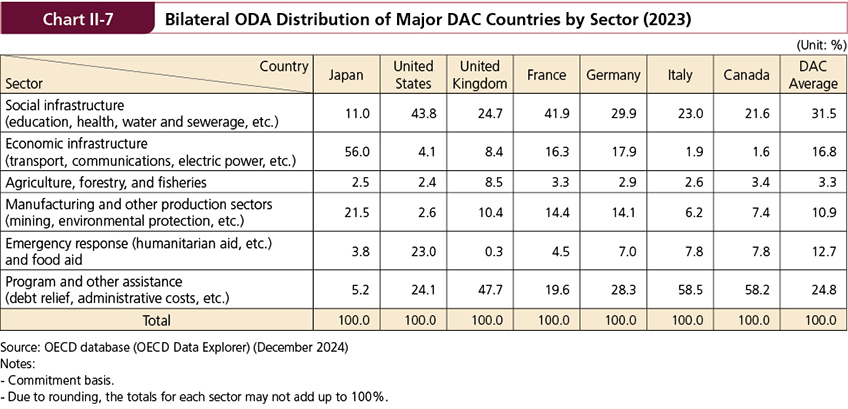
Disbursements in 2023 from the United States, the United Kingdom, France, Germany, Italy, and Canada were concentrated in the social infrastructure sectors, including education, health, and water supply and sewerage. The United States allocated more than 20% of total ODA to emergency response (humanitarian aid, etc.) and food aid. On the other hand, in the economic infrastructure sectors, such as roads, bridges, railroads, communications, and electric power, Japan has the highest allocation with 56.0% of its total ODA, followed by Germany with 17.9%. Economic infrastructure assistance makes up a large share of Japan’s cooperation because Japan, with its postwar recovery experience, considers that, in order to achieve poverty reduction and other goals through sustainable economic growth in developing countries, it is essential first and foremost to establish economic infrastructure and support the self-help efforts of developing countries (Chart II-7).
■Regions Aided by Major Donors
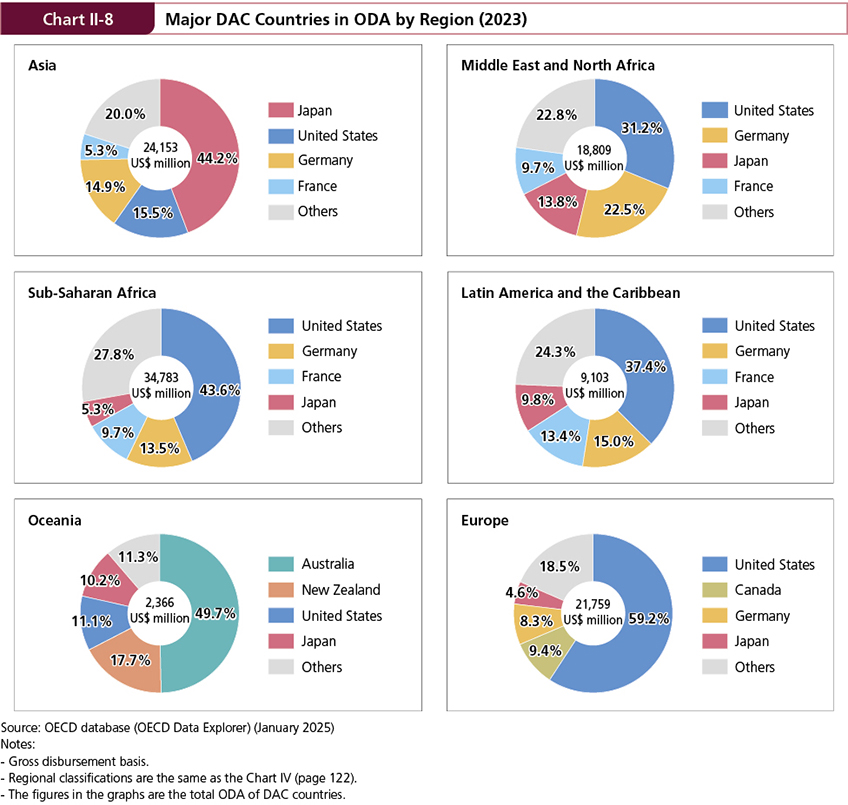
Whereas Japan’s ODA is primarily directed at the Asian region (approximately 52.4% of gross disbursements in 2023 [hereinafter the same]) (Chart II-2), Sub-Saharan Africa was the top recipient of aid from the United States, the United Kingdom, France, Germany, and Italy (25.5%, 11.8%, 30.6%, 16.0%, and 12.9% respectively), and Europe was the top recipient of aid from Canada (28.6%).Note 8 In terms of the percentage of total aid disbursements from major DAC countries by region, the United States was the largest donor to the Middle East and North Africa (31.2%), Sub-Saharan Africa (43.6%), Latin America and the Caribbean (37.4%), and Europe (59.2%). Australia provided 49.7% of total ODA to Oceania. As these figures indicate, the regional priority of aid for each donor is influenced by factors such as geographic proximity and historical background (Chart II-8).
■Disbursements by Type of Assistance
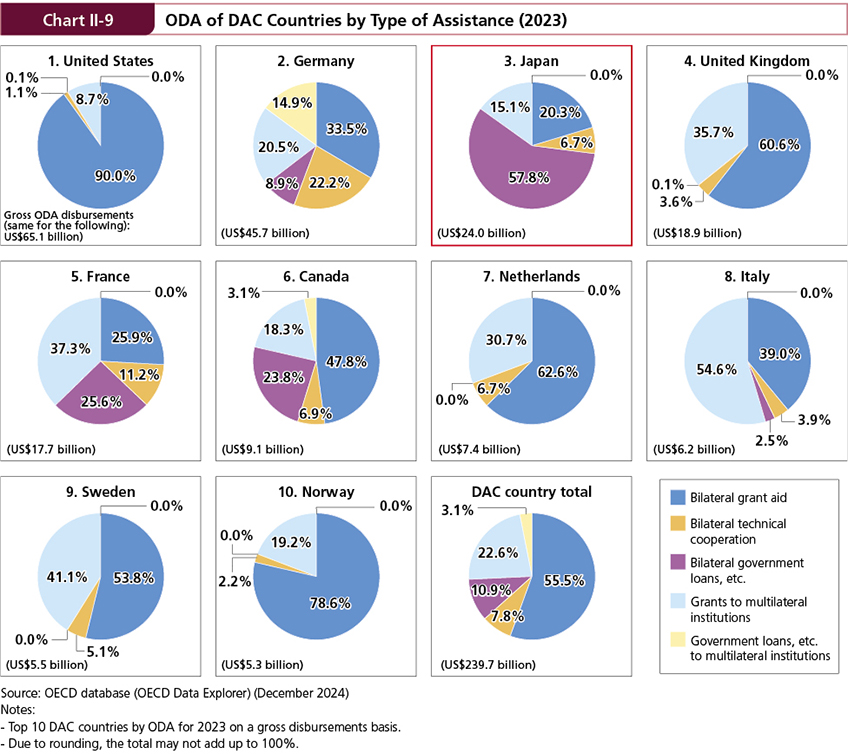
By type of assistance, approximately 86.0% of ODA provided by all DAC countries in 2023 were grants (bilateral grant aidNote 9: approximately 55.5%; bilateral technical cooperation: approximately 7.8%; grants to multilateral institutions: approximately 22.6%), and approximately 14.0% were government loans, etc. (bilateral loans: approximately 10.9%; loans to multilateral institutions: approximately 3.1%). With the exception of Japan, Canada, France, and Germany, the top 10 major DAC countries implemented most of their ODA as grants (bilateral grant aid, bilateral technical cooperation, and grants to multilateral institutions) (Chart II-9).
Government loans, etc. (loan aid) account for a large share of Japan’s ODA because Japanese assistance aims to support developing countries’ self-reliant efforts to achieve economic growth. This is based on the idea that effective development cooperation requires awareness raising that development is not something that is granted; rather, it is something that developing countries take ownership of. (For more on the characteristics of Japan’s ODA, see Part I, Section 1 (2).)
- Note 7: OECD database (OECD Data Explorer) (December 2024).
- Note 8: OECD database (OECD Data Explorer) (January 2025).
- Note 9: Bilateral grant aid refers to grant aid, debt relief, and grants through multilateral institutions etc., on Chart II-1.