
Part II Japan’s Official Development Assistance and Trends in Aid of Other Donors in Terms of Disbursement
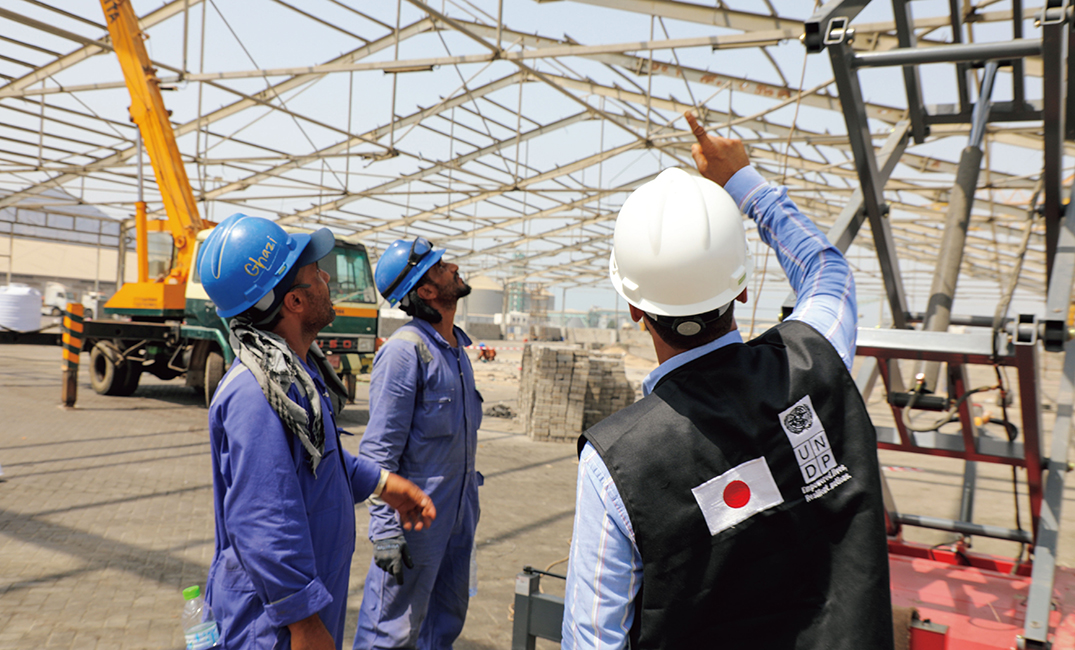
Yemeni workers and UNDP staff engaged in the renovation of a cargo shed at the port to facilitate faster cargo handling under “the Project for the Improvement of Efficiency in the Port of Aden (Partnership with UNDP),” a grant project in Yemen (Photo: UNDP)
1 Japan’s Official Development Assistance in Terms of Disbursement
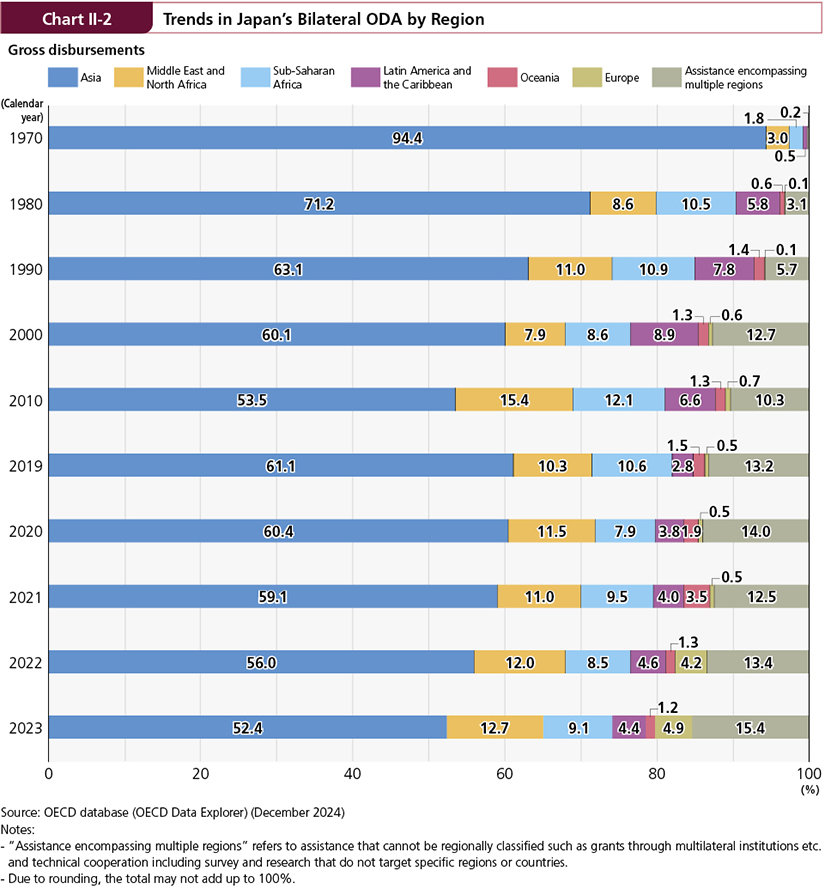
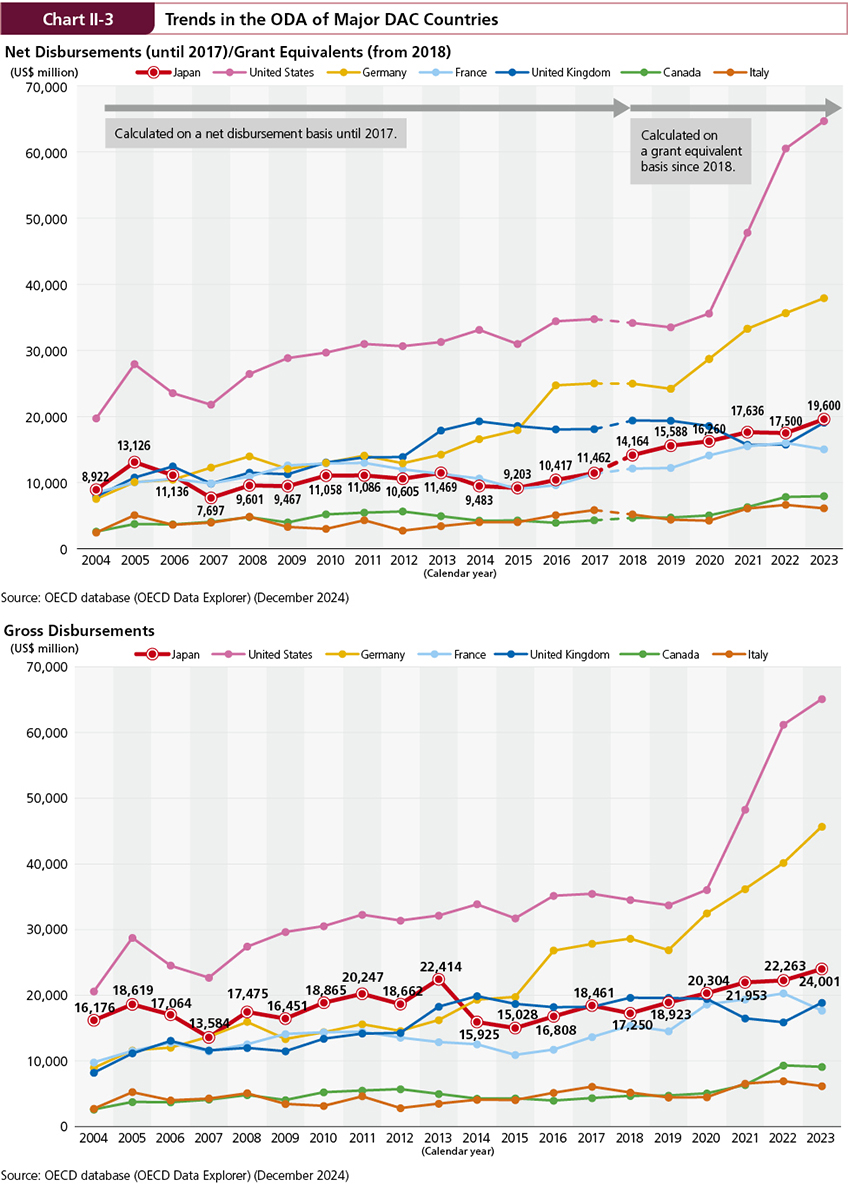
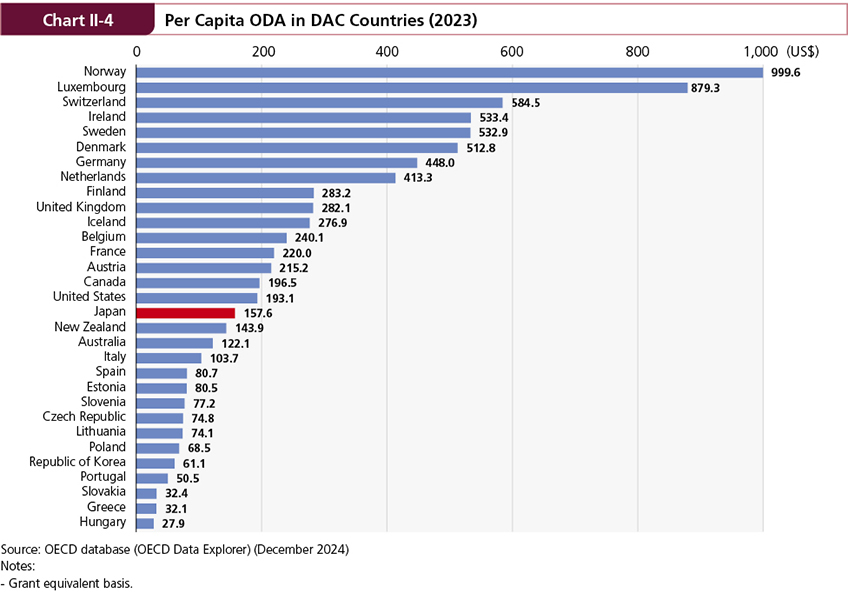
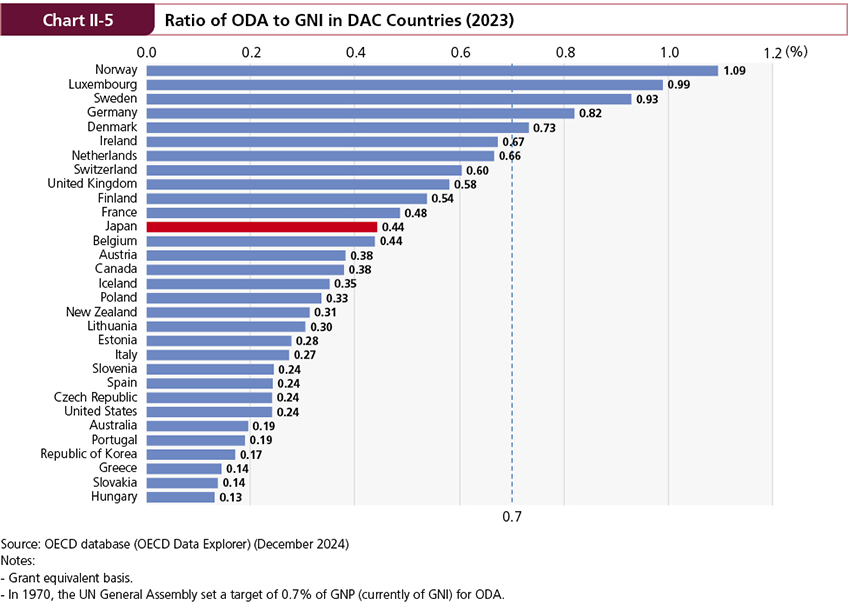
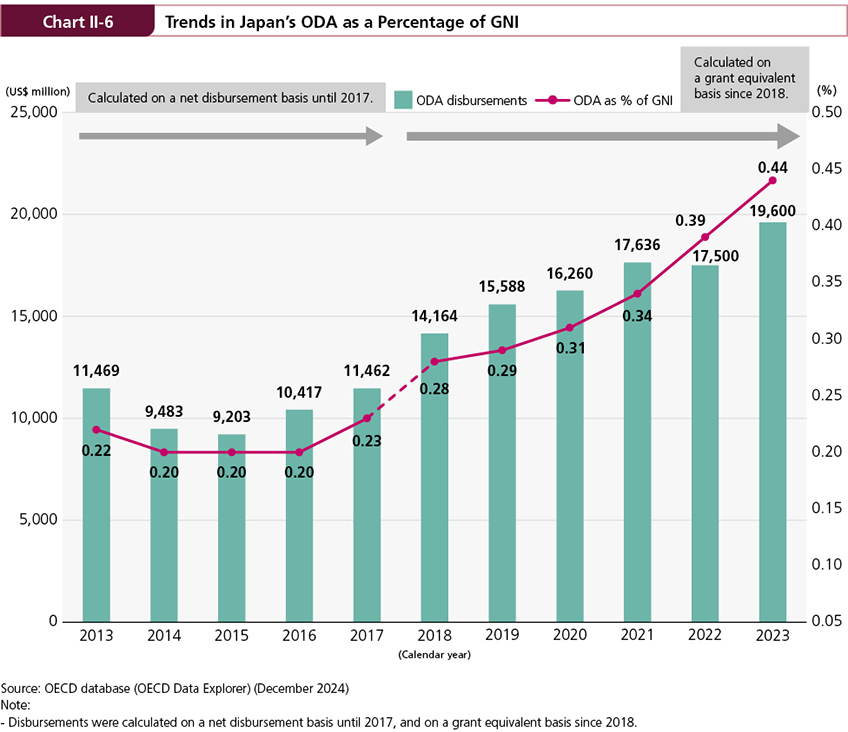
Japan’s total ODA in 2023Note 1, Note 2 was approximately $19,600.37 million (approximately ¥2,754 billion) according to the Grant Equivalent System (GE system)Note 3 introduced from 2018. Among the members of the Development Assistance Committee (DAC) of the Organisation for Economic Co-operation and Development (OECD), Japan has ranked thirdNote 4 following the United States and Germany since 2021. Japan’s ODA as a percentage of Gross National Income (GNI) in 2023 was 0.44% (compared to the international target of 0.7%, and ranked 12th out of 31 DAC countries excluding the EU) (Chart II-5).
The breakdown of Japan’s ODA is as follows: Bilateral ODA accounted for approximately 81.5% of overall disbursements, while ODA to multilateral institutions accounted for approximately 18.5%. Bilateral ODA is expected to contribute to strengthening Japan’s relations with recipient countries. Meanwhile, ODA to multilateral institutions that have expertise and political neutrality enables Japan to provide necessary support more promptly and flexibly, including to countries and regions where direct bilateral assistance from the Japanese government is difficult to reach. Japan will actively provide more effective aid while making flexible use of the above types of assistance and coordinating between them.
As regards bilateral ODA by aid scheme, the funding provided without repayment obligation totaled approximately $4,261.37 million (¥598.7 billion), or approximately 21.7% of total ODA, on a grant equivalent basis. Among this funding, grants through multilateral institutions, etc., accounted for approximately $2,625.81 million (¥368.9 billion), or approximately 13.4% of total ODA. Technical cooperation accounted for approximately $2,238.74 million (¥314.6 billion), or approximately 11.4% of total ODA. With regard to government loans, etc., loan disbursements accounted for approximately $13,882.80 million (¥1,950.6 billion), while the grant equivalent of government loans, etc., totaled approximately $9,481.72 million (¥1,332.2 billion), or approximately 48.4% of total ODA.
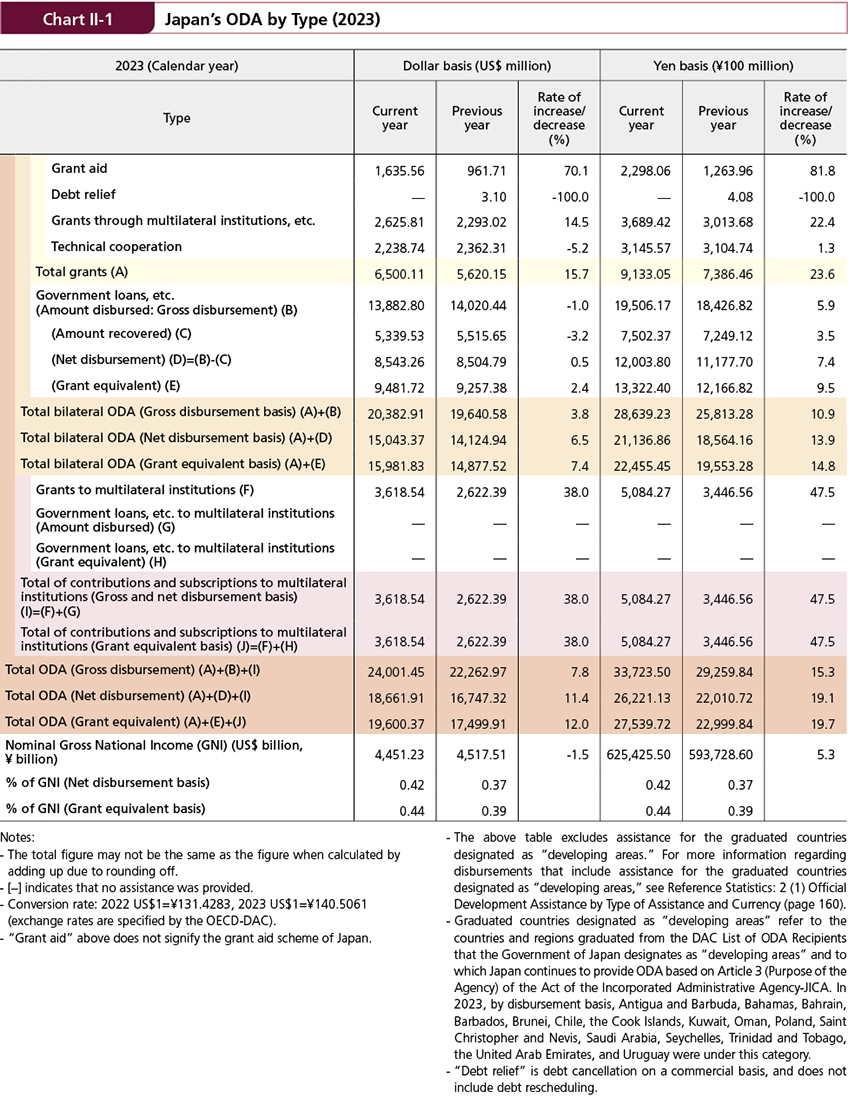
Japan’s bilateral ODA disbursements (excluding support for the graduated countries designated as “developing areas”),Note 5 in descending order by percentage of total disbursements (gross disbursements), are as followsNote 6 (See Chart II-2 for details).
◆Asia: 52.4% (approximately $10,672.10 million)
◆Middle East and North Africa: 12.7% (approximately $2,591.93 million)
◆Sub-Saharan Africa: 9.1% (approximately $1,858.56 million)
◆Europe: 4.9% (approximately $992.44 million)
◆Latin America and the Caribbean: 4.4% (approximately $892.75 million)
◆Oceania: 1.2% (approximately $240.88 million)
◆Assistance covering multiple regions: 15.4% (approximately $3,134.28 million)
- Note 1: DAC members’ final figures for ODA disbursements in 2024 are to be published at or after the end of 2025.
- Note 2: In Part II, “grants” signifies transfers in cash or in kind for which no legal debt is incurred by the recipient, as defined by the OECD-DAC.
- Note 3: The GE system records the amount of government loans, etc., equivalent to a grant as an actual ODA disbursement. The grant equivalent is calculated by applying the terms of the loan, such as the amount of loan provided, interest rate, and repayment period, to a formula. The more concessional the terms of the loan are, the larger the grant equivalent is. This system measures Japan’s actual government loans, etc., more accurately compared to the net flow system, which was the standard used by the DAC until 2017. (The full amount of the loan is recorded; on the other hand, repaid amounts are counted as negative.)
- Note 4: OECD database (OECD Data Explore) (December 2024).
- Note 5: Graduated countries designated as “developing areas” refer to the countries and regions graduated from the DAC List of ODA Recipients that the Government of Japan designates as “developing areas” and continues to provide ODA to, based on Article 3 (Purpose of the Agency) of the Act of the Incorporated Administrative Agency-JICA. In 2023, by disbursement basis, Antigua and Barbuda, Bahamas, Bahrain, Barbados, Brunei, Chile, the Cook Islands, Kuwait, Oman, Poland, Saint Christopher and Nevis, Saudi Arabia, Seychelles, Trinidad and Tobago, the United Arab Emirates, and Uruguay were under this category.
- Note 6: Gross disbursement basis.