
(2) Characteristics of Japan’s ODA
■Quality Economic Growth
Based on its post-war reconstruction experience, Japan has consistently prioritized poverty reduction through inclusive, sustainable, and resilient economic growth. To this end, it has supported the development of industrial foundations and investment environments in developing countries through infrastructure development, industrial human resource development, and legal and institutional reforms. Unlike other major donors who place emphasis on social infrastructure—such as education, health, and water and sewage—Japan’s development cooperation is distinguished by its greater focus on economic infrastructure, including transportation, communication, and power.Note 4 While such project-based large-scale financing for large-scale infrastructure development has sometimes diverged from the approach of European countries, which focuses on fiscal and programmatic support, it has ultimately contributed to the rapid economic growth of developing countries, including Asia, and to poverty reduction, thereby earning high praise from the international community.
Japan advocates that achieving high-quality economic growth in developing countries requires the development of “quality infrastructure”Note 5 that takes into account factors such as openness, transparency, economic efficiency from a life-cycle cost perspective, and debt sustainability. It has played a leading role in promoting this agenda in the international fora such as the G20. In recent years, developing countries have achieved remarkable economic growth, and the challenges they face have become increasingly complex. To address common challenges—such as Green Transformation (GX), Digital Transformation (DX),Note 6 and food and energy security through the strengthening and diversification of supply chains—Japan is working in collaboration with a wide range of stakeholders to implement diverse initiatives.
[Case 2] Eastern Seaboard Development in Thailand
Drawing on its experience in developing coastal industrial zones to foster export-oriented industries, Japan has supported the development of Thailand’s Eastern Seaboard region through a combination of technical cooperation and yen loans. Established as an industrial zone, this region has grown into Thailand’s second-largest economic hub after the capital, Bangkok. It now hosts a wide range of industries—including Japanese companies in the automotive, electrical, and electronics sectors—that are driving the Thai economy. Today, Japan also supports the development of highly skilled industrial human resources to promote growth in emerging industries such as next-generation vehicles and smart electronics, in line with the Thai government’s goals.
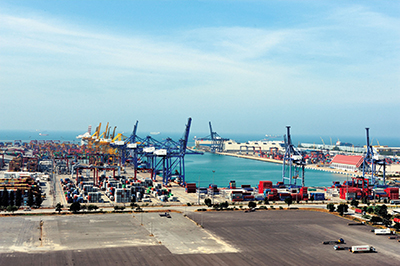
Laem Chabang Port, developed with yen loan assistance, opened in 1991 as an alternative to Bangkok Port, which is too shallow for large vessels. Today, it is Thailand’s largest container port. (Photo: OKUNO Yasuhiko/JICA)
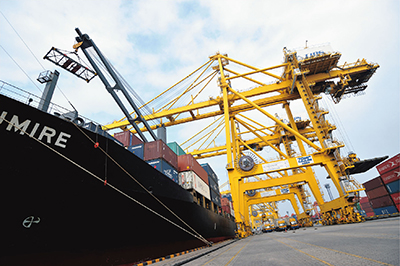
Vessels loading and unloading cargo at Laem Chabang Port (Photo: OKUNO Yasuhiko/JICA)
■Supporting Self-Help Efforts
Japan, once a recipient of development aid, borrowed substantial funds from the World Bank and other sources across a wide range of sectors necessary for post-war reconstruction, laying the foundation for its rapid economic growth. Based on this experience of achieving development through the responsible repayment of loans, Japan places emphasis on encouraging ownership by developing countries in carrying out their own projects. As a result, a consistently high proportion of Japan’s ODA takes the form of loan-based assistance with repayment obligations, based on the belief that such an approach contributes to more effective development cooperation.Note 7
In line with this approach, Japan values the will and autonomy of partner countries, encouraging ownership and engaging in constructive dialogue and collaboration. Japan’s cooperation extends beyond physical infrastructure to capacity building and legal and institutional development. By combining these “structural” and “non-structural” components, Japan has helped lay the groundwork for self-reliant efforts and sustainable development in partner countries.
[Case 3] Capabilities Enhancement of the Philippine Coast Guard (PCG)
Since 2002, Japan has continuously supported the capacity building and human resource development of the Philippine Coast Guard (PCG), which is responsible for maritime safety and law enforcement of the country. This support has ranged from training in law enforcement, safe navigation, and maritime rescue to the development of education systems. The PCG’s personnel has grown from around 4,000 at the time to over 30,000 today. Japan has also provided yen loans to support the construction of two large patrol vessels. Cooperation with the Philippines—located along key sea lanes vital to the Pacific region—contributes to securing maritime safety across the broader Indo-Pacific, thereby promoting regional peace and stability.
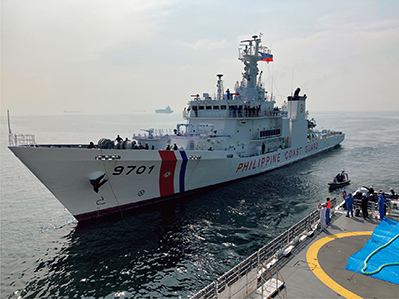
A patrol vessel developed with a yen loan. With a cruising range of more than 4,000 nautical miles, vessels are equipped with devices and equipment necessary for maritime situational awareness and maritime law enforcement activities, including telecommunications equipment capable of monitoring the Exclusive Economic Zone (EEZ), facility for helicopters, remotely-operated unmanned underwater vehicles, and high-speed work boats. These vessels play a crucial role in rescue operations in stormy weather and patrols in offshore and coastal areas. (Photo: JICA)
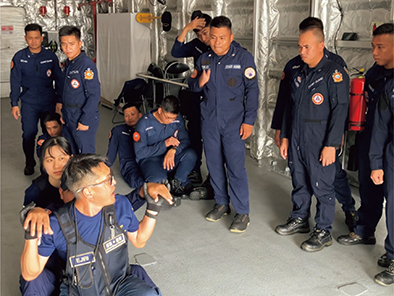
Providing technical training to members of the PCG.
■Human Security
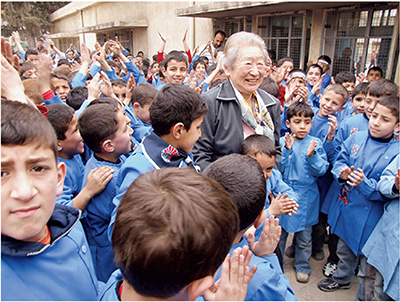
Late Dr. OGATA Sadako, a leading advocate of human security, visiting a school in a Palestinian refugee camp in Aleppo, Syria, in 2008 (Photo: JICA)
The keyword “leaving no one behind” in the SDGs is well-known. While promoting development in developing countries, special attention must be paid to the socially vulnerable. Human security is a concept that focuses on each individual in socially vulnerable positions—such as those suffering from poverty and hunger, victims of natural disasters, war and conflict, as well as women, children, persons with disabilities, and refugees or displaced persons. It promotes nation- and society-building through “investment in people,” including the protection and empowerment of individuals, to enable all individuals to live in dignity, free from fear and want. Japan, in collaboration with international organizations such as the United Nations Development Programme (UNDP), has worked to promote understanding of the concept of human security. It has also delivered support to socially vulnerable populations across a wide range of areas, including responses to intensifying threats such as infectious diseases and climate change; emergency humanitarian assistance related to food, refugees, and natural disasters; and the provision of essential services such as healthcare and education.
The concept of human security serves as a guiding principle that underpins all of Japan’s development cooperation. In addition to “investment in people” through the protection and empowerment of individuals, Japan is committed to development cooperation that places human agency at its core, with solidarity among diverse actors as a central pillar of human security of the new era.
[Case 4] Humanitarian Assistance and Mutual Cooperation Following the Earthquake of Southeastern Türkiye
Immediately after the major earthquake that struck southeastern Türkiye in February 2023, Japan launched emergency relief efforts. It swiftly provided emergency goods such as tents and blankets, and dispatched Japan Disaster Relief Teams. Drawing on Japan’s extensive disaster response expertise, these teams carried out search and rescue operations for missing persons, provided emergency medical care, transported relief goods, and supported recovery and reconstruction through the provision of yen loans. Japan also provided emergency grant in cooperation with international organizations and NGOs. The relationship between the two countries dates back to the 1890 “Ertuğrul Frigate Incident,” when Japan rescued and repatriated members of a Turkish delegation who had been shipwrecked by a typhoon off the coast of Kishu in Wakayama Prefecture. Sharing the common characteristics of being earthquake-prone countries, Japan and Türkiye have maintained a long-standing relationship of mutual support. Notably, during the Great East Japan Earthquake in 2011, Türkiye’s aid/rescue team conducted rescue operations in Miyagi Prefecture.
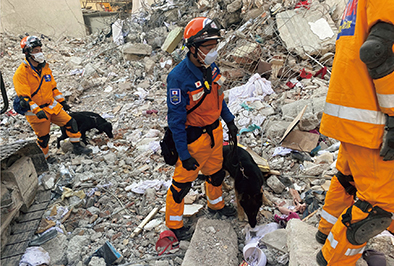
Japanese rescue team and rescue dogs operating in the disaster area following the earthquake with its epicenter in southeastern Türkiye (Photo: JICA)
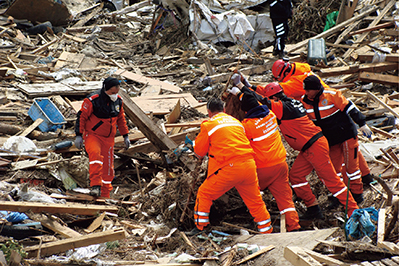
Türkiye’s aid/rescue team carrying out rescue operations in Miyagi Prefecture following the Great East Japan Earthquake
- Note 4: Analysis based on comparison with major DAC countries (United States, United Kingdom, France, Germany, Italy, Canada) using the OECD database. For 2023 results, see Chart II-7.
- Note 5: See Part III, Section 1 (3).
- Note 6: See Note 15.
- Note 7: See Chart II-9 for ODA of DAC Countries by Type of Assistance in 2023