
(3) Significance of ODA
Japan sustains its economy by importing a significant portion of its energy and mineral resources and food, while exporting various products, such as automobiles. If the security of critical maritime routes and regional hubs for Japan’s logistics is not ensured, the supply of oil, gas, food, and other essentials could be disrupted, significantly affecting the daily lives of Japanese people. As evidenced by the frequent spikes in domestic prices caused by conflicts or disasters overseas, Japan and the rest of the world—including developing countries—are bound by a relationship of mutual support and this can only function when peace and economic growth are ensured on both sides.
Engaging in efforts to build relationships with other countries, promote regional stability and development, and address global challenges, as well as creating multi-layered win-win relationships with partner countries through these efforts, constitutes an essential contribution to ensuring the peace and safety of Japan and its people, in addition to generating further prosperity through economic growth.
■Trust and Mutual Support Fostered Through 70 Years of ODA
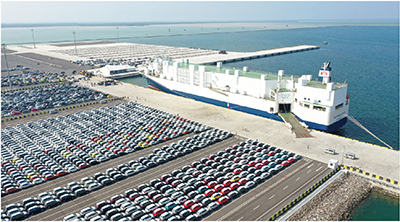
An automobile and container terminal at Patimban Port, Indonesia (Photo: Oriental Consultants Global Co., Ltd.)
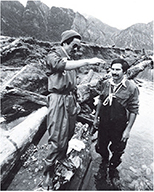
A JICA expert working on salmon farming in Chile, where wild salmon did not exist (Photo: JICA)
Japan has contributed to addressing the challenges faced by developing countries through ODA, one of its key diplomatic tools, thus fostering strong bilateral relationships.
Japan’s ODA, which has continued for 70 years, has steadily cultivated the trust of the international community, including developing countries. In an opinion poll conducted annually since 2019 in Southeast Asia by the ISEAS-Yusof Ishak Institute, a prominent think tank in Singapore, Japan has been selected as the most trusted partner for ASEAN among major powers for six consecutive years. Additionally, the Japanese passport allows visa-free travel to more than 190 countries, demonstrating the friendly and trusting relationships Japan has built with other countries through various forms of cooperation, including ODA.
Japan’s cooperation through ODA has not only contributed to building friendly bilateral relations, but also supported Japan’s own economic and social development.
First, ODA has supported the economic growth of partner countries while also contributing to the overseas expansion of Japanese companies. For example, at Patimban Port, which serves as a logistics hub in Indonesia, Japan—drawing on its advanced technologies in landfill ground improvement and quay wall construction as a fellow island nation—supports the construction of container and automobile terminals, as well as access roads connecting to existing highways. These efforts help improve logistics efficiency in the Jakarta metropolitan area, enhancing Indonesia’s investment environment and contributing to its economic growth. In 2021, a Japanese-led business consortium began operating the automobile terminal, and Japanese companies that had entered the Indonesian market started full-scale automobile exports from the port. Given its proximity to industrial parks where many Japanese companies, particularly in the automotive sector, are located, the port is expected to boost exports from Indonesia and bring benefits to Japanese businesses as well (see [Case 2] for the Eastern Seaboard Development in Thailand).
In addition, ODA has contributed to ensuring and maintaining maritime safety and freedom of navigation. Safe navigation of vessels on international routes is of great importance for world trade. For Japan, which depends on maritime transport for approximately 99% of its imports and exports, it is also essential for the stable supply of materials to the country and the export of manufactured products, such as automobiles. For example, in the Strait of Malacca, the Singapore Strait, and the waters off the coast of Somalia and in the Gulf of Aden—critical points along the sea routes for importing energy resources such as crude oil and other goods to Japan, and where many Japan-related vessels operate—Japan has contributed to the safe navigation of vessels, and by extension, the stable supply of materials to Japan, by strengthening the capacity of maritime safety agencies in coastal countries and developing patrol vessels through ODA (see [Case 3] for support to the Philippine Coast Guard, and Part III, Section 2 (2) for maritime safety).
Furthermore, ODA contributes to Japan’s food security while also supporting the industrial development of partner countries. For example, on Japanese dining tables, one can find food products that have resulted from industrial development in developing countries supported by Japan’s ODA, which later led to exports to Japan. One such case is Chile—a country that was not even a natural habitat for salmon—to which Japan provided cooperation for about 20 years beginning in 1969, including the transfer of aquaculture technology. Since then, Chile has developed into one of the world’s leading salmon exporters. Today, about 30% of the salmon consumed in Japan is imported from Chile. It was also Japan’s ODA that introduced octopus pot fishing to Mauritania shortly after its independence. At that time, there was no culture of seafood consumption in the country and the fishing industry did not exist, but now octopus fishing has grown into a major industry, accounting for about 86% of the country’s seafood exports. Japan has long supported Mauritania’s fisheries sector beyond octopus fishing, and about 40% of the octopus imported by Japan comes from Mauritania. Japanese tuna longline fishing vessels also operate in Mauritanian waters. These mutually beneficial relationships, built over many years, contribute to securing a stable supply of food for Japan.
■Development Cooperation Knowledge that Also Benefits Domestic Challenges in Japan
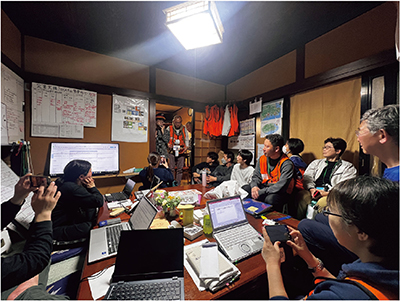
A preparation meeting for evacuation center support by the Japan Overseas Cooperative Association, Social Welfare Corporation Bussi-en, and JICA (Photo: JICA)
The knowledge and experience gained from development cooperation overseas has proven to be equally valuable in addressing domestic challenges in Japan. For example, in the aftermath of major earthquakes—including the 2004 Niigata Chuetsu Earthquake, the 2011 Great East Japan Earthquake, the 2016 Kumamoto Earthquake, and the 2024 Noto Peninsula Earthquake, the experiences gained through overseas initiatives such as the JICA Volunteer Program and peacebuilding assistance have been utilized in disaster response efforts in Japan. In the case of the recent Noto Peninsula Earthquake, the Japan Overseas Cooperative Association (JOCA)—an organization primarily composed of ex-Japan Overseas Cooperation Volunteers (JOCVs)—partnered with a local social welfare corporation to launch relief efforts in the immediate aftermath of the disaster. These efforts were centered around community exchange facilities that had been established jointly with local governments during normal times. Together, they support early-stage relief as well as longer-term recovery and reconstruction. JICA also worked in partnership with JOCA and the local social welfare corporation to support the operation of evacuation centers. In parallel, JICA dispatched staff to disaster-affected local governments, assessed the impact on foreign technical intern trainees, and provides medium- to long-term assistance, from the immediate emergency response through to recovery and reconstruction (see “Master Techniques from Japan to the World” for an example of how cooperation on volcanic disaster prevention projects in Indonesia has informed disaster prevention efforts in Japan).