
MASTER TECHNIQUES from Japan to the World 2


Protecting the Lives of People in Indonesia from Volcanic Disasters with Japanese Sediment Disaster Control Technology, Known as Sabo
– Building Sabo Infrastructure for Disaster Preparedness and Use during Normal Times –
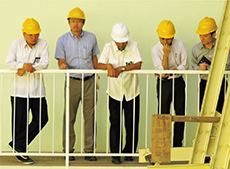
Mr. Mizoguchi (second from the left) with staff from Indonesian companies involved in the construction of the sabo facility (Photo: Yachiyo Engineering Co., Ltd.)
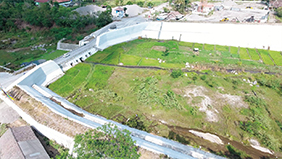
A sabo dam that is used as a bridge during normal times (Photo: Yachiyo Engineering Co., Ltd.)

Mr. Fukushima with staff from Indonesian companies involved in the construction of the sabo facility (Photo: Yachiyo Engineering Co., Ltd.)
Indonesia is one of the world’s most volcanic countries with 130 active volcanoes. Among them, Mount Merapi, located in central Java Island, is one of the most active volcanoes in the world, erupting every 5 to 10 years. While residents living at the foot of the volcano benefit from fertile volcanic ash soil and abundant spring water, they are also exposed to the threats of pyroclastic and debris flows.
In the wake of the 1969 eruption of Mount Merapi, the Government of Indonesia began implementing measures to mitigate debris flow disasters using sediment disaster control technology known as sabo and sought cooperation from Japan. Sabo is a technology that controls the movement of debris flows with structuresNote 1 to protect people’s lives and livelihoods from sediment-related disasters. Japanese sabo technology, developed through years of disaster experience, is renowned worldwide, to the extent that the word “SABO” is used even in foreign languages.
Japan began its support in 1970 by dispatching a sabo expert, and in 1977, assisted with the formulation of a master plan for land erosion and volcanic debris control. Based on this master plan, approximately 250 sabo facilities were constructed to date, including projects funded by Japanese ODA Loan. These facilities have repeatedly captured debris flows, protecting the lives and livelihoods of residents. However, the eruption of Mount Merapi in 2010 was the largest in the past 100 years, releasing volcanic debris equivalent to 28 times the amount estimated in the master plan, causing significant damage. Therefore, in 2015, through ODA Loan, Japan supported the construction of sabo facilities to channel and store debris flows and to revise the master plan for land erosion and volcanic debris control, so as to address issues such as debris flows occurring in rivers at the foot of Mount Merapi and unexpected debris flows caused by changes in terrain.
Mr. MIZOGUCHI Masaharu, Deputy Director General of the International Division at Yachiyo Engineering Co., Ltd., who participated in these Japanese ODA Loan projects, reflects on the challenges and how his company overcame them. He explains, “We modified the design of sabo facilities each time the surveyed terrain changed due to heavy rain or floods. Based on the characteristics of riverbed fluctuations in Indonesia’s volcanic regions, we made various improvements, such as placing the foundations of sabo dams at deeper positions than those in Japan to enhance durability. Also, since there was a risk of debris flows and flash floods during construction, we ensured workers’ safety by strengthening evacuation systems specifically for such events in addition to normal safety management.”
Reflecting on how Japanese technology was applied locally in response to the evolving needs of the partner government, he recalls, “In the 1980s, when Indonesia was undergoing economic development, employment was the national priority. Therefore, labor-intensive construction methods such as stone masonry utilizing inexpensive labor were widely used. In the late 1990s, when it was hit by the Asian financial crisis, there was a demand for efficient infrastructure development with limited budgets. This led to the active promotion of multi-functional sabo facilities that could also be used as bridges or intake weirs during normal times. In recent projects, as economic development progressed, to maintain higher quality structures, factory-mixed concrete transported to sites began to be used as construction material instead of stone masonry and on-site mixed concrete, which were used before.” He adds, “I believe that our ability to respond to the demands of each era led to trust in Japan.”
Mr. FUKUSHIMA Junichi, who has a deep understanding of field operations as the General Manager of the company’s Jakarta office, says, “We also made efforts to build relationships with local governments and residents, and tried to reflect their voices by designing multi-functional sabo facilities that can be utilized even outside of emergency situations. Local residents use the sabo facilities during normal times and are conscious that these are their own facilities. We often hear from them that they are now able to lead stable lives thanks to sabo,” expressing his sense of contribution to the improvement of local lives.
The knowledge gained through technical cooperation on sabo in Indonesia was also applied to disaster prevention in Japan, such as in the volcanic debris flow control project at Mount Unzen Fugen-dake. Mr. Mizoguchi states, “Japan’s technical cooperation overseas is by no means one-sided. It brings mutual benefits. I would like to continue to be involved with a focus on mutual cooperation moving forward.”
Note 1 Such as a dam or a levee built with stone and/or concrete, etc. to stem the flow of water or sediment from rivers and valleys.
<< Previous Page Next Page >>
Main Text | Reference Statistics | Stories from the Field | Master Techniques from Japan to the World | ODA Topics