
MASTER TECHNIQUES from Japan to the World 1

Improving Public Safety through Optimizing Patrol Operations Using Demonstrative AI
– Introducing Cutting-Edge Digital Technology to the Brazilian Police to Enhance Operational Efficiency –
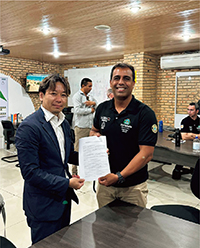
Mr. Kurachi (on the left) participating in the signing ceremony with the Fortaleza Public Safety Department (Photo: Singular Perturbations Co., Ltd.)
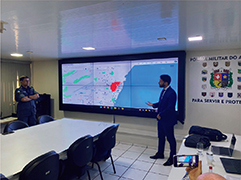
Mr. Kashihara (on the right) explaining the crime prediction system “CRIME NABI” to the Amapa State Military Police (Photo: Singular Perturbations Co., Ltd.)
Brazil is a country with one of the highest crime rates in the world, experiencing numerous violent crimes such as homicide and armed robbery. While improving and maintaining public safety is a critical issue, the country faces challenges in conducting sufficient patrol and surveillance activities for crime prevention due to police personnel shortages and other issues.
Singular Perturbations Co., Ltd. (hereinafter “SP”) addresses these challenges using its unique crime prediction system powered by artificial intelligence (AI). SP is a Japanese company that develops and provides CRIME NABI, a system that predicts when and where crimes will occur with high precision and speed, using its unique methodology based on theoretical physics frameworks, analyzing information such as regional crime statistics, population, weather, building structures, and road types. The company was founded by an entrepreneur who was a victim of pickpocketing in Italy, which inspired her to develop CRIME NABI. They were facing difficulties in developing a market for their product in Japan, where public safety is relatively good, but as they explored business models for overseas expansion, they eventually found opportunities in Brazil.
”Unlike Japan, which emphasizes responding to crimes after they occur, Brazil has a high need for crime prevention,” explains Mr. KURACHI Takamasa, Representative/Administrator of the Brazil office. “Police organizations in growing urban areas operate 24 hours a day to prevent crime, but they are understaffed, with one person monitoring footage from 20 surveillance cameras. There is high demand for CRIME NABI, which can produce more precise and real-time crime prediction information.”
In June 2023, SP began providing patrol operation support services utilizing crime prediction to state and municipal police through the SDGs Business Supporting Surveys (JICA Biz).Note 1 “I think a private company alone would have had difficulties in even arranging a meeting with the Brazilian municipal police,” says Mr. Kurachi, emphasizing the advantages of leveraging JICA’s program. “Japan’s long-standing support for public security improvement in Brazil—particularly through the introduction of the Japanese-style community policing model—helped us in gaining the trust and understanding from the country’s police organization.”
“The police organization was cautious about providing crime statistics to external parties for security reasons. We therefore decided to provide tools that allow them to analyze data within their own organization to identify high-crime areas and times, as well as a system to formulate crime prevention surveillance operation plans,” explains Mr. Kurachi, describing how the business model was adapted to local circumstances. “With CRIME NABI, if they can predict, for example, that ‘at this location, under these weather conditions, crimes are likely to occur at this time,’ it would be possible to conduct more efficient patrols. In addition, by supporting the formulation of prioritized surveillance camera lists, targeted and effective monitoring would also be possible.”
From August 2023, SP conducted a two-month demonstration experiment targeting copper cable theft in Belo Horizonte, the capital of Minas Gerais State, which is Brazil’s second-largest state by population and third-largest by economic scale. They had turned their attention to the rapid increase of copper cable theft in the city, affecting traffic signals and power supply to factories and hospitals. As a result, the number of theft incidents decreased by 69%, from 543 cases in the two months before the experiment to 171 cases, demonstrating the system’s effectiveness. From December 2023, Belo Horizonte’s municipal guardNote 2 began its operational use of CRIME NABI. As of September 2024, when the JICA Biz ended, SP had signed trial contracts to begin demonstrative experiments with five agencies across five states, including the military police of São Paulo, where many Japanese companies are located. They are also in discussions with six agencies in six states toward signing trial contracts. Furthermore, in addition to government agencies, they are continuously discussing business development with private companies, focusing specifically on the mining and oil industries, which are prone to crime, since they handle critical resources across vast areas.
”In the future, we would like to form partnerships with police organizations in all states in Brazil. We also hope to expand our business to other Latin American countries facing public safety challenges, such as Honduras, Uruguay, and Mexico,” says Mr. Henrique Kashihara, General Manager of the Brazil office, regarding future prospects.
Note 1 See the glossary.
Note 2 Brazil has multiple police organizations, including the Federal Police, State Military Police, Civil Police, and Municipal Guards. The Military Police are responsible for outdoor patrols, while the Municipal Guards oversee city surveillance camera monitoring for crime prevention.
Next Page >>
Main Text | Reference Statistics | Stories from the Field | Master Techniques from Japan to the World | ODA Topics