
(2) Ensuring Safety and Stability in Society
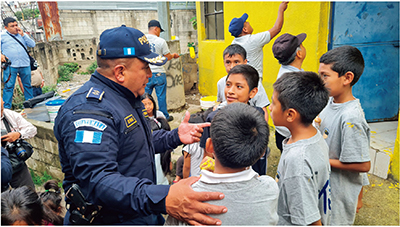
A community policing project through the promotion of the Koban system (Japanese-style neighborhood police box system) in Guatemala (Photo: JICA)
Japan is an island country surrounded by the sea, and it depends on maritime transport for more than 99.5% of its imports such as energy resources and food. Therefore, Japan has been addressing maritime threats and developing technologies to ensure the safety and security of marine traffic. Ensuring the safety of maritime transport, including addressing threats in critical maritime transport, and human resources development for the safe use of shipping routes are issues that directly affect national existence and prosperity, including in developing countries. Japan promotes the realization of a Free and Open Indo-Pacific (FOIP), and a free and open maritime order based on the rule of law is vital for the realization of FOIP. To this end, Japan, in collaboration with like-minded countries and international organizations, is advancing its efforts in maritime security cooperation, including ensuring the safety of maritime transport.
Transnational organized crime and acts of terrorism also continue to pose a threat to the entire international community. Effective response to these threats cannot be achieved by the efforts of a single nation alone. Therefore, in addition to strengthening countermeasures by individual nations, the entire international community must work together through capacity building assistance in the fields of justice and law enforcement in developing countries.
As a State Party to the UN Convention against Transnational Organized Crime (UNTOC), a legal framework for preventing transnational organized crime, Japan is promoting international cooperation based on the Convention, including mutual legal assistance. Additionally, Japan is engaged in international efforts to combat transnational organized crime, including countermeasures against illicit drugs (see Part III, Section 1 (2) for measures against threats to cyberspace).
●Japan’s Efforts
■Enhancing the Capabilities of Security Authorities
Based on their achievements and experiences in international cooperation, Japanese police provide support for establishing institutions, improving administrative capacities, and developing human resources, through the transfer of knowledge and skills to police agencies in developing countries, who play a key role in maintaining security.
As one example, the National Police Agency (NPA) of Japan has been dispatching experts and providing training and technical cooperation to Indonesia since 2001. In 2024, the NPA received executive candidates from Indonesia at the Hyogo Prefectural Police and conducted training, as part of a program to support the reform of the country’s National Police. The NPA also accepts trainees from countries in Asia, Africa, and Oceania to show them the ways of the Japanese police.
■The Seas
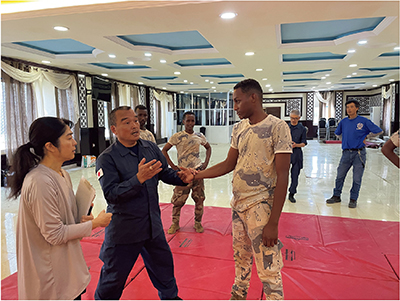
Arresting techniques training conducted under the “Project for Capacity Development of Djibouti Coast Guard Phase III” in Djibouti (Photo: Japan Coast Guard)
In order to establish and promote the rule of law at sea, Japan seamlessly supports building the law enforcement capacities of maritime security agencies in the Indo-Pacific region through the provision of patrol vessels and technical assistance, while also promoting cooperation among developing countries for capacity building in Maritime Domain Awareness (MDA). Specifically, Japan provides vessels and maritime security-related equipment to the Philippines, Viet Nam, and other countries, while facilitating human resources development through training programs and expert dispatch to littoral countries along sea lanes important to Japan, including Indonesia and Malaysia.
Japan’s support extends to areas such as the following; (1) Support for improving the capacity to create nautical charts that comply with international standards necessary for safe navigation of ships, (2) Training for maritime security agencies on maritime law enforcement and maritime rescue through international organizations such as the United Nations Office on Drugs and Crime (UNODC), and (3) Training of personnel involved in the operation of vessel traffic services (VTS) aimed at improving the safety of maritime traffic and alleviating congestion in shipping lanes (see the Ministry of Foreign Affairs (MOFA) website for Efforts for a free and open oceanNote 46). Furthermore, Japan supports Pacific Island countries, such as Samoa and the Federated States of Micronesia, through the provision of patrol vessels and other equipment related to maritime security and safety, as well as through grant projects such as the “Project for Strengthening Capacity of Maritime Law Enforcement Agencies for Effective Maritime Crime Control in the Pacific Island Countries (UN Cooperation / UNODC Implementation).” In addition, following the endorsement at the Japan-Australia-India-U.S. (Quad) Leaders’ Meeting in 2022 of the “Indo-Pacific Partnership for Maritime Domain Awareness (IPMDA)” to promote information sharing related to MDA, Japan has been providing non-structural support through UNODC to countries in the region. This includes capacity building for detecting dark ships that do not show their position information via the Automatic Identification System (AIS), thereby assisting these countries to better monitor activities, including illegal activities, in their exclusive economic zones.
As part of its efforts to promote regional cooperation in countering piracy and armed robbery against ships in Asia, Japan led the formulation of the Regional Cooperation Agreement on Combating Piracy and Armed Robbery against Ships in Asia (ReCAAP), and has been supporting comprehensive training aimed at building capacity for maritime law enforcement agencies of the ReCAAP Contracting Parties. In 2024, 13 ReCAAP Contracting Parties participated in the training program. Each country shared their best practices, which contributed to the participating countries deepening their knowledge related to anti-piracy and to promoting cooperation among coastal countries.
Japan has been conducting anti-piracy operations since 2009 in order to counter the threat of piracy off the coast of Somalia and in the Gulf of Aden in Eastern Africa. Furthermore, Japan contributed to the trust fund established by the International Maritime Organization (IMO) to implement the Djibouti Code of Conduct,Note 47 and, through this fund, established the information-sharing centers for anti-piracy measures and the Djibouti Regional Training Centre. This Regional Training Centre is used for training programs that aim to improve the maritime security capabilities of the neighboring countries of Somalia, and is used by Japan and other like-minded countries including EU member countries.
In 2024, Japan also provided support through UNODC to strengthen the capacity of maritime law enforcement agencies to address maritime crime and piracy in Eastern Africa, the Gulf of Guinea as well as the Red Sea.
In cooperation with the Japan Coast Guard, Japan also conducts “maritime law enforcement training courses” to combat piracy in Asia and the waters off Somalia. In 2024, 21 maritime security officers from 17 countries participated in the course. Recognizing that the reconstruction and stability of Somalia are essential for a fundamental solution to the piracy issue in the area, Japan has disbursed a total of $599 million since 2007 for the restoration of basic social services, improvement of law enforcement capabilities, and revitalization of domestic industries in Somalia.
Oil spills from ships that occur at sea not only have an impact on the safe navigation of ships passing through, but can also cause fatal damage to the fishery and tourism industries of coastal countries by polluting the coast. Hence, it is important to strengthen the capacity for dealing with such oil spill incidents.
The International Hydrographic Organization (IHO) has conducted an annual training program in the United Kingdom since 2009, to train nautical chart experts in developing countries under the auspices of the Nippon Foundation and has produced 98 graduates from 51 countries by December 2023. The IHO and Intergovernmental Oceanographic Commission (UNESCO-IOC) are engaged in a joint project to create the General Bathymetric Chart of Oceans (GEBCO), a topographical map of the world’s seafloor. The map is under revision through the cooperation of experts around the world, including the Hydrographic and Oceanographic Department of the Japan Coast Guard.
■Outer Space
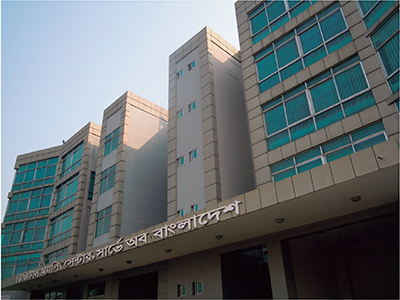
A candidate site for the installation of the GNSS CORSs Management System (equipment to manage GNSS CORSs data, consisting of Data Center Unit and Software) under “The Project for the Densification of Global Navigation Satellite System Continuously Operating Reference Station Network and the Modernization of Tidal Stations in Bangladesh” (Photo: JICA)
Japan contributes to addressing global issues, such as climate change, disaster risk reduction, marine and fishery resource management, agriculture, forest conservation, as well as natural resources and energy, through the implementation of development cooperation and capacity building assistance utilizing space technology.
The international cooperation project “Sentinel Asia,” which aims to contribute to disaster management in the Asia-Pacific region utilizing earth observation satellites, began its activities in 2006 under the leadership of the Japan Aerospace Exploration Agency (JAXA). Currently, 123 organizations, including space agencies and disaster management organizations, are members of the project, and have responded to more than 490 emergency observation requests. In addition, through the Global Satellite Mapping of Precipitation (GSMaP), which analyzes and integrates various satellite observation data, Japan provides global precipitation information, contributing to the estimation of precipitation in areas where ground observation networks are absent. Japan also provides capacity building assistance for national meteorological agencies in Africa and the Asia-Pacific region. In FY2023, Japan conducted a training program for the use of GSMaP with more than 50 participants. Moving forward, Japan will publish guidelines for the use of GSMaP to further contribute to capacity building in relevant countries.
Japan also proactively provides assistance in the field of human resources development for emerging countries in their efforts toward space development and utilization. In particular, Japan’s initiatives, such as providing opportunities to utilize the space environment and the deployment of CubeSats by making use of the Japanese Experiment Module “Kibo” on the International Space Station (ISS), are highly acclaimed in the international community. From June to December 2023, a new round of application to the “KiboCUBE” programNote 48 (the 8th round) was opened, resulting in the adoption of a joint proposal from agencies of Tanzania and Côte d’Ivoire. As of 2024, in addition to the agencies selected in the 8th round, the Central American Integration System (SICA) and Mexico, chosen in previous rounds, are developing CubeSats under the program.
Japan provides capacity building assistance to emerging space-faring nations in the development and implementation of domestic space-related laws in order to contribute to the realization of the rule of law in outer space. Since the start of its cooperation in FY2021 on the “Space Law for New Space Actors Project” led by the United Nations Office for Outer Space Affairs (UNOOSA), Japan has been providing assistance toward emerging space-faring nations in the Asia-Pacific region to develop and implement domestic space-related laws and regulations. Japan also contributes to building the legal capacity emerging space-faring nations need to properly manage and supervise their space activities, including private-sector activities. In FY2024, Japan conducted legal capacity building assistance to the Philippines and Thailand, with a focus on the supervision and licensing of space activities.
■Counter-Terrorism
Terrorism continues to occur around the world, and counter-terrorism remains an important issue for all countries. With the easing of international travel restrictions that were put in place in response to COVID-19, challenges that existed priorly, such as measures against terrorist movements and border control, have once again come to the fore
In recent years, with the internet and social media being widely used, violent extremist ideologies have been increasingly disseminated online. Additionally, challenges are arising due to online fraud, money launderingNote 49 and terrorist financing through the exploitation of the cryptocurrencies system, as well as new forms of terrorism misusing emerging technologies such as drones. It is necessary for countries worldwide to cooperate more than ever, not only through the United Nations and the G7, but also through regional initiatives such as ASEAN.
In May 2024, Japan held the 6th Meeting of the Japan-India Joint Working Group on Counter-Terrorism in New Delhi, India. During the meeting, the two sides exchanged views on the global terrorism situation and threat perception, as well as countermeasures against terrorism involving the misuse of emerging technologies, against radicalization and terrorist financing. Through such efforts, Japan continues to work toward reducing the global risk of terrorism in cooperation with other countries.
■Countermeasures against Illicit Drugs
Japan proactively makes efforts to combat illegal drugs as an issue to be tackled globally. While actively participating in relevant international conferences such as the Commission on Narcotic Drugs (CND) under the UN, Japan also provided financial contributions to the UNODC in 2024 to monitor the distribution of illicit drugs, including new compounds,Note 50 strengthen border control capabilities, and continuously survey the illegal cultivation of opium poppy, a raw material used in drug production, in cooperation with related organizations in Southeast Asia and other countries.
In addition, the NPA invites officials from countries mainly in the Asia-Pacific region to share information on the regional drug situation, relevant investigation measures, and modes of international cooperation, and to strengthen cooperative structures.
■Measures against Trafficking in Persons
Based on the “Protocol to Prevent, Suppress and Punish Trafficking in Persons Especially Women and Children,” a comprehensive international agreement concerning trafficking in persons,Note 51 as well as Japan’s “2022 Action Plan to Combat Trafficking in Persons,” Japan is engaged in various efforts to eradicate trafficking in persons.
Japan provides support to foreign victims of trafficking who are sheltered in Japan through its contribution to the International Organization for Migration (IOM). The support includes assistance for their safe return to home countries and for their independence and social rehabilitation, including mental healthcare, medical assistance and vocational training. Japan supports measures against trafficking in persons and efforts to strengthen law enforcement capacity in Southeast Asia and other countries, through bilateral technical cooperation and financial contributions to projects delivered by UNODC and other UN agencies. In addition, Japan provides financial contributions and participates in the Bali Process, an Asia-Pacific regional framework against people smuggling, trafficking in persons, and related transnational crime.
■International Measures against Money Laundering and Terrorist Financing
There is a high risk for the proceeds of transnational organized crime to be used to finance further organized crime or acts of terrorism. Thus, eliminating such illicit financial flows is an important task for the international community. From this viewpoint, Japan actively participates in discussions on international measures against money laundering and terrorist financing through intergovernmental frameworks such as the Financial Action Task Force (FATF).Note 52 In order to implement effective global measures against money laundering and terrorist financing, each country needs to properly implement the international standards in this field set by the FATF so as not to create loopholes in countermeasures. Therefore, assistance for countries and regions with insufficient capacity and resources to deal with money laundering and terrorist financing contributes to the improvement of international measures to counter money laundering and terrorist financing. Japan provides assistance for FATF-Style Regional Bodies, a network which promotes the effective implementation of FATF standards by non-FATF member countries, including through mutual evaluations among member countries, with a particular focus on supporting technical assistance activities conducted by the Asia Pacific Group on Money Laundering (APG), a FATF-Style Regional Body in the Asia-Pacific region.
- Note 46: Efforts for a free and open ocean https://www.mofa.go.jp/mofaj/gaiko/oda/sanka/page22_001603.html (in Japanese only)
- Note 47: A regional cooperation framework for Somalia and its neighboring countries.
- Note 48: A cooperation program between the United Nations Office for Outer Space Affairs (UNOOSA) and JAXA that provides developing countries with the opportunity to deploy CubeSats from “Kibo.”
- Note 49: The act of disguising funds acquired through criminal activity as legally-obtained assets, or the act of concealing such funds. One example of such act is when narcotic drug dealers hide drug trafficking proceeds in bank accounts opened under a false name.
- Note 50: New Psychoactive Substances (NPS). Also known as “designer drugs.” These are substances that are synthesized to produce effects similar to those of regulated drugs (narcotics, etc.). They are not recognized as legal medicines, and are compounds that exhibit psychotropic effects that are not yet regulated.
- Note 51: A crime that involves placing vulnerable individuals, especially women and children, under control or transferring them by means of violence, threat, abduction, or fraud, for the purpose of exploitation, including forced prostitution, sexual services, or labor (see also Article 3 (a) of the Protocol to Prevent, Suppress and Punish Trafficking in Persons Especially Women and Children).
- Note 52: Established based on the Economic Declaration of the Arch Summit (G7 Summit) in 1989.