
(3) Legal technical assistance and assistance for Democratization
Achieving “quality growth” in developing countries requires a solid social foundation that guarantees individual rights, enables people to engage in economic and social activities in security and with confidence, and is governed in a fair and stable manner. To build such a foundation, it is essential to foster a shared commitment to universal values, such as freedom, democracy, respect for fundamental human rights, and the rule of law, while also securing good governance and ensuring peace, stability, and safety.
In such context, corruption involving public officials, such as bribery and embezzlement, can hinder fair competition and undermine the sound economic growth of developing countries. To realize fair and stable societies, donor countries need to support good governance, including efforts to combat corruption.
Reinforcing the foundations of democracy through citizen participation in governance and development, as well as the protection and promotion of human rights is essential for achieving medium- to long-term stability and development in developing countries. In particular, it is important to support developing countries that are actively working toward democratization, including through assistance in holding fair and transparent elections, and in strengthening the media’s role in ensuring the public’s right to information and protecting freedom of expression.
●Japan’s Efforts
■Legal technical assistance
Japan has been actively supporting the development of legal and judicial systems to help establish the rule of law, promote good governance, foster and entrench democratization, uphold fundamental human rights, and improve investment. This support includes assistance on legal and judicial reforms, legislative drafting, capacity development for national and local government officials responsible for implementing and enforcing law, strengthening audit functions, and developing legal frameworks in areas such as civil law, competition law, intellectual property rights, taxation, auditing, and public investment. These efforts have been carried out in countries such as Bangladesh, Cambodia, Fiji, Indonesia, Kenya, Kyrgyz, Laos, Mongolia, Nepal, Sri Lanka, Timor-Leste, Uzbekistan, and Viet Nam. For instance, in Cambodia, the prolonged civil war that lasted over two decades until the 1990s resulted in the abolition of many laws and the mass killing of intellectuals, including legal professionals. Therefore, significant challenges remain in establishing the proper interpretations and application of civil law. In response, Japan has been supporting the drafting and dissemination of civil laws for over 20 years, while also assisting in the training and development of legal professionals, including judges, who are responsible for applying these laws.
Following the 2023 G7 Hiroshima Summit, where support for Ukraine’s legal system reform—particularly in the judicial sector and the promotion of the rule of law—was affirmed, the Anti-Corruption Task Force for Ukraine was established at the G7 Justice Ministers’ Meeting in July of the same year, based on Japan’s proposal. The task force aims to formulate effective anti-corruption support programs and prevent duplication of these programs. In November 2024, the third meeting was held in Tokyo and had robust discussions, bringing together about 40 participants from the justice ministries of G7 countries, the EU, international organizations including the United Nations, and Ukraine’s anti-corruption agencies.
Japan also takes a leading role in the implementation of the “Kyoto Declaration”Note 53 adopted at the 14th United Nations Congress on Crime Prevention and Criminal Justice (Kyoto Congress)Note 54 held in Kyoto in March 2021. In June 2024, Japan convened the 3rd “Criminal Justice Forum for Asia and the Pacific” (Crim-AP), where criminal justice practitioners from 23 countries and organizations in the region actively exchanged views on asset recovery of transnational crime and treatment of women offenders in prisons. Furthermore, from June to July of the same year, the first meeting of the ASEAN-G7 Next Leaders Forum—established under Japan’s proposal in the 2023 ASEAN-G7 Justice Ministers’ Interface—was held. Approximately 60 young officials from ministries of justice and other agencies of 18 countries and organizations in ASEAN and the G7 participated. Through discussions on national policy challenges and shared issues related to the rule of law, they deepened mutual understanding and built a network to serve as a foundation for future cooperation. In addition, in July 2024, Japan held a symposium titled “The Rule of Law and International Cooperation in the Pacific Island Countries and Regions” as a commemorative event ahead of the 10th Pacific Islands Leaders Meeting (PALM10). Ministers and senior government officials from Fiji, the Marshall Islands, the Federated States of Micronesia, and Samoa joined the panel discussion, along with senior officials from Australia and New Zealand, who are Japan’s long-standing partners in the region. In the discussion, participants recognized the importance of the rule of law, while also raising numerous challenges related to capacity building. Notably, the representative from Fiji referred to the anti-corruption training organized by JICA and remarked, “We would like to see capacity building programs implemented in the areas of rehabilitation, corrections, and other legal and judicial sectors as well.” Australia and New Zealand emphasized not only the importance of coordinating capacity building assistance to avoid duplication, but also the need to provide training that is aligned with the specific needs of the region.
Japan provides capacity building support for national and local public officials involved in the implementation and enforcement of legal and judicial systems. Specifically, it organizes international training programs, research studies, and local seminars aimed at strengthening the development of human resources, including legal practitioners. Participants include legal professionals and officials responsible for lawmaking, such as justice ministry staff, judges, and prosecutors. The programs cover topics such as legislative drafting, improvement of legal and judicial systems operation, and capacity development of relevant professionals, taking into account the needs of each country, recent political developments, and the activities of international organizations such as the United Nations.
To ensure that its cooperation aligns with the specific needs of developing countries, Japan conducts comprehensive and foundational research on their legal systems, including how laws are interpreted and applied. As one of the efforts, Japan has been convening the “Asia-Pacific Real Estate Legislation Study Group” since April 2022 to conduct comparative studies on property legislation in Cambodia, Indonesia, Laos, and the Philippines. In October 2023, Japan also hosted the 11th Symposium on International Civil and Commercial Law.
■Governance Support, including Anti-Corruption Measures
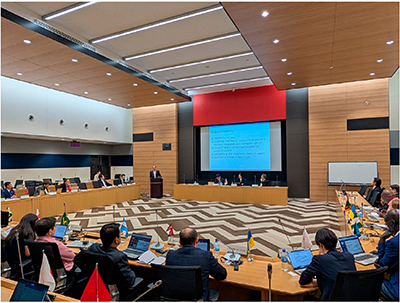
The 26th UNAFEI UNCAC Training Programme (Photo: UNAFEI)
As a State Party to the United Nations Convention against Corruption (UNCAC), Japan has been actively involved in supporting the development of legal frameworks for preventing and combating corruption, and in strengthening the capacities of justice and law enforcement agencies through cooperation with the Convention’s secretariat, the United Nations Office on Drugs and Crime (UNODC).
As part of its legal technical cooperation and governance support, including anti-corruption measures, Japan conducts annual training programs and seminars for criminal justice practitioners from developing countries in regions such as Asia and Africa through the United Nations Asia and Far East Institute for the Prevention of Crime and the Treatment of Offenders (UNAFEI),Note 55 operated by the Ministry of Justice of Japan under an agreement with the United Nations.
As a concrete example of Japan’s efforts, since 1998, it has held an annual training program to support criminal justice systems in their fight against corruption, with the exception of the year in which it was canceled due to the COVID-19 pandemic. The program selects its themes based on key issues under the UNCAC and contributes to the sound development of criminal justice for anti-corruption efforts, as well as the strengthening of cooperation among participating countries. From October to November 2024, the 26th session was held under the main theme: “Strengthening Prevention, Detection and Prosecution of Corruption, and Public-Private Partnerships.” The program was attended by 25 criminal justice practitioners from 20 countries and regions, including four participants from Ukraine.
Furthermore, since 2007, in order to support governance efforts in Southeast Asian countries and contribute to human resources development in the fields of criminal justice and anti-corruption, Japan has held a seminar titled the “Regional Seminar on Good Governance for Southeast Asian Countries (GG Seminar)” annually, except for the year in which it was canceled due to the COVID-19 pandemic. In 2024, the GG Seminar was succeeded by a new initiative, the “ASEAN-Japan Criminal Justice Seminar.” In December of the same year, the first seminar was held, featuring two parallel sessions: one under the theme, “Enhancing International Cooperation within the ASEAN Region: Utilizing New Tools for Effective Mutual Legal Assistance” and the other under the theme, “Countermeasures against Overpopulation of Prisons within the ASEAN Region, with a focus on Challenges and Developments regarding Non-custodial Measures and the Treatment of Offenders.” Criminal justice practitioners from 10 countries, including 9 ASEAN Member States (Brunei, Cambodia, Indonesia, Laos, Malaysia, the Philippines, Singapore, Thailand, and Viet Nam) and Timor-Leste, participated in the seminar.
UNAFEI’s activities are not limited to anti-corruption efforts. They also address key issues in crime prevention and criminal justice within the international community. In response to the evolving global landscape, UNAFEI has organized training programs and seminars on these pressing topics for criminal justice practitioners from developing countries worldwide. In 2024, the 183rd International Senior Seminar was held from January to February under the theme “Management of Correctional Institutions in the 21st Century—with a focus on the Nelson Mandela Rules.” In May, the 184th International Training Course was conducted under the theme “Countermeasures against Trafficking in Persons, with a focus on Trafficking in Persons for Sexual Exploitation.” From September to October, the 185th International Training Course was held under the theme “Preventing Inmate Abuse and Corruption in Correctional Facilities: Creating a Rehabilitative Prison Environment.”
Featured Project 2
Tanzania


Strengthening of Local Governance through Tanzania’s Original Participatory Planning Method (Improved O&OD)
Technical Cooperation (May 2022 – May 2025)
Advancing Inclusive and Just Development through Community-Administration Collaboration
Since the decentralization in 1996, local governments in Tanzania have undertaken a wide range of responsibilities, including primary and secondary education, healthcare, waste management, road maintenance, and community development. However, limited human and financial resources have made it difficult to deliver adequate public services.
To address these challenges, Japan has supported the development and nationwide dissemination of a unique participatory planning method known as the Improved O&OD, since 2002.Note 1 This approach enables communities to identify their own issues and priorities and to deliver public services in collaboration with the local governments, thereby promoting regional development.
The featured project of this column aims to further consolidate and promote the adoption of the Improved O&OD method. With support from JICA experts, the President’s Office, Regional Administration and Local Government (PO-RALG) provided training for development officers from 184 districts across 26 regions nationwide, and conducted monitoring and evaluation of district development planning and project implementation. As a result, during the one-year period from July 2023, approximately 1,600 community-driven activities, such as road maintenance and construction of clinics and schools, were carried out nationwide based on this method.
Through the Improved O&OD approach, communities in Tanzania have been empowered to take the lead in development, while the role of local governments as partners has also been strengthened. Local governments are expected to play an even bigger role in Africa, with its increasing population. Japan remains committed to supporting development based on mutual cooperation between local governments and communities.
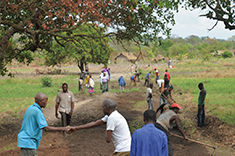
Community members engaged in road construction, with ongoing support from facilitators (government extension officers). (Photo: JICA)
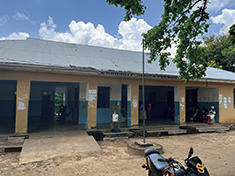
A clinic long desired by the community was built by the village residents themselves, with the local government supporting the installation of the ceiling. (Photo: JICA)
Note 1 Abbreviation for Opportunities and Obstacles to Development.
■Assistance for Democratization
As part of its support for democratization, Japan has implemented the “Project for Capacity Development of Radio Television of Kosovo (RTK)” since January 2015. The project aims to improve the accuracy of reporting in multiethnic areas by supporting the establishment of branch offices in regions with ethnic minorities and mixed populations, and by enhancing the skills of reporting, program production, and technical staff through on-the-job training and workshops conducted by JICA experts. In South Sudan, Japan is also supporting the overall capacity development of the South Sudan Broadcasting Corporation (SSBC), the national public broadcaster, including its regional staff, to help ensure reliable and trusted broadcasting across the country.
- Note 53: An outcome document of the Kyoto Congress that provides medium- to long-term guidelines for the UN and UN Member States in the field of crime prevention and criminal justice.
- Note 54: The largest UN international conference in the field of crime prevention and criminal justice, held once every five years. UNODC serves as the secretariat of the conference.
- Note 55: Established in 1962 under the “Agreement between the United Nations and the Government of Japan for the Establishment of the Asia and Far East Institute for the Prevention of Crime and the Treatment of Offenders,” UNAFEI is operated by the UN Training Cooperation Department of the Research and Training Institute, Ministry of Justice. Since its establishment, it has produced over 6,600 alumni from 144 countries and regions.