
(4) Humanitarian Assistance in Response to Natural Disasters
In recent years, the frequency of extreme torrential rainfall, characterized by its short duration and localized occurrence, has been increasing globally, partly due to the effects of climate change. As a result, damage caused by floods and landslides is becoming more intense and frequent. Developing countries, often with fragile economic and social infrastructures, are particularly vulnerable to these disasters and increasingly require support from the international community.
Japan maintains a mechanism that enables prompt provision of emergency assistance in the event of large-scale disasters overseas, in response to requests from the affected country’s government or from international organizations. This assistance may include the dispatch of Japan Disaster Relief (JDR) teams, the provision of emergency relief goods, and Emergency Grants. One or more of these tools are chosen according to the magnitude of the disaster and requests from the affected country.
●Japan’s Efforts
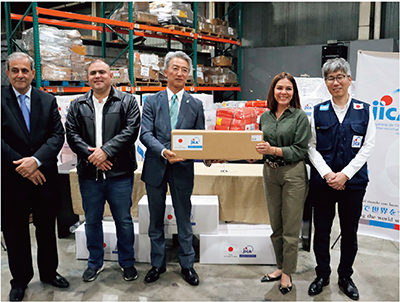
Mr. Nakahara, then Ambassador of Japan to Honduras (third from the right), handing over emergency relief supplies to Mrs. Cindy Rodriguez, Vice Minister of Foreign Affairs and International Cooperation of Honduras (second from the right), in response to the tropical storm disaster in the country (Photo: JICA)
Japan’s humanitarian assistance includes the dispatch of JDR teams, which consist of five types: (i) Urban Search and Rescue Team, (ii) Medical Team, (iii) Infectious Diseases Response Team, (iv) Expert Team (providing technical advice and guidance on emergency response and recovery), and (v) Self-Defense Force Unit (engaged in medical activities or the transport of aid supplies and personnel when deemed particularly necessary). These teams may be deployed individually or in combination.
As in-kind assistance, Japan provides emergency relief goods. Tents, blankets, and other essential items for affected populations are stockpiled in three overseas warehouses, ensuring their prompt delivery to disaster-affected countries when needed.
In 2024, Japan swiftly responded to a series of natural disasters by providing emergency relief goods through JICA. Supplies such as tents, blankets, plastic sheets, water purifiers, and firefighting equipment were provided in response to the damage caused by the heavy snow in Mongolia, the landslide in Papua New Guinea, the flood in Afghanistan, the heavy rain in Brazil, the hurricane in the Central American and Caribbean region, the typhoon in Viet Nam, the forest fire in Bolivia, the hurricane in Cuba, the tropical storm in Honduras, the flood and landslide in Sri Lanka, and the earthquake in Vanuatu.
As financial assistance, Japan provides Emergency Grants to the governments of countries affected by natural disasters or conflict, as well as to the international organizations implementing emergency relief operations in affected areas, aiming to assist victims, refugees and displaced persons.
In 2024, Japan provided support through international organizations to the countries affected by natural disasters, including assistance in water and sanitation, as well as the provision of shelter and food. Such relief efforts were extended to Ethiopia, Somalia, Kenya, and Bangladesh following severe floods; to Papua New Guinea after a landslide; and to Viet Nam and Myanmar in the aftermath of typhoons.
Japanese NGOs provide assistance to disaster-affected populations by utilizing ODA and also serve as implementing partners to international organizations and others in carrying out emergency relief activities. Japan Platform (JPF)Note 56 offers humanitarian assistance to refugees and internally displaced persons, as well as people affected by conflicts and natural disasters. JPF-affiliated NGOs deliver a wide range of support tailored to local needs in areas where government assistance has difficulty reaching, including Kenya (drought and floods caused by climate change), Afghanistan (earthquake), Bangladesh (flood), and Ukraine (conflict), among other regions (For details, see Part V, Section 1 (3)).
Disaster response is a shared challenge for Japan and Southeast Asian countries, both of which are highly prone to natural disasters. Japan has provided support to the ASEAN Coordinating Centre for Humanitarian Assistance on disaster management (AHA Centre), established in 2011, and has contributed to strengthening the Centre’s disaster response capacity, and others. In 2024, Japan continued to support the development of the Disaster Emergency Logistics System for ASEAN (DELSA) and utilize this system to ensure the swift delivery of emergency relief items to affected countries. Japan also supported human resources development for the ASEAN Emergency Response and Assessment Team (ASEAN-ERAT), which conducts rapid damage assessments of disaster-stricken areas, as well as for future leaders of the National Disaster Management Organisations of ASEAN countries.
Featured Project 3
Ethiopia, Somalia and Kenya Public nomination

Emergency Grants in Response to the Flood Disasters in Ethiopia, Somalia and Kenya
Emergency Grants (March – September 2024)
Protecting Lives and Livelihoods of Habitants in the “Horn of Africa” Region Suffering from Conflict and Floods
Many people in the “Horn of Africa” regionNote 1 have been displaced from their homes due to the compound effects of prolonged conflicts, climate change, and the surge in global food and energy prices stemming from recent international situations. Since October 2023, repeated floods caused by heavy rainfall have further worsened living conditions, forcing more than two million people to evacuate.
In response, the Government of Japan and the Office of the United Nations High Commissioner for Refugees (UNHCR) provided support to protect the lives of those affected by floods and to sustain the livelihoods of displaced persons and their host communities in Ethiopia, Somalia, and Kenya, three countries located in the “Horn of Africa” region.
The Somali Region in the east of Ethiopia, which hosts more than 350,000 refugees from neighboring Somalia over the past 40 years, is one of the target areas of this project due to the severe impact of floods. With support from the Government of Japan, UNHCR strengthened its efforts towards building shelters, providing clean drinking water and medical services, raising awareness about hygiene practices, and taking measures to prevent gender-based violence, thereby contributing to the improvement of the lives of approximately 220,000 people.
Mr. KOSAKA Junichiro, Donor Relations Officer at the UNHCR Ethiopia, states, “Addressing prolonged conflicts and climate change requires support from a medium- to long-term perspective. In Ethiopia, we are leveraging Japan’s strength in the ‘Humanitarian-Development-Peace (HDP) Nexus’ approach to incorporate sustainable development perspectives from the early stages of humanitarian crises. This involves enhancing the use of existing public services and strengthening local communities’ crisis response capabilities.”
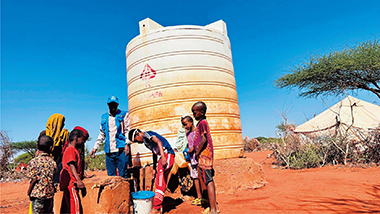
A refugee family collecting water from a tank installed in a refugee settlement in Ethiopia with Japan’s support (Photo: UNHCR)
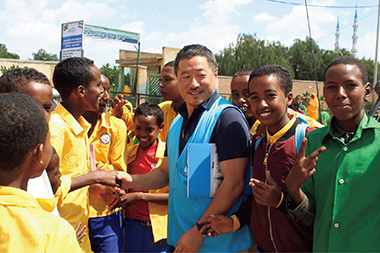
Donor Relations Officer Kosaka (center) visiting an elementary school in Ethiopia where refugee students and host community students learn together (Photo: UNHCR)
Note 1 A term referring to the region that projects like a “horn” extending toward the Indian Ocean and the Red Sea in northeastern Africa, including Ethiopia, Eritrea, Djibouti, Somalia, and Kenya.
- Note 56: See glossary.