
3 Leading International Efforts to Addressing Increasingly Complex and Serious Global Issues
(1) Climate Change and the Environment
Global environmental challenges, including climate change, are pressing issues that the international community is working on together, as is addressed in the Sustainable Development Goals (SDGs), and in the wake of extreme weather events and devastating natural disasters in recent years. Following the G7 Hiroshima Summit held under Japan’s Presidency in 2023, the Apulia G7 Leaders’ Communiqué in 2024 reaffirmed the need to take steps to address the triple crisis of climate change, pollution, and biodiversity loss, faced by the planet. Japan has vigorously worked on addressing these issues and provided assistance to developing countries, as one of the top donors, through the Global Environment Facility (GEF),Glossary a financing mechanism for major multilateral environmental agreements such as the Convention on Biological Diversity (CBD) and the United Nations Framework Convention on Climate Change (UNFCCC).
●Japan’s Efforts
■Climate Change
The issue of climate change is a threat to the sustainable development of all countries in the world as well as a security issue that concerns the very existence of humankind. All countries must work together to address this issue, which requires increased concerted efforts by the international community, including not only developed countries but also developing countries. The Paris Agreement was adopted at the 21st Session of the Conference of the Parties to the UNFCCC (COP21) held in 2015, as a framework under which all countries would work toward greenhouse gas (GHG) emission reductions. The Paris Agreement entered into force in 2016.
In October 2020, Japan declared that it would achieve net-zero GHG emissions by 2050. In April 2021, Japan also declared its aim to reduce its GHG emissions by 46% in FY2030 from its FY2013 levels, and to continue strenuous efforts in its challenge to meet the lofty goal of cutting its emissions by 50%. In October 2021, Japan submitted its “Nationally Determined Contribution (NDC)”Note 57 reflecting these goals, together with “The Long-term Strategy under the Paris Agreement” to the UN.
At the G7 Cornwall Summit in June 2021, Japan announced a total of ¥6.5 trillion in assistance from both public and private sources over five years from 2021 to 2025. Furthermore, at COP26 held in the same year, Japan announced its intention to provide up to an additional $10 billion from both public and private sources over the following five years, including by doubling finance for adaptation to approximately ¥1.6 trillion over the same period.
(COP29)
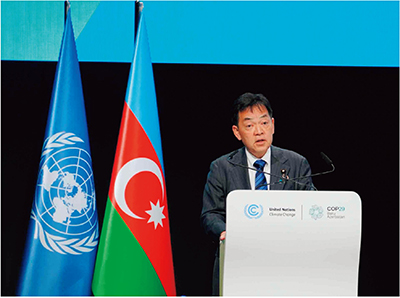
Then Minister of the Environment Asao delivering a speech at the ministerial-level session of the 29th Conference of the Parties (COP29) to the United Nations Framework Convention on Climate Change (UNFCCC) (Photo: Ministry of the Environment)
From November 11 to 24, 2024, COP29 was held in Baku, Azerbaijan. Attending the ministerial-level session, then Minister of the Environment Asao emphasized the importance of steady implementation of NDCs toward achieving the 1.5°C goal.Note 58 At the conference, a decision on the New Collective Quantified Goal (NCQG) on climate finance was adopted, setting the support goal of “at least $300 billion per year by 2035 for developing country Parties.” It was also decided to call on all actors to work together to enable the scaling up of financing to developing country Parties for climate action from all public and private sources to at least $1.3 trillion per year by 2035. In addition, decisions on the Mitigation Work Programme (MWP) and the Global Goal on Adaptation (GGA) were adopted, and detailed operational rules for Article 6 of the Paris Agreement, which enables the international transfer of GHG emission reductions and removals, were finalized and became fully operational.
(“Asia Zero Emission Community (AZEC)”)
In his Policy Speech in 2022, then Prime Minister Kishida announced the “Asia Zero Emission Community (AZEC)” concept as a platform to aim for decarbonization in Asia. In March 2023, the first AZEC Ministerial Meeting was held with the participation of nine Southeast Asian countries and Australia, marking the official launch of AZEC. The first AZEC Leaders Meeting was held in December 2023, followed by the 2nd AZEC Ministerial Meeting in August 2024. The principles of AZEC consist of simultaneously achieving decarbonization, economic growth, and energy security, as well as pursuing net-zero emissions through various pathways. At the 2nd AZEC Leaders Meeting held in October 2024, an agreement was reached on an “Action Plan for the Next Decade” with three pillars: (i) promoting “AZEC solutions” such as developing rules to promote activities that contribute to decarbonization in Asia; (ii) launching initiatives for decarbonization in the sectors with high GHG emissions, such as electricity, transportation, and industry; and (iii) promoting tangible projects, while reaffirming the AZEC principles.
(Green Climate Fund (GCF))
Japan supports developing countries through its contribution to the Green Climate Fund (GCF),Glossary the world’s largest multilateral climate fund. Japan has contributed a total of approximately ¥319 billion to the fund to date. In addition, for the second replenishment period from 2024 to 2027, Japan has announced its intention to contribute up to ¥165 billion, the same amount as the first replenishment. At the GCF, a total of 285 projects have been approved and implemented by October 2024, which are expected to reduce GHG emissions by three billion tons and increase the resilience of one billion people through support for adaptation. Additionally, from Japan, JICA, MUFG Bank, Ltd., and Sumitomo Mitsui Banking Corporation are approved as “Accredited Entities” that are entitled to propose GCF projects. To date, three projects by MUFG Bank, Ltd. have been approved, namely a private sustainable forestry project in seven countries in Sub-Saharan Africa and Latin America and the Caribbean (March 2020), assistance on a green bond issuance project in eight countries in Asia, Latin America and the Caribbean, and Africa (October 2022), and a blended finance project to support mitigation and adaptation in 19 countries in Asia, Africa, and Latin America and the Caribbean (October 2023), along with two projects by JICA, “Community-based Landscape Management for Enhanced Climate Resilience and Reduction of Deforestation in Critical Watersheds in Timor-Leste” (March 2021) and “Building Climate Resilient and Safer Islands in the Maldives” (July 2021).
(Bilateral Assistance)
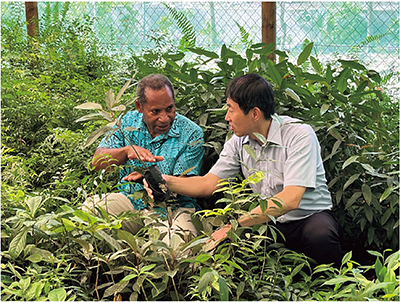
A Forest Authority staff member and a JICA expert discussing seedling cultivation in a technical cooperation project aimed at sustainable forest management in Papua New Guinea (Photo: JICA)
As a specific example of bilateral assistance, Japan dispatches experts on climate actions to the Pacific Climate Change Centre in Samoa, which Japan supported the construction of through grants. Through this Centre, Japan strives to develop human resources in the Pacific Island countries vulnerable to climate change. This support is expected to improve the capacity to implement climate change solutions, which will widely benefit more than 10 million people in 14 Pacific Island countries. In addition, in cooperation with UNDP, Japan supports the shift to renewable energy in Papua New Guinea, Samoa, Timor-Leste, and Vanuatu.
In relation to the African region, at TICAD 8 held in August 2022, Japan launched the “Green Growth Initiative with Africa (GGA)” with the goal of addressing climate change and transforming the energy structure toward decarbonization. Under this initiative, Japan aims to maximize its cooperation through three approaches, (i) ownership and co-creation, (ii) flexible finance mobilization, and (iii) collaboration with diverse partners, and is promoting various efforts by both the public and private sectors to contribute to sustainable growth in Africa (see Part IV, Section 8 for efforts related to green growth).
As part of its assistance for climate change actions in developing countries, Japan promotes the “Joint Crediting Mechanism (JCM),”Glossary which facilitates the diffusion of advanced decarbonizing technologies to partner countries around the world, including developing countries. This contributes to GHG emission reductions in partner countries, and helps Japan to achieve its reduction targets, as part of the achieved emission reductions in developing countries can be credited as those of Japan. In 2013, Japan signed the first Memorandum of Cooperation (MoC) on the implementation of the JCM with Mongolia, followed by the signing of an MoC with Ukraine in February 2024. As of 2024, Japan has established the JCMs with 29 countries. Since the start of the JCM in 2013, JCM credits have been issued from 46 energy-saving and renewable energy projects in Bangladesh, Cambodia, Indonesia, Kenya, Laos, Maldives, Mongolia, Palau, Saudi Arabia, Thailand, and Viet Nam. These JCM projects contribute to GHG emission reductions worldwide.
Japan will continue to lead the international community toward the realization of a decarbonized society as envisaged in the Paris Agreement.
■Biodiversity Loss
In recent years, the expansion of human activities in scope, scale, and types has given rise to serious concerns about biodiversity loss, such as the degradation of habitats and the destruction of ecosystems. Japan places importance on biodiversity efforts, as seen in its initiative to hold the 10th meeting of the Conference of the Parties to the Convention on Biological Diversity (CBD)Glossary(COP10) in Nagoya City, Aichi Prefecture, in 2010. In addition, Japan makes contributions to the Japan Biodiversity FundNote 59 launched at COP10 as well as the GBF Fund to implement the “Kunming-Montreal Global Biodiversity Framework (GBF),” which was adopted as new global goals and targets at the 15th Meeting of the Conference of the Parties (COP15) in December 2022, to support the capacity building of developing countries.
In October 2024, the 16th Meeting of the Conference of the Parties (COP16) to the Convention on Biological Diversity (CBD) was held in Cali, Colombia, where parties agreed to establish a framework for a multilateral benefit-sharing mechanism for the use of Digital Sequence Information (DSI)Note 60 on genetic resources and to set up a subsidiary body on the participation of indigenous peoples and local communities. Japan will continue to contribute toward the 2030 mission “to take urgent action to halt and reverse biodiversity loss to put nature on a path to recovery” and the 2050 Vision of “living in harmony with nature,” as described in the GBF, based on the “National Biodiversity Strategy and Action Plan of Japan 2023-2030.”
Illegal trade of wildlife has also become an increasingly serious issue and is causing concerns among the international community, as it has become one of the funding sources for international terrorist organizations. Japan has been actively contributing to the discussions at the Convention on International Trade in Endangered Species of Wild Fauna and Flora (CITES), and has been working on resolving the issue in cooperation with the international community through contributions to projects implemented by the CITES Secretariat. As a specific initiative, Japan supports the construction of facilities and other measures to combat elephant poaching, mainly in Africa.
■Conservation of the Marine Environment
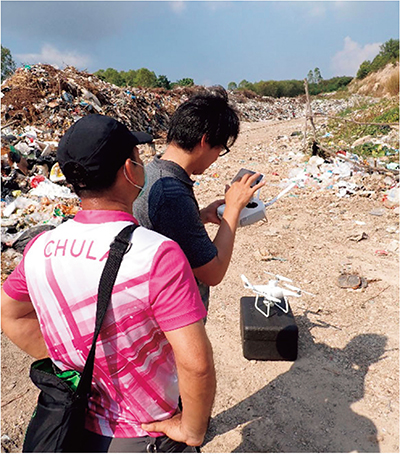
Measuring plastic waste using drones through technical cooperation in Thailand “Project for Formation of a Center of Excellence for Marine Plastic Pollution Studies in the Southeast Asian Seas” (Photo: JICA)
The importance of addressing the problem of marine plastic litter has grown in recent years as an urgent challenge, with concerns of adverse impacts on the marine ecosystem, tourism, fisheries, and human health. As of December 2024, 87 countries and regions have shared the “Osaka Blue Ocean Vision,” an initiative led by Japan at the G20 Osaka Summit in 2019 that aims to reduce additional pollution by marine plastic litter to zero by 2050. In order to realize the Vision, Japan launched the “MARINE Initiative” that focuses on (i) Management of wastes, (ii) Recovery of marine litter, (iii) Innovation, and (iv) Empowerment. Under this Initiative, Japan supports capacity building and infrastructure development for waste management in developing countries in order to promote effective measures against marine plastic litter worldwide.
At the Sixth Meeting of the High-Level Panel for a Sustainable Ocean Economy held in September 2024, Japan highlighted its concrete actions to end plastic pollution as the proponent of the “Osaka Blue Ocean Vision.” Japan also emphasized that one of the expected outcomes of the Third United Nations Ocean Conference (UNOC3) to be held in June 2025 is to increase momentum for negotiation and implementation of various international agreements on the marine environment. Furthermore, Japan reiterated its continued active engagement in the negotiations on an international legally binding instrument on plastic pollution currently under negotiation, in order to realize an effective and progressive treaty in which many countries would participate. Noting that blue carbonNote 61 is one of the areas where the Panel could contribute beyond 2025, Japan shared how it calculates the amount of carbon absorbed by blue carbon ecosystemsNote 62 and reflects it in its greenhouse gas inventoryNote 63 submissions. In April 2024, Japan became the first country in the world to make a report that includes the amount absorbed by seaweed beds.
Japan supports efforts against marine plastic litter in the field of marine environmental protection, and in 2024, implemented the JICA Knowledge Co-Creation Program (Group and Region Focus) “Waste Management towards Control of Marine Litter.”
As part of expanded assistance for ASEAN to address marine plastic litter issues, which was announced at the ASEAN-Japan Summit in 2018, Japan has conducted human resource development, awareness-raising, and public relations activities for environmental conservation, primarily on reducing marine plastic litter in ASEAN countries since 2019. In 2024, through the Japan-ASEAN Integration Fund (JAIF),Note 64 Japan provided assistance to strengthen the capacity of local governments in ASEAN member states to address microplastics and water pollution, and to promote a plastic circular society in the ASEAN region. In addition, Japan provides capacity building support for monitoring and reducing marine debris from fisheries. Furthermore, based on the commitments made at the G20 Osaka Summit, Japan has been working on harmonizing monitoring methods for ocean surface microplastics to ensure data comparability and data aggregation in cooperation with experts from various countries. In 2024, Japan launched a database called the “Atlas of Ocean Microplastics (AOMI)” that collects monitoring data from around the world and provides it along with visualizations on maps.
Japan supports marine plastic litter countermeasures through the United Nations Environment Programme (UNEP) especially in Southeast Asia, South Asia, and Pacific Island countries. In response to the worsening marine pollution caused by plastic waste, UNEP developed a method for monitoring the leakage of plastic waste into the ocean, starting from 2018. In addition, to enable science-based policymaking, UNEP conducts sampling surveys of plastic litter and scientific analysis on its pathways. UNEP formulates policy recommendations and guidelines based on the results, and in collaboration with a Japanese IT company, a plastic leakage hotspot map was created, identifying over 3,000 leakage points (hotspots), and released it on a dedicated websiteNote 65 available to the general public.
■Protection of Forests and Marine Living Resources
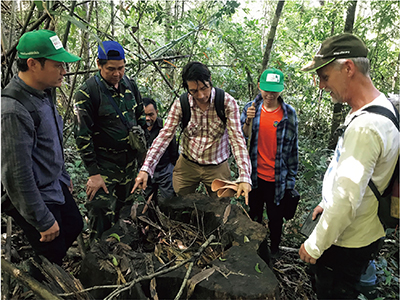
Forest biomass survey exercise conducted jointly with German experts in Phou Khao Khouay National Park in Vientiane Province, Laos (Photo: JICA)
Among forest resources, tropical forests account for approximately half of the world’s forests and play an important role in tackling climate change and conserving biodiversity. Japan invited the International Tropical Timber Organization (ITTO) to establish its headquarters in Yokohama, and has been supporting the sustainable management of tropical forests as well as legal and sustainable tropical timber trade through the organization for nearly 40 years. Through voluntary contributions to ITTO, the Government of Japan provides support for tropical timber-producing countries, including holding workshops in Brazil in 2024 for companies involved in forestry, utilizing tools for sustainable forest management (such as tropical forest monitoring software).
Regarding the conservation of marine living resources, Japan conducts training and workshops on countermeasures against illegal, unreported, and unregulated (IUU) fishing in the ASEAN region in cooperation with the Southeast Asian Fisheries Development Center (SEAFDEC). These cooperative efforts help reduce the impact on fish ecosystems of IUU fishing that exceeds regulatory thresholds. In doing so, Japan contributes to the sustainability of the fishing industry, one of the core industries for ASEAN countries, and to the sustainable development of fishing communities.
■Environmental Pollution Control Measures
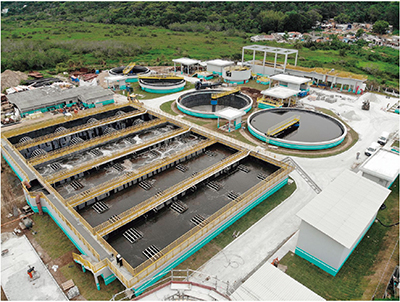
Wastewater treatment plant constructed with yen loans in the northern part of Florianópolis City, Santa Catarina State, Brazil (Photo: State Water Supply and Sanitation Company of Santa Catarina)
In developing countries, regulatory measures on hazardous chemicals are often inadequate, which in some cases leads to environmental pollution and health damage. Japan has accumulated knowledge, experience, and technology related to environmental pollution control measures and utilizes them to solve the problems in developing countries. Japan also conducts technical cooperation, such as dispatching experts to and accepting trainees from developing countries, in the areas of environmental management techniques in the chemical industry, analysis techniques and risk evaluation for environmentally hazardous chemicals, as well as trace analysis techniques for hazardous chemicals.
The “Minamata Convention on Mercury” was adopted at the Conference of Plenipotentiaries on the Minamata Convention on Mercury in 2013 and entered into force in August 2017. Through its experience with the Minamata disease, Japan has accumulated technology and expertise in preventing environmental pollution and health damage caused by mercury, and is actively sharing the technology and expertise with the world, thereby demonstrating leadership in global mercury control efforts. In addition to conducting training programs on mercury management to support Nepal, Malaysia, and other countries in ratifying the Convention, Japan conducted technology needs surveys in Indonesia, Viet Nam, and other countries, which has ratified the Convention, to promote the overseas expansion of Japan’s advanced mercury management technology. Furthermore, since 2019, the UNEP Regional Office for Asia and the Pacific (UNEP/ROAP) as an implementing agency has been conducting the “Project for Promoting Minamata Convention on Mercury by making the most of Japan’s knowledge and experiences” with Japan’s contribution. Through this project, Japan supports the Parties to the Convention in improving the quantity and quality of domestic mercury-related information and developing a platform to implement mercury management in line with the Convention.
In the field of waste management, based on the “MARINE Initiative,” Japan announced its commitment to develop 10,000 officials engaging in waste management around the world by 2025 and has already trained approximately 30,000 officials by FY2023 through various means, such as training programs.
Moreover, as a model project for waste management support in Africa, Japan promotes resource circulation through efficient resource recovery in Kenya. The outcomes and experiences gained from this project are shared with member countries and cities through the “African Clean Cities Platform (ACCP).”Glossary At TICAD 8 held in August 2022, Japan announced that, under the ACCP, it would promote decarbonization and recycling in the waste sector, improve public health including through waste management that benefits 30 million people in Africa, as well as implement human resources development for 1,000 people. Through the ACCP, which has expanded to 47 countries and 188 cities, including 5 countries and 80 cities that joined after TICAD 8, Japan has been promoting efforts in these fields.
Glossary
- Global Environment Facility (GEF)
- A multilateral financial mechanism for six multilateral conventions, namely the UNFCCC, Convention on Biological Diversity (CBD), United Nations Convention to Combat Desertification (UNCCD), Stockholm Convention on Persistent Organic Pollutants, Minamata Convention on Mercury, and the Agreement under the United Nations Convention on the Law of the Sea on the Conservation and Sustainable Use of Marine Biological Diversity of Areas Beyond National Jurisdiction (BBNJ Agreement), that provides primarily grants for projects that would contribute to global environmental benefits in developing countries. Established in 1991, 186 member countries including Japan are participating (as of December 2024). The World Bank administers the contributions by donors. The GEF supports developing countries under five focal areas, namely biodiversity loss, climate change, international waters, land degradation, and chemicals and waste through 18 implementing agencies including Multilateral Development Banks (MDBs) such as the World Bank, Asian Development Bank (ADB) and UN organizations such as the United Nations Development Programme (UNDP) and United Nations Environment Programme (UNEP).
- Green Climate Fund (GCF)
- A multilateral climate fund established by the decision of COP16 (Cancun Agreement) in 2010, in order to support developing countries in reducing their GHGs (mitigation) and in their responses to the effects of climate change (adaptation).
- Joint Crediting Mechanism (JCM)
- A mechanism to quantitatively evaluate contributions from Japan to GHG emission reductions or removals realized through the diffusion or implementation of leading decarbonizing technologies, products, systems, services, and infrastructure, etc., mainly in developing countries, to acquire part of the credit, and to use the contributions to achieve Japan’s NDC.
- Convention on Biological Diversity (CBD)
- A convention adopted in 1992 to advance global efforts to address biodiversity issues. The objectives of CBD are the following: (1) conservation of biological diversity, (2) sustainable use of the components of biological diversity (utilizing living resources for the future while maintaining diversity at each level of ecosystems, species, and genes), and (3) fair and equitable sharing of the benefits arising out of the utilization of genetic resources. Through the provision of economic and technical assistance to developing countries from developed countries, the international community as a whole facilitates the conservation and sustainable use of biological diversity worldwide.
- African Clean Cities Platform (ACCP)
- ACCP was established in 2017 by the Ministry of the Environment, Japan, together with JICA, the City of Yokohama, UNEP, and the United Nations Human Settlements Programme (UN-Habitat) aiming to share knowledge on waste management and promote the achievement of the SDGs in Africa. 188 cities in 47 countries in Africa have joined the Platform, holding plenary sessions, developing various guidelines and educational materials, and planning study tours, among others.
- Note 57: Parties set their GHG emission reduction targets and formulate measures to achieve them as National Determined Contribution (NDC). It will then be submitted to the UNFCCC secretariat.
- Note 58: A goal set to limit the global average temperature rise to 1.5°C above the pre-industrial level.
- Note 59: Established in the Secretariat of the CBD by Japan during its COP10 Presidency with the aim of building capacities in developing countries.
- Note 60: Although there is currently no internationally agreed, clear definition, the term generally refers to data related to the DNA of plants, animals, microorganisms, and other organisms. In recent years, such data has increasingly been used in research and development across various fields, prompting discussions on mechanisms for the fair and equitable sharing of benefits arising from their use.
- Note 61: Carbon that is captured by living organisms in coastal and ocean ecosystems, accumulates in the soil, and sinks to the seafloor
- Note 62: Major carbon sinks of blue carbon consisting of seaweed beds (seagrass and algae), salt marshes and tidal flats, and mangrove forests.
- Note 63: Data that compiles the amount of greenhouse gases emitted and absorbed domestically in a year. Under the UNFCCC, each country is required to prepare and submit this data annually to the Convention secretariat.
- Note 64: See Note 5.
- Note 65: “Mobile Application for Macro Plastic Survey” https://arcg.is/1DOOWW