
(2) Health and Medical Care
SDG 3 aims to “Ensure healthy lives and promote well-being for all at all ages.” In addition, achieving universal health coverage (UHC)Note 66 is positioned as an important global target in order to respond to various health issues, diversified across countries and regions. On the other hand, at present, it is estimated that at least half of the world’s population has no access to basic medical care, and that over 4.9 millionNote 67 children under the age of five die annually due to preventable diseases. Approximately 287,000 womenNote 68 die during and following pregnancy and childbirth per year, primarily due to the lack of emergency obstetric care provided by doctors and midwives. Moreover, COVID-19 has had a wide range of effects on people around the world. It has also exposed various vulnerabilities, including those related to vaccine distribution, in the current global health architecture (GHA), which comprises the governance and finance for addressing global health and medical issues.
In light of various changes in the global situation, such as the spread of COVID-19, the Government of Japan formulated the “Global Health Strategy” in May 2022. The goal of the Strategy is (i) to contribute to developing GHA for international health security and strengthening Prevention, Preparedness, and Response (PPR) for public health emergencies including pandemics, and (ii) to achieve more resilient, equitable, and sustainable UHC required for the post-COVID-19 era in order to embody human security, and Japan promotes initiatives in line with this Strategy.
●Japan’s Efforts
■Building Global Health Architecture (GHA) that Contributes to Prevention, Preparedness and Response (PPR) to Future Health Crises
Building on the experience and lessons learned from the COVID-19 response, and amid an unprecedented level of interest from the international community in strengthening PPR for future health emergencies, Japan is actively cooperating with international organizations to address these challenges. Japan has provided financial contributions to the World Health Organization (WHO)’s Health Emergencies Programme,Glossary the Contingency Fund for Emergencies (CFE),Glossary and other relevant programs to support WHO’s response to health crises. These contributions were also used to respond to the acute phase of COVID-19. Through cooperation with the World Bank, Japan also provides support for capacity building and strengthening the health system to prepare for and respond to health emergencies in developing countries. Additionally, Japan has supported the Pandemic Fund, launched in 2022 and hosted by the World Bank, as one of its founding donors, assisting its efforts in enhancing the PPR capabilities of low- and middle-income countries. In October 2024, at the Joint Ministerial Committee of the Boards of Governors of the Bank and the Fund, then Finance Minister Kato announced Japan’s intention to contribute $50 million in addition to the $70 million already pledged. Japan also contributes to the Health Emergency Preparedness and Response Multi-Donor Trust Fund (HEPRTF), established in cooperation with the World Bank Group. Furthermore, Japan serves as a co-chair, together with the World Bank, of the Health Systems Transformation and Resilience Multi-Donor Trust Fund (HSTRF), which has been active since 2024.
Based on the achievements that Japan made as the G7 Presidency in 2023, Japan continues in 2024 to work on raising international awareness and maintaining momentum through various international conferences that Japan hosts or participates in, under the philosophy of breaking the cycle of “panic” and “forgetfulness” and guiding structural global change in preparation for the next pandemic. For example, the outcome document of the G7 Apulia Summit, held in June 2024, reflected key priorities that Japan has consistently placed importance on and has been emphasized during the G7 Hiroshima Summit and other forums, such as achieving UHC, equitable access to medical countermeasures (MCMs) for infectious disease emergencies, strengthening GHA, and enhancing coordination between financial and health authorities. At the G20, discussions on strengthening pandemic response financing have continued, building on the outcomes of the G7 in 2023, and Japan has been actively contributing to these discussions.
During the Tokyo International Conference on African Development (TICAD) Ministerial Meeting held in August, two thematic events focused on health were organized. During these events, titled “Global Health Financing to Achieve Universal Health Coverage” and “Accelerating Universal Health Coverage (UHC) with Innovations toward 2030,” active discussions were held with participation from representatives of African countries and the Global Health Initiatives, etc. Then Parliamentary Vice-Minister for Foreign Affairs Hosaka, who delivered opening remarks at the latter event, emphasized the importance of mobilizing private funds from the perspective of sustainable financing, while referring to the “Impact Investment Initiative for Global Health (Triple I),” which was endorsed at the G7 Hiroshima Summit in 2023.
Japan also actively participates in rulemaking in the international arena. Since February 2022, Japan has been taking part in the meetings of the Intergovernmental Negotiating Body (INB) on a “WHO convention, agreement or other international instrument on pandemic prevention, preparedness and response (PPR) (WHO CA+)” held under the WHO. Japan also actively contributed to discussions on the amendments to the International Health Regulations (2005) (IHR),Note 69 and a set of IHR amendments was adopted by consensus on June 1, 2024, the final day of the Seventy-seventh World Health Assembly.
■Promotion of Universal Health Coverage (UHC)
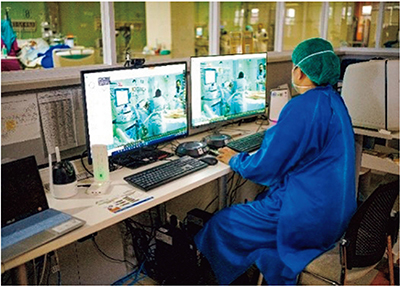
Remote treatment being provided by the Indonesia University Hospital under technical cooperation “Project for Capacity Development of ICU Using Telemedicine under COVID-19 Pandemic” in Indonesia (Photo: Otto Ferdinando)
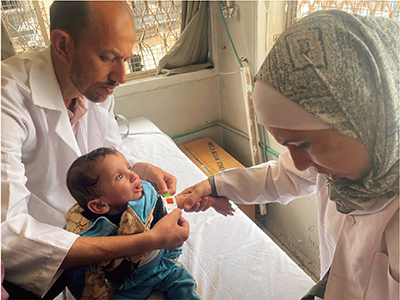
A doctor conducts a mid-upper arm circumference (MUAC) screening for an infant at a makeshift clinic in Gaza City, Palestine (Photo: CCP Japan)
Japan has promoted international cooperation based on the recognition that it is necessary to address existing health issues that suffered a setback since the spread of COVID-19 and to achieve more resilient, equitable, and sustainable UHC.
Japan has long provided support for the health and medical care systems in countries in Southeast Asia and Africa based on the view that building a sustainable and resilient health system will serve as the foundation for controlling infectious diseases. In addition, based on various lessons learned from pandemics such as COVID-19, Japan is working to strengthen health systems, including the establishment and networking of core medical facilities and support for human resources development in the medical field. For example, in March 2024, Japan and Uganda exchanged notes regarding Japan’s support through grants for the improvement of medical equipment in two of the three regional referral hospitals in the eastern part of the country, with the aim of strengthening the medical systems in hospitals in eastern Uganda, where the poverty rate is high. These efforts contribute to the promotion of UHC, as well as to the PPR for public health emergencies. Japan also provides assistance in a wider range of areas to create a more resilient environment against infectious diseases, including the development of water and sanitation infrastructure such as water supply and sewage systems, and the enhancement of food security. Japan also contributes to the prevention of infectious diseases by collaborating with NGOs to build handwashing facilities and toilets in health facilities and schools, and to conduct hygiene awareness activities. In partnership with Sanrio Company, Ltd., Japan has also implemented awareness-raising activities using handwashing videos featuring Hello Kitty, one of the company’s characters (see Part III, 3 (3) on efforts in the area of water and sanitation).
Japan has consistently emphasized the importance of UHC as the foundation for human capital development and sustainable growth. In close collaboration with relevant organizations, including the World Bank and WHO, Japan has been supporting developing countries in achieving UHC. From this perspective, it was announced in 2024 that the “UHC Knowledge Hub” will be established in Japan the following year, in partnership with the World Bank and WHO, with the aim of collecting and sharing knowledge on health financing and other relevant areas, as well as developing human resources among finance and health authorities in developing countries.
Primary healthcare services under UHC include all types of services, including nutritional improvement, vaccination, maternal and child health, sexual and reproductive health, infectious disease control, noncommunicable disease (NCD) control, and comprehensive community care and long-term care for older persons (see Part III, Section 1 (1) regarding nutritional improvement).
Especially with regard to maternal and child health in developing countries, there are major issues that are yet to be solved. In response to this situation, in 2024, Japan provided support to improve maternal and child health in numerous countries, including Angola, Bangladesh, Bhutan, Bolivia, Burundi, Côte d’Ivoire, Gabon, Georgia, Ghana, Indonesia, Pakistan, Rwanda, Senegal, Sierra Leone, Tajikistan, and Zambia
Japan carries out activities utilizing the Maternal and Child Health (MCH) Handbook as a means of improving maternal and child health, drawing on its own experience and expertise. The MCH Handbook can contribute to the Continuum of Care (CoC) from pregnancy, childbirth, the post-partum period,Note 70 to the neonatal period, infancy, and early childhood. It also enables mothers to acquire knowledge about health, raising their awareness and helping them modify their behavior. As a concrete example of this assistance, in Indonesia, the MCH Handbook is widely used throughout the country as a result of Japan’s technical cooperation on its operation. Furthermore, the Government of Indonesia, together with JICA, hosts international training sessions that invite third countries promoting the use of the MCH Handbook to share and learn from each other’s experiences and knowledge. Since 2007, a total of 18 countries and regions, including Afghanistan, Cameroon, Palestine, Tajikistan, and Uganda, have been invited to 16 training sessions.
In the African region, the “Tunis Declaration,” which was adopted at TICAD 8 in August 2022 as its outcome document, confirms the importance of realizing the concept of human security, building a resilient and sustainable society to achieve the SDGs, and intensifying efforts in the health sector to achieve UHC. The Joint Communiqué of the TICAD Ministerial Meeting held in August 2024 also expressed the importance of promoting prevention of diseases, strengthening health systems including local manufacturing and value chains of medicines and vaccines to achieve UHC and advance primary healthcare.
Japanese NGOs implement projects in the area of health and medical care using the Grant Assistance for Japanese NGO Projects and the Japan Platform (JPF).Note 71 For example, in 2024, AMDA Multisectoral and Integrated Development Services, a Japanese NGO, constructs public health facilities equipped for childbirth and provides medical equipment and supplies, in addition to conducting technical training for skilled birth attendants in the Chure Rural Municipality of Kailali District in far western Nepal.
Japan works in cooperation with international organizations such as the United Nations Population Fund (UNFPA), the International Planned Parenthood Federation (IPPF), the World Bank, as well as NGOs to promote maternal and child health that includes sexual and reproductive health services, aiming to thereby improve the health of a greater number of women and children. Japan also contributes to raising vaccination rates in developing countries through Gavi, the Vaccine Alliance,Glossary and bilateral cooperation. In June 2024, Japan announced a contribution of $30 million to the African Vaccine Manufacturing Accelerator (AVMA),Note 72 a financing mechanism launched by Gavi to accelerate the expansion of commercially viable vaccine manufacturing in Africa.
The Asian Development Bank (ADB) positions health as one of the key priority sectors in its “Strategy 2030” and sets the following three pillars to achieve UHC in the Asia-Pacific region in cooperation with Japan: (i) building institutional framework, (ii) accelerating human resources development, and (iii) investing in infrastructures. In April 2021, Japan began contributing to the ADB’s Japan Trust Fund for the purpose of providing technical assistance and small grants to support initiatives based on these three pillars. As of October 2024, Japan has contributed a total of approximately $15 million through the Fund.
Additionally, at the Japan-Australia-India-U.S. (Quad) Leaders’ Meeting in September 2024, the four countries, which have experience in cooperation on COVID-19 vaccines, confirmed that they would initially focus on cervical cancer prevention while laying the groundwork to address other types of cancer, as part of their cooperation on health and safety in the Indo-Pacific region. In this context, Japan confirmed that it will continue to (i) provide medical equipment and facilities and technical assistance, (ii) collaborate with cancer-related institutions in each country, and (iii) contribute to international organizations (such as Gavi). In the same month, Japan signed a memorandum of cooperation with the United States Agency for International Development (USAID) to achieve goals such as promoting UHC and strengthening international health security. Japan has supported building health and medical systems in developing countries for many years from various perspectives such as supporting the capacity building of healthcare workers, networking regional hospitals, and strengthening regional health systems. During the COVID-19 crisis, the medical facilities that Japan has supported evidently played central roles for infection control measures.
■Efforts on Individual Global Health Issues
(The Three Major Infectious Diseases (HIV/AIDS, Tuberculosis, and Malaria))
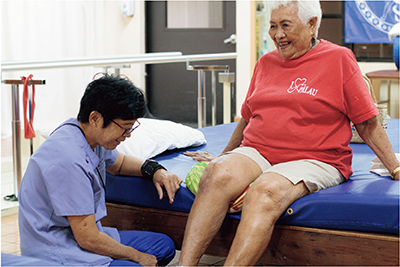
A JOCV providing exercise therapy guidance at Belau National Hospital in Palau (Photo: JICA)
SDG target 3.3 sets out to end epidemics of the three major infectious diseases by 2030. Japan has been actively supporting measures against these diseases and strengthening health systems, which also contributes to building GHA and promoting UHC, through the Global Fund.Note 73 From its establishment to September 2024, Japan has contributed a total of approximately $4.9 billion to the Global Fund. In order to ensure that measures against the three major infectious diseases are carried out more effectively, Japan also implements bilateral cooperation such as enhancing health systems, community empowerment, and improving maternal and child health, as a complementary support to the efforts made through the Global Fund.
As for bilateral cooperation in HIV/AIDS countermeasures, Japan provides assistance to raise awareness for preventing new infections as well as to promote testing and counseling. Primarily in Africa, in 2024, Japan Overseas Cooperation Volunteers (JOCVs) continue to engage vigorously in deepening people’s knowledge and understanding of HIV/AIDS prevention and providing care and support to people living with HIV/AIDS.
With regard to tuberculosis, Japan engages in reducing the annual number of deaths from tuberculosis in developing countries, particularly in Asia and Africa, in accordance with the “Stop TB Japan Action Plan,” revised in 2021. As an interim goal by 2025, Japan aims to achieve a 75% reduction in deaths from tuberculosis (compared to 2015) and a 50% reduction in tuberculosis incidence (compared to 2015; less than 55 cases per 100,000 people) through a public-private partnership, drawing on Japan’s own experience and technology cultivated through its struggle against tuberculosis.
In respect of malaria, one of the major causes of infant mortality, Japan supports efforts to combat malaria by strengthening local communities in Myanmar and Solomon Islands. Through contributions to the Global Fund, Japan also takes measures against malaria on a worldwide level.
(Responding to Antimicrobial Resistance (AMR))
Antimicrobial Resistance (AMR)Note 74 is a serious threat to public health, and in recent years, the momentum for countermeasures has been growing. In order to advance measures against AMR, Japan promotes the “One Health Approach,” in which actors engaged in the areas of human, animal, and environmental health work together. Based on the consensus at the G20 Osaka Summit in 2019 on promoting the One Health Approach, Japan announced in the same year that it would contribute approximately ¥1 billion to GARDP,Note 75 which promotes research and development for new antibiotics and diagnostics. Japan takes the lead in tackling AMR, including through its participation in the Global Leaders Group on Antimicrobial Resistance. In 2024, Japan contributed approximately ¥250 million to GARDP.
(Neglected Tropical Diseases (NTDs))
Parasitic and bacterial infections, such as Chagas disease, Filariasis, and Schistosomiasis, are known as “neglected tropical diseases (NTDs).” 1.6 billion people worldwide are infected with NTDs, causing major socio-economic losses to developing countries. In June 2022, Japan signed “the Kigali Declaration on neglected tropical diseases (NTDs)” and cooperates closely with the relevant countries and international organizations on countermeasures. As of November 2024, Japan has contributed a total of ¥24.72 billion to the Global Health Innovative Technology (GHIT) Fund and provides support for countermeasures against NTDs through GHIT. In May 2024, a pediatric formulation for Schistosomiasis developed through support from GHIT was included in the WHO List of Prequalified Medicinal Products.
In addition, Japan has provided support in combating Lymphatic Filariasis for Pacific Island countries through technical cooperation since the 1970s. The “Project for Elimination of Lymphatic Filariasis in the Pacific Region” provided support through a public-private partnership, with JICA dispatching experts for technical guidance and a Japanese pharmaceutical company offering anthelmintics to WHO free of charge, enabling mass drug administration to stop transmission in infected areas. This long-term support from Japan has proved successful, with nine of the Pacific Island countries (Cook Islands, Kiribati, Marshall Islands, Nauru, Niue, Palau, Solomon Islands, Tonga, and Vanuatu) having eliminated Lymphatic Filariasis. Currently, Japan implements the “Project for Elimination of Lymphatic Filariasis Phase 2” aimed at eliminating Lymphatic Filariasis in Papua New Guinea through the dispatch of experts and other means.
(Polio)
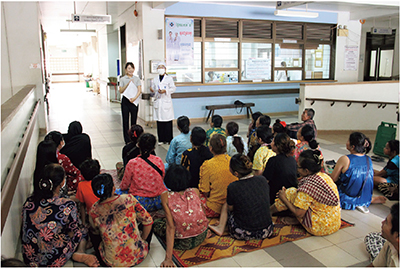
A JOCV working with hospital staff on nursing activities at Kampong Cham Hospital in Kampong Cham Province, Cambodia, constructed through Japanese grants (Photo: JICA)
Polio is on the brink of eradication. Japan, in cooperation mainly with UNICEF and Gavi, provides support toward its eradication with a focus on countries where the disease remains endemic (countries with endemic wild poliovirus: Afghanistan and Pakistan). During 2024, in Afghanistan, Japan provided support for routine immunization activities and the procurement of vaccines necessary for polio vaccination campaigns in cooperation with UNICEF. Similar supports are also ongoing in Pakistan.
Glossary
- WHO Health Emergencies Programme
- A program within WHO that responds to health emergencies. It evaluates the health emergency response capacity of countries, supports drafting of plans, and monitors new and ongoing health emergency situations. It also provides health services to save lives in countries where health emergencies are occurring.
- Contingency Fund for Emergencies (CFE)
- An emergency fund for responding to outbreaks and states of emergency, established by WHO in 2015, reflecting on the Ebola virus outbreak in West Africa in 2014. Decision-making regarding 24 hours of that decision.
- Gavi, the Vaccine Alliance
- A public-private partnership established in 2000 with the aim of saving children’s lives and protecting people’s health by improving immunization coverage in developing countries. Governments of both donor countries and developing countries, relevant international organizations, the pharmaceutical industry, private foundations, and civil society participate in this partnership. Since its establishment, it is said to have vaccinated more than 1 billion children and saved over 16.2 million lives.
- Note 66: The concept that all people have access to effective and quality-assured health services at affordable costs without financial hardship.
- Note 67: According to data from the United Nations Children’s Fund (UNICEF). https://data.unicef.org/topic/child-survival/under-five-mortality/
- Note 68: According to data from the World Health Organization (WHO) (as of April 26, 2024). https://www.who.int/news-room/fact-sheets/detail/maternal-mortality
- Note 69: Health regulations established by the WHO with the aim of preventing the international spread of diseases to the greatest extent possible.
- Note 70: The period after childbirth in which women recover to a similar condition before pregnancy, usually around one to two months after birth.
- Note 71: See glossary.
- Note 72: A support program by Gavi aimed at establishing a sustainable vaccine manufacturing foundation in Africa and improving the resilience of vaccine supply. It provides funding to vaccine manufacturers that meet certain criteria to promote the strengthening of vaccine manufacturing capacity. The program will provide up to $1 billion in support over ten years starting in 2024.
- Note 73: Public-Private Partnership established in 2002, following the G8 Kyushu-Okinawa Summit in 2000, where infectious disease control was raised as a major agenda for the first time. It contributes to efforts in achieving the SDGs by providing financial cooperation for measures against the three major infectious diseases (HIV/AIDS, tuberculosis, and malaria) and strengthening health systems in developing countries.
- Note 74: Pathogenic microorganisms, including bacteria and viruses, gaining resistance to antimicrobials such as antibiotics and antiviral drugs, which causes the drugs to lose sufficient efficacy.
- Note 75: An abbreviation for Global Antibiotic Research & Development Partnership.