
1 Japan’s ODA: Its Track Record and Significance
2024 marks the 70th anniversary of Japan’s first provision of technical cooperation to Asian countries after joining the Colombo Plan in 1954. Over the course of those 70 years, Japan went through the post-war period and high growth period, and its Official Development Assistance (ODA) has played a significant role. It helped Japan contribute to addressing a wide range of regional and global challenges as a responsible member of the international community, and by doing so, build peace and prosperity for itself.
ODA has contributed to actively fostering a favorable international environment for Japan—including strengthening bilateral relations, enhancing Japan’s credibility, and gaining support in international fora—in addition to supporting the stability and growth of the Japanese economy, by securing reliable supplies of energy and mineral resources and food, as well as promoting the overseas expansion of Japanese companies.
Over the past 70 years, the trust Japan has cultivated through its ODA to a total of 190 countries and regions has been reflected in various ways. For instance, Japan’s cooperation has been featured in the design of banknotes and postage stamps in developing countries. This trust was also evident in the many messages of sympathy and support Japan received from countries around the world—including developing countries—following the Great East Japan Earthquake and other recent disasters. In addition, Japan has earned strong international support in elections to international organizations, including from developing countries, as demonstrated by its record 12 elections as a non-permanent member of the United Nations Security Council—the most among the UN Member States. These are the fruits of the trust Japan has built through diplomatic efforts, including ODA, and reflect the high expectations the international community places on Japan.
(1) Track Record
In 1954, Japan joined the Colombo PlanNote 1 and began providing technical cooperation to countries in Asia, including hosting trainees and dispatching experts. In 1958, it extended its first yen loan to India, followed by the establishment of the Japan Overseas Cooperation Volunteers (JICA Volunteer program) in 1965 and the launch of grants, starting with food aid, in 1968. At the same time, Japan itself was still a recipient of assistance from developed countries and international organizations, borrowing funds in sectors such as steel, automobiles, shipbuilding, electric power development, and road infrastructure. The international support laid the foundation for Japan’s post-war period of rapid economic growth.
From the late 1960s through the 1970s, as Japan’s growing economic power and international status led to rising global expectations for its ODA. In 1974, the Japan International Cooperation Agency (JICA) was established as the implementing agency for ODA, marking the full-scale launch of Japan’s development cooperation. By the late 1970s, Japan’s areas of support had expanded from primarily Asia to include the Middle East, Africa, Latin America, and Oceania.Note 2 Entering the 1980s, Japan deepened its collaboration with a broad range of partners—including international organizations as well as both national and international NGOs—and diversified the sectors in which it provided support. In 1989, Japan overtook the United States to become the world’s top donor in terms of total ODA.
With the end of the Cold War and the expansion of globalization, with a view to addressing the new development challenges of the 21st century, Japan formulated its first ODA Charter in 1992 as a guideline for ODA policy and implementation. Following subsequent revisions, the ODA Charter evolved into the Development Cooperation Charter in 2015.
Since 2015, international cooperation to address global challenges has advanced through milestones, such as the adoption of the Sustainable Development Goals (SDGs) and the entry into force of the Paris Agreement on climate change. At the same time, the international community has become increasingly fragmented and confrontational. In this context, it has become ever more important for countries to overcome differences in values and work together. Accordingly, the role of development cooperation has grown significantly. With a rising need to collaborate with a diverse range of actors and mobilize new sources of funding, Japan revised the Development Cooperation Charter in 2023 for the first time in eight years to chart a path towards more effective and strategic use of development cooperation.
Public opinion surveysNote 3 conducted since 1997 include a question on the “Development Cooperation in the Future.” Positive responses to this question have consistently exceeded 60%, with this figure rising to nearly 80% since 2014 (79.4% in 2023). At the same time, a certain proportion of respondents continue to express more critical views such as “It should be reduced as much as possible” or “It should be discontinued” (16.2% in 2023). Recognizing that contributing to peace, stability, and prosperity in the international community and building trust-based relationships with a wide range of countries also serves Japan’s own national interests, Japan will continue to pursue strategic and effective development cooperation, while making ongoing efforts to secure public understanding and support for ODA.
[Case 1] Japan’s Post-war Reconstruction Experience with International Support
Following World War II, Japan received extensive support from the international community to recover from devastation and to pursue reconstruction and development. In the 1950s, Japan borrowed approximately USD 863 million from the World Bank across 31 projects, covering areas such as steel, automobile manufacturing, shipbuilding, and electric power development, including dam construction. During the 1960s, support extended to road and transportation infrastructure, including major projects such as the Tokaido Shinkansen (bullet train) and the Tomei and Meishin Expressways that link Tokyo and Nagoya and Nagoya and Kobe respectively. These investments laid the foundation for the country’s subsequent period of rapid economic growth. The final World Bank loan was repaid in 1990, and Japan is now the Bank’s second largest shareholder.

Toyota Motor Corporation received a loan of USD 2.35 million from the World Bank to purchase machine tools for trucks and buses at the Koromo Plant (now the Toyota Headquarters Plant), which was Japan’s first fully integrated automobile production facility. (Photo: World Bank)
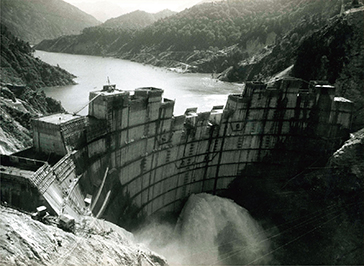
To address the severe power shortages during Japan’s post-war economic recovery, Kansai Electric Power Co., Inc. constructed the Kurobe River No. 4 Hydropower Plant with a loan of USD 21.5 million. The plant provided stable electricity supply to major cities in the Kansai region, supporting key industries of the time such as steel, shipbuilding, and textiles. (Photo: World Bank)
- Note 1: A cooperative organization established in 1950 to support economic and social development in Asia-Pacific countries.
- Note 2: See Chart II-2.
- Note 3: Cabinet Office “Public Opinion Survey on Diplomacy” https://survey.gov-online.go.jp/r05/r05-gaiko/