
3 Increasing Development Cooperation to Developing Countries by Emerging Donors and the Private-Sector
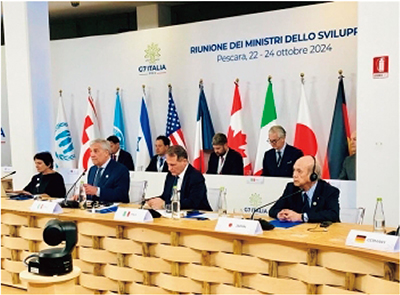
Discussion at the G7 Development Ministerial Meeting
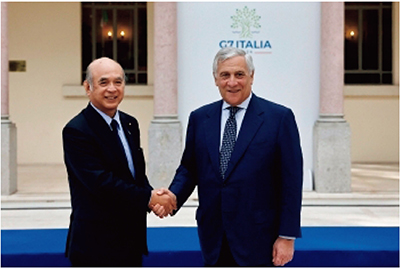
Then State Minister for Foreign Affairs Tsuge and Minister of Foreign Affairs and International Cooperation Tajani of Italy (Photo: Agenzia ANSA/Italian MFA)
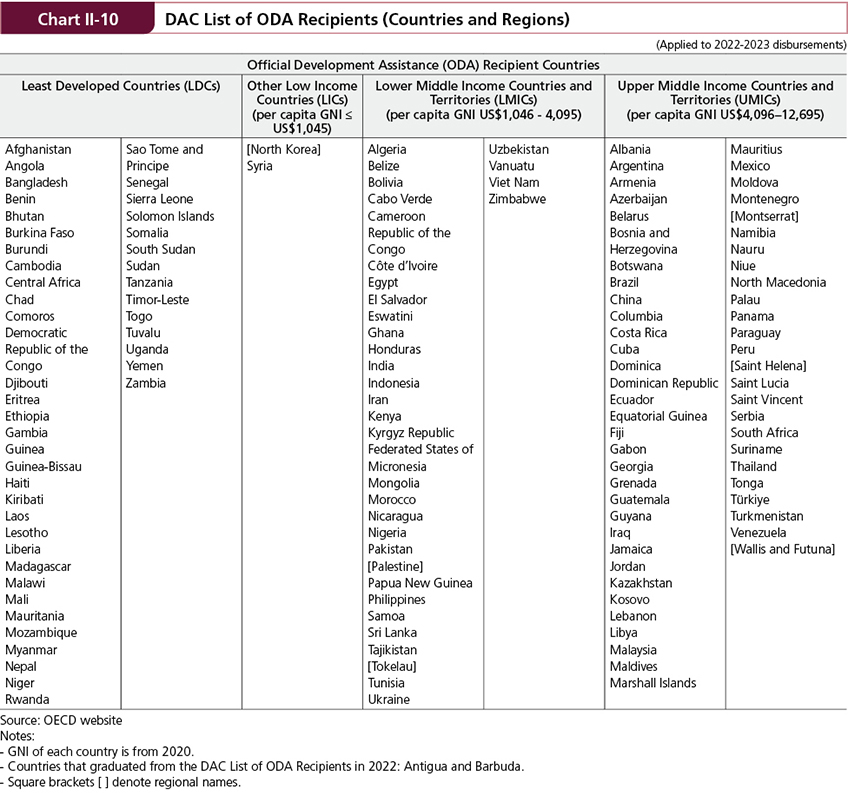
Recent years have seen an increase in aid for developing countries provided by non-DAC emerging donors, such as China, India, Indonesia, Saudi Arabia, Brazil, Argentina, Mexico, Turkey, South Africa, and private foundations, in addition to the DAC members. Although only a few non-DAC countries report to DAC, according to DAC statistics alone, the total amount of aid provided in 2023 was more than $17.4 billion by non-DAC countries, and approximately $0.4 billion from private funds by those countries. Aid provided by non-profit organizations, including NGOs, from DAC and non-DAC countries, has reached approximately $60 billion.Note 10
As stated in the “Pact for the Future” adopted by the UN General Assembly during the Summit of the Future in September 2024, to bridge the financing gap for achieving the SDGs in developing countries, it is essential to “provide and mobilize sustainable, affordable, accessible, transparent and predictable development finance from all sources and the required means of implementation to developing countries.” Thus, funding by various actors must be directed to developing countries in order to achieve the SDGs.
While the flow of funds to developing countries is diversifying, it is essential to accurately grasp the flow of funds and to effectively utilize limited development finance in order for the international community to promote development cooperation in a coordinated manner. However, the statistics prepared and published by the DAC do not reveal the full details of aid for developing countries provided by non-DAC countries. It has also been pointed out that there are opaque and unfair lending practices that do not conform to international rules and standards.
Under these circumstances, the transparency of development finance and other related matters were discussed in concrete terms at various international forums in 2024.
In the G7, the G7 Foreign Ministers’ Communiqué in April 2024 reaffirmed the promotion of transparency in development finance. Subsequently, at the G7 Apulia Summit in June, then Prime Minister Kishida pointed out the need to appropriately address debt issues and stated that it is important for all creditor countries and debtor countries to have a shared recognition of the importance of transparent and fair development finance that complies with international rules. It was further confirmed that all actors involved in development cooperation must work together to adhere to existing principles. In addition, there was a shared commitment to support the development of bankable projects in partner countries, including developing countries. Based on these discussions, at the G7 Ministerial Meeting on Development in October, then State Minister for Foreign Affairs Tsuge emphasized the importance of promoting transparent and fair development finance that complies with international rules and standards, including the “G20 Principles for Quality Infrastructure Investment.” The Communiqué of this meeting reaffirmed the G7’s determination to continue advancing high standards for quality, inclusive, and sustainable infrastructure, and to promote collaboration with various partners, including private sector entities.
In the G20, at the G20 Development Ministerial Meeting in July, then Parliamentary Vice-Minister for Foreign Affairs Hosaka called for the G20 to continue working to ensure that all development cooperation providers conduct transparent and fair development finance that complies with international rules and standards, including the “G20 Principles for Quality Infrastructure Investment.” The Ministerial Declaration issued at this meeting stated that the G20 reaffirms the importance of promoting development finance, respecting the applicable finance-related principles while noting the importance of transparency and mutual accountability. The Leaders’ Declaration adopted at the G20 Rio de Janeiro Summit held in November called for mobilizing new and additional domestic and international resources from all sources, while at the same time increasing their effectiveness, and noted the importance of transparency and mutual accountability.
Furthermore, the Ministerial Council Statement of the OECD Ministerial Council Meeting in May, chaired by Japan, reiterated the call for all providers of development cooperation to adhere more closely to international standards and practices that improve the effectiveness, transparency and accountability in development cooperation. The statement also underscored that development finance should be provided in a transparent and fair manner in line with existing international rules and standards. Additionally, it included a call for the international community to further enhance debt transparency through actions by all creditors and debtor countries, including through debt data sharing exercises.
Japan will continue to work with the international community to ensure that aid for developing countries, provided by emerging donors, is transparent and consistent with international standards and initiatives (see also Part III, Section 1 (4), and Part V, Section 1 (2)).
- Note 10: OECD database (OECD Data Explorer) (December 2024)