
Stories from the Field 06
Voices of Japanese Personnel Working in International Organizations
– Tackling the Challenges of Forced Displacement –
In 2024, Japan celebrates the 50th anniversary of the start of its Junior Professional Officer (JPO) Programme.Note 1 More than 2,000 young Japanese professionals have been dispatched to international organizations through this programme, and as of the end of 2023, approximately half of the 960 Japanese staff (at professional level or above) working in UN-related organizations are former JPOs. Thus, the JPO Programme plays a significant role as the first step for Japanese nationals pursuing careers in international cooperation as staff members of international organizations. The author of this column, Ms. SHINOZAKI Tomomi, is among those who have benefited from the programme and is set to assume a regular staff position as of January 2025.
Refugee Camp Visit Leading to a Career in International Cooperation
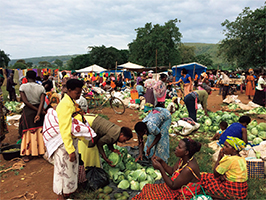
Refugee women working in a market within a refugee settlement in Uganda to make a living (Photo: SHINOZAKI Tomomi)
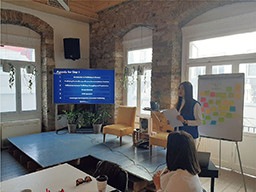
The author conducting training on counter-trafficking in persons for IOM Greece staff (Photo: SHINOZAKI Tomomi)
After visiting Hiroshima on an elementary school field trip and hearing testimonies from atomic bomb survivors, I began to think, “I want to contribute to global peace through meaningful roles in international cooperation.” To identify the fields I aspired to work in, I actively took part in internships both in Japan and overseas as well as study abroad programs during my student years. While studying Post-war Recovery Studies in graduate school, I traveled to Uganda to conduct research for my master’s thesis. Engaging directly with refugees and hearing their stories firsthand shaped my desire to pursue a career at the International Organization for Migration (IOM). Witnessing the struggles of people forced to flee and rebuild their lives in countries with different languages and cultures, I became determined to support displaced individuals and address the root causes of forced migration.
After completing graduate school, I joined a Japanese NGO and provided assistance to displaced persons in South Sudan and Uganda. I then served as a UN Volunteer at IOM Nigeria through the “Program for Global Human Resource Development for Peacebuilding and Development”Note 2 before being appointed as a JPO at IOM Greece in January 2022, where I supported efforts to combat trafficking in persons.Note 3 Since April 2023, I have been working on IOM Somalia’s peacebuilding programme from its Kenya-based Sub-Office. Initially, I was primarily responsible for project formulation and reporting on ongoing projects. Over time, I was entrusted with managing projects that I had developed myself. I am currently tasked with a broad scope of work, including coordination with the Somali government, donors, and other international organizations, as well as the recruitment of local staff, selection of local NGOs as implementing partners, budget management, and monitoring activities.
Addressing the Root Causes of Forced Displacement
In Somalia, the activities of violent extremist groups, notably Al-Shabaab, have been a significant cause of forced migration and human suffering. Therefore, the Government of Somalia aims to dismantle these groups by encouraging voluntary defections and providing rehabilitation and reintegration support for “low-risk” defectors. Many women who have left these groups, such as the wives of the combatants, face serious challenges including discrimination and alienation from local communities and the risk of retaliation from the groups, despite not being directly involved in killings or acts of violence. Many are also victims of conflict-related sexual violence (CRSV). The project I am currently managing provides psychosocial care, vocational training, and other support to low-risk defectors from violent extremist groups, including such women, as well as marginalized young people who are at high risk of being recruited by these groups. The project aims to promote their socio-economic reintegration and meaningful participation in society. At IOM Somalia, I am based in the Nairobi Support Office in the Kenyan capital. I regularly communicate with local staff via phone, social media, email, and online meetings. While it is difficult to visit project sites in person, I find great fulfillment in delivering much-needed assistance in hard-to-reach areas through cooperation with local staff and partner NGOs who share the same aspirations. I am committed to continuing my work on addressing the issues that cause forced displacement and supporting those affected by it.
SHINOZAKI Tomomi International Organization for Migration (IOM) Somalia Office
Note 1 Established by a 1961 resolution of the United Nations Economic and Social Council, this program allows international organizations to accept young professionals on the condition that their costs are covered by their respective governments.
Note 2 See Note 40.
Note 3 See Note 51.
<< Previous Page
Main Text | Reference Statistics | Stories from the Field | Master Techniques from Japan to the World | ODA Topics