
Stories from the Field 05
Trainees Returning from Japan Advancing National Development and Japan-Nepal Relations
– The Network and Contributions of JICA Alumni in Nepal –
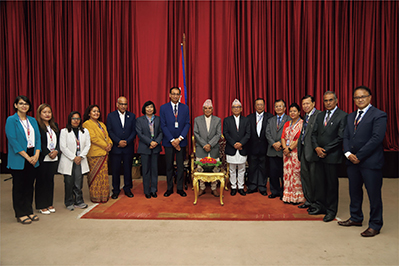
JAAN executive committee members paying a courtesy call on President Paudel of Nepal (Ms. Shrestha, fourth from the left; Dr. Bhusal, seventh from the left) (Photo: JAAN)
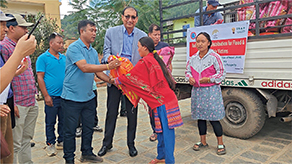
JAAN providing food assistance in areas affected by flooding that occurred in September 2024 (Dr. Bhusal at the center) (Photo: JAAN)
Nepal, a traditionally pro-Japan country, has the lowest income level in Southwest Asia. Its main industry, agriculture, struggles with low productivity. The country also faces a number of challenges, including its landlocked geography, natural disasters, underdeveloped social infrastructure, and governance issues.
Japan has long accepted many government officials and engineers from Nepal through JICA’s training programs, supporting them in acquiring the knowledge and skills necessary to address national challenges. The JICA Alumni Association of Nepal (JAAN), whose members include former JICA trainees who have returned after completing their training or studies in Japan, not only applies what they have learnt in Japan in developing their home country, but also contributes to strengthening bilateral relations between Japan and Nepal.
JAAN was established in 1973 and currently has nearly 1,100 members. Many members hold key positions in the government as well as in major public and private institutions, forming an extensive network. While working to strengthen connections among alumni, members leverage their experiences in Japan to support Nepal’s development in a wide range of areas from various positions.
For example, in the energy sector, under the leadership of Mr. Kul Man Ghising, now Managing Director of Nepal Electricity Authority, the country has achieved a stable electricity supply for its citizens, resolving the long-standing issue of scheduled power outages. In the field of education, Ms. Biva Kalika Malla Shrestha, who serves as vice-principal at a Nepali high school, is making notable contributions.
“I visited Japan in 1996 and 2018. Having received an education centered on blackboard-based, one-way instruction, I was impressed by Japan’s primary education methods, which emphasize learning through practice. It made me realize that education drives national development. As an educator, I’m working to integrate Japanese teaching methods in Nepal, working with relevant institutions to enhance children’s learning,” she says with enthusiasm.
The current president of JAAN, Dr. Ram Chandra Bhusal, came to Japan in 1997 as a JICA trainee, where he received training in agriculture. As his desire to continue learning in Japan grew following his training, he made his way back, and over the course of seven years, earned his doctoral degree from the United Graduate School of Agricultural Sciences at Ehime University. After returning to Nepal, he made full use of the expertise he gained in Japan by working on agricultural research and development projects at international NGOs and major donor agencies. He is dedicated to improving the lives of the poor by increasing farmers’ income through new agricultural technologies and production of high-value crops. Dr. Bhusal reflects on his experience and says, “I learned the importance of considering human health and plant health as one, and that management, not just agricultural technology, is crucial.”
One of the characteristics of JAAN’s activities, Dr. Bhusal explains, is that “JAAN always carries out its work flexibly, adapting to the needs and circumstances of the times.” For example, in 2024, JAAN redirected funds typically allocated for their annual event during Nepal’s traditional “Dashain” festival to provide relief supplies to flood victims, contributing to the country’s recovery. In recent years, JAAN has also expanded its network beyond national borders, organizing international seminars with participation from South Asian countries, in addition to hosting domestic seminars focused on human resource development.
Furthermore, JAAN contributes to the development of friendly bilateral relations between Japan and Nepal by strengthening cooperation and fellowship with the Embassy of Japan in Nepal, JICA Nepal Office, JICA experts dispatched from Japan, and Japan Overseas Cooperation Volunteers, as well as by regularly engaging in discussions. A relationship of mutual cooperation has been established, with the Government of Nepal and JAAN offering support to Japan during the Great East Japan Earthquake, and the Government of Japan and JICA providing aid to Nepal following the major earthquake in 2015.
JAAN is expected to continue playing a vital role in Nepal’s development while serving as a bridge between Nepal, Japan, and other countries.
<< Previous Page Next Page >>
Main Text | Reference Statistics | Stories from the Field | Master Techniques from Japan to the World | ODA Topics