
Stories from the Field 04

Mine Clearance Expertise from Cambodia Protecting the People of Ukraine
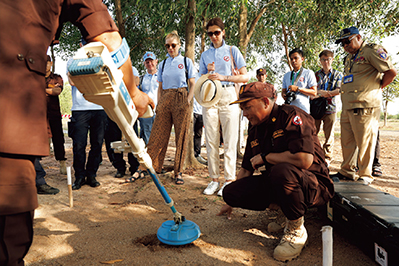
Mr. Rithisak from CMAC (front right) training personnel from Ukraine’s State Emergency Service on landmine and UXO detection using a metal detector equipped with a Japanese radar system (Photo: JICA)
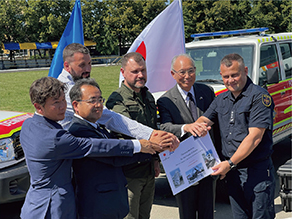
Mr. Amemiya (far left) participating in the handover ceremony of demining machines in Ukraine, together with then Ambassador to Ukraine Matsuda, Mr. Ihor Klymenko, Minister of Internal Affairs of Ukraine, and Mr. Matsunaga, Director of JICA Ukraine Office (Photo: Nikken Corporation)
Cambodia is among the countries most affected by landmines and unexploded ordnance (UXO) as a consequence of the Vietnam War and the subsequent civil war. While the Government of Cambodia places landmine and UXO clearance as a national priority, the Cambodian Mine Action Centre (CMAC) plays a central role as the leading government agency in these demining efforts.
Since 1998, Japan has provided consistent support for Cambodia’s mine action efforts, supplying equipment, training personnel, funding research and development, and offering technical assistance to strengthen institutional capacity. Having made steady progress in clearing mines within its own territory, Cambodia now holds the world’s largest record of demined land area and is recognized as a global leader in mine action. Drawing on its experience and expertise, Cambodia has also contributed to mine action in countries such as Colombia, Laos, Angola, and Iraq through training and other initiatives.
Japan and CMAC are also working together to support mine action in Ukraine, where Russian aggression continues. Since 2023, they have conducted training for Ukrainian government officials on the use of demining equipment, offered capacity-building programs on mine risk education for local communities, and hosted site visits for senior government officials.
In July 2024, Japan provided two Anti-personnel Landmine Clearance Machines (so called demining machines) to the State Emergency Service of Ukraine. The machines were developed by Nikken Corporation, which had previously collaborated with CMAC in Cambodia to develop demining machines. President AMEMIYA Makoto recalls, “The former president of Nikken had a vision of creating a playground where Cambodian children could run around freely. Despite having no prior knowledge of landmines or explosives, the company embarked on the development of a demining machine and after five years, succeeded in creating the world’s first and only shovel-type demining machine.” The hydraulic excavator-type machine offers greater versatility than traditional bulldozer-type models. By changing the front attachments, it can carry out a wide range of operations for various purposes, even in environments with high risk of explosives. Furthermore, by switching to attachments designed for debris transport or infrastructure construction, it also supports reconstruction efforts even after mine clearance. Highly acclaimed internationally, these machines are now used in 12 countries, with specifications tailored to the unique conditions of each. Mr. Amemiya explains, “In Ukraine, we faced the challenge of not being able to inspect the site directly. However, we studied the conditions through photos and videos, and received direct feedback from the Ukrainian side. As a result, we added protective covers to prevent debris from scattering from the sides of the demining machine.” Reports from the field indicate that “the latest demining machines have already been tested under actual conditions, with deminers effectively utilizing their capabilities.” Japan continues to supply demining machines, and as of December 2024, all 12 planned units have been shipped.
Mr. Srey Rithisak, a CMAC staff member with extensive experience in equipment development, operations, and management in collaboration with Japanese companies, is now contributing to mine action in Ukraine, a country where he previously studied. He emphasizes the importance of continuous efforts, stating, “Unlike standard metal detectors or construction machinery, mine clearance equipment requires delicate handling. In addition to initial training, repeated practice is essential.” Mr. HAYASHI Akihito, a JICA expert in landmine and UXO currently dispatched to CMAC, looks ahead to future prospects of mine action: “Through Japan’s ongoing technical cooperation in Cambodia, we help strengthen CMAC’s organizational capacity, enabling it to draw on its own experience to contribute more actively to mine action efforts in other countries. We also share a common understanding of the need for continued cooperation for mine action in Ukraine.” Reflecting on the initiative, Mr. Amemiya remarks: “Cambodia has been a trusted partner in mine action, with whom Japan has built a relationship over many years. It is a source of pride to work alongside them to support mine action in other countries. I hope Japan will continue to be a country that promotes peace through international cooperation.”
Japan will continue to contribute to mine action around the world through its ongoing cooperation with Cambodia.
<< Previous Page Next Page >>
Main Text | Reference Statistics | Stories from the Field | Master Techniques from Japan to the World | ODA Topics