
Stories from the Field 03


Expanding Transportation Infrastructure by Supporting the Construction of the Cairo Metro
– Building a Transportation Network Leveraging Japan’s Advanced Technology –
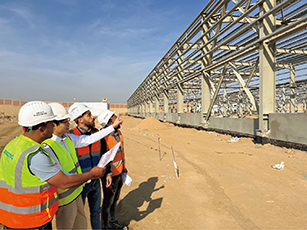
Japanese company representatives and local engineers discussing at the construction site (Photo: Mitsubishi Corporation)
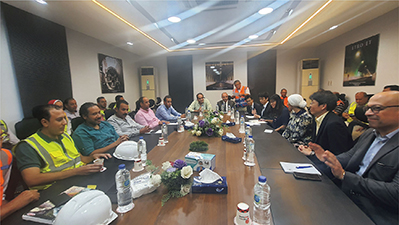
Japanese company representatives discussing with NAT (Photo: Oriental Consultants Global Co., Ltd.)
The Government of Egypt has been working to expand transportation means to alleviate traffic congestion that has resulted from population growth. In 1987, it opened the first subway on the African continent. However, despite the completion of three metro lines to date, the population has continued to grow rapidly, increasing by 20 million in just a decade since 2010. Approximately 20% of the total population is concentrated in the Greater Cairo Region, exacerbating traffic congestion. Within this context, the Cairo Metro Line No.4 is positioned as a particularly urgent project for expanding transportation options in the Greater Cairo Region under the national plan for transportation and urban development formulated by the Government of Egypt. Since 2012, Japan has been supporting the development of the approximately 19 km section of Line No.4 connecting central Cairo with the Giza Pyramid area through its financial assistance
This project is the first yen loan project for Egypt to which Special Terms for Economic Partnership (STEP)Note 1 has been applied, and Japanese advanced railway products and technologies are planned to be utilized for the railroad vehicles and signaling systems. Once this line opens, travelers will be able to reach major tourist destinations such as the Pyramids in Giza and the Grand Egyptian Museum (GEM), which Japan supported through construction, cultural property restoration, and operational assistance, and which began its trial opening in October 2024, from central Cairo in just about 20 minutes. This is expected to contribute significantly to the development of Egypt’s tourism industry.
Mr. NISHIKORI Atsushi, Deputy Director of the Railway Division at Oriental Consultants Global Co., Ltd., which is involved in the construction supervision of this project, highlights technology transfer as one of the strengths of Japanese infrastructure development. “For Line No.4 construction, we need to build a tunnel under the Nile River and construct multiple tunnels not horizontally but with vertical alignment, which is technically challenging. While this construction method is new for Egyptian engineers, many experienced experts in railway projects from Japan, Europe, and other regions are participating in this project. We believe it would be a good opportunity for them to acquire new technologies through collaboration.”
At the same time, Mr. Nishikori faced difficulties in securing local talent due to the strict qualification requirements set by the National Authority for Tunnels (NAT), the implementing agency under Egypt’s Ministry of Transport. He notes that they are overcoming problems by building a relationship of trust with NAT. “Given that experienced Egyptian engineers tend to move to neighboring countries for higher salaries, we explained to NAT that easing qualification requirements would help the development of domestic human resources. Through close communication and persistent negotiation with NAT, we are gradually gaining a certain level of their understanding,” he states.
Mr. Nishikori also mentions, “I am staying at an accommodation near tourist sites, and nearby hotels are thriving, partly due to the trial opening of the GEM. If the launch of the Line No.4 alleviates traffic congestion and improves access, Egypt’s tourism industry is likely to become even more vibrant.” He also explains the economic effects that will be brought about by the opening of Line 4. “Foreign companies are increasingly entering the Egyptian market. Recently, the manufacturing and sales of Oronamin C Drink, a vitamin drink made in Japan, has begun in Egypt. I hope that the development of the transportation network will attract investments from Japan, ultimately contributing to job creation for Egyptians.”
In addition to the construction of Line No.4, the Government of Egypt is proceeding with the development of the New Administrative Capital, located approximately 45 km east of Cairo. In 2022, some government officials started operations in the New Administrative Capital, advancing large-scale urban development. Japan will continue to respond to the Government of Egypt’s expectations for its excellent technology and expertise, contributing to Egypt’s economic development by expanding transportation infrastructure and other means.
Note 1 See Part V, 2(2).
<< Previous Page Next Page >>
Main Text | Reference Statistics | Stories from the Field | Master Techniques from Japan to the World | ODA Topics