
(2) Institutional Design for Development Cooperation that Enables Qualified Response with Japan’s Strengths
The human resources, knowledge, high level of technical competency, and institutions that Japan has developed in the course of its democratic economic development while valuing its own traditions are assets for development cooperation. Japan builds on these strengths to engage in development cooperation.
■Investment in People
Since Japan began providing ODA in 1954, it has consistently emphasized “investment in people” to transfer its technologies and expertise through acceptance of trainees and dispatch of experts, and strove to develop human resources with careful programming. For the purpose of contributing to solving problems in developing countries, Japan has hosted from developing countries trainees in a wide range of fields, including public administration, agriculture, forestry, fisheries, mining and manufacturing, energy, education, health, medicine, transport, and communications. In FY2023, 9,253 new trainees from 137 countries and regions came to Japan to participate in training programs, while a total of 463 new trainees from seven countries participated in the In-Country Training Program—conducted in the home countries and regions of the trainees—and 2,479 new trainees from 110 countries and regions participated in the Third-Country Training Program. Furthermore, through the Dispatch of Technical Cooperation Experts, Japan aims to develop the human resources of developing countries by providing advanced policy recommendations to governments tackling development challenges and by developing technologies tailored to local conditions, in pursuit of enhanced development outcomes. As of FY2023, a total of 6,827 JICA experts, both new and those from previous fiscal years, are active in 103 countries and regions.
■Japan Overseas Cooperation Volunteers (JICA Volunteer Program)
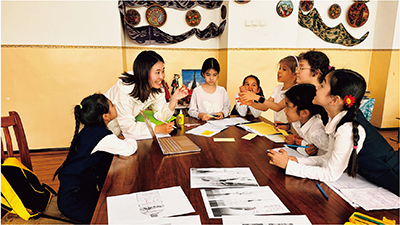
A JOCV teaching Japanese language and culture to children at an elementary school in Tashkent, Uzbekistan (Photo: JICA)
Started in 1965, the Japan Overseas Cooperation Volunteers (JICA Volunteer Program) has a long track record of success over half a century. More than 57,000 volunteers have been dispatched to 99 developing countries and regions in total, and as of December 2024, 1,756 volunteers are in service in 74 countries. This is an ODA program that invites public participation in the true sense of the word and has contributed to developing countries and regions while embodying the “visibility of Japanese development cooperation.” Furthermore, the program not only contributes to the socio-economic development in developing countries and regions but also to the promotion of mutual understanding and friendship between Japan and these countries and regions through cultivating people’s affinity for Japan, and, as a result, it is highly acclaimed both domestically and internationally.
In 2012, the JICA Volunteer Program, to dispatch personnel in partnership with private companies and organizations (hereinafter referred to as “private entities”), local governments, and universities, became officially institutionalized.Note 24 In partnership with private entities, the Program actively supports the overseas outreach of these companies through the dispatch of their staff as volunteers, tapping their professional experience from Japan for activities in developing countries and, upon return to Japan, by incorporating their knowledge of country-specific business practices and market needs from volunteering days in their corporate activities. By December 2024, 134 volunteers had been dispatched from private entities to 39 countries (see “Featured Project” for specific examples). In partnership with local governments, the Program enables the community-building know-how of Japanese municipality offices to be utilized for community development in developing countries through the dispatch of their staff as volunteers. Those former volunteers are expected to incorporate the community-building experiences from their volunteering days in their work back in local government offices in Japan for community development and nation-building. By December 2024, 80 volunteers had been dispatched from local government offices to 13 countries. The Program also supports university students being dispatched in partnership with universities, with the hope that the volunteering experiences in developing countries will enhance their personal growth and lead to effective human resource development in both Japan and developing countries. By December 2024, 1,123 volunteers had been dispatched from universities to 40 countries.
Moreover, it is worth noting that the JICA Volunteer Program returns its advantages to the Japanese society in the form of former volunteers’ contribution to regional revitalization and the business expansion of Japanese corporations to developing countries on the back of the global perspectives they newly obtained through the volunteering activities. Since 2022, to enhance such effects, JICA has been implementing the “GLOCAL Program (Pre-departure Type),” which provides opportunities for prospective JOCVs undergoing pre-dispatch training that intend to address challenges faced by regional communities in Japan after their volunteering service abroad to participate in activities for regional revitalization and multicultural coexistence implemented by local governments. In FY2023, 112 pre-dispatch volunteers participated in the program in 20 areas across 12 prefectures. Those who participated in the program regarded it as beneficial for acquiring firsthand experiences of fostering social relationships in a new place, gaining personal connections with communities that last beyond the end of the program, and broadening their career options after volunteer service abroad. Host local governments give highly positive feedback on the program, noting that insights from outsiders’ perspectives helped residents rediscover the value of their own communities.
In order to promote these initiatives, Japan strives to make it easier for more people to join the JICA Volunteer Program through supporting former volunteers’ pursuit of career advancement as well as disseminating information on how to participate in the Volunteer Program while retaining one’s job.
■Co-creation for Common Agenda Initiative
Japan’s advanced technologies and science and technology are major advantages. At the same time, as emerging and developing countries raise their technological base and present diversified needs, it is becoming important to provide value-added development cooperation in a way that couples the cooperation on quality hardware provision, including the equipment procurement and facility development, with the cooperation on software provision, including intervention in operation and maintenance, institutional building, and human resources development. Against such a backdrop, Japan has launched in the revised Development Cooperation Charter of June 2023 the galvanized Co-creation for Common Agenda Initiative, which advocates the proactive proposition of a cooperation menu, including Official Development Assistance (ODA), Other Official Flows (OOF), and private funding, which leverage Japan’s strengths in strategically important fields for foreign policy. In September 2023, Japan formulated the strategy document, “Co-creation for common agenda initiative”Note 25 and identified (i) climate change response and green transformation (GX), (ii) economic resilience, and (iii) promotion of digitalization and digital transformation (DX)Note 26 as strategic fields to promote this initiative.
Based on the above strategy document, Japan and a prospective developing country work together to formulate sector-based goals, scenarios, and a menu of possible development cooperation through policy dialogue. Through the process of presenting a cooperation menu indicating mid- to long-term inputs from Japan—indicative figures of financial contribution and enabling workforce, overview of a mixture of projects by different modalities, etc.—and discussing policy initiatives to be undertaken by developing countries, Japan and the developing country would gain a consensus on the overall framework of cooperation, if desired. Japan also emphasizes establishing a platform for dialogue for each target developing country with relevant stakeholders from both Japan and developing countries. Through these efforts, Japan aims to realize development cooperation goals and solve challenges of developing countries while also attempting to “co-create” with various stakeholders in addressing Japan’s own challenges and promoting economic growth.
A specific example of the Co-creation for Common Agenda Initiative is the cooperation for the development of Cambodia’s digital economy and society. In December 2023, then Prime Minister Kishida and Cambodian Prime Minister Hun Manet reached a consensus on a cooperation menuNote 27 for the development of Cambodia’s digital economy and society during their summit meeting. In March 2024, a public-private roundtable meeting was held to further promote cooperation by leveraging private sector services, products, and expertise. Relevant ministries (Ministry of Internal Affairs and Communications, Ministry of Economy, Trade and Industry), relevant organizations (JICA, Japan ICT Fund (JICT), Japan External Trade Organization (JETRO), Nippon Export and Investment Insurance (NEXI), Japan Bank for International Cooperation (JBIC)), and private companies participated in the conference.
Additionally, in March 2024, at the Japan-Mozambique Foreign Ministers’ Meeting, the two countries concurred on advancing cooperation under the Co-creation for Common Agenda Initiative for the stabilization of security in the northern region and stable supply of liquefied natural gas (LNG). In April 2024, at the Japan-Madagascar Foreign Ministers’ Meeting, the two countries agreed to utilize this initiative for the development of the Greater Toamasina area and the improvement of production technology for critical minerals. We are also promoting cooperation in disaster prevention and climate change countermeasures in Fiji and the Oceania region through this initiative.
Most recently, in October 2024, at the Japan–Laos Summit Meeting, the two countries concurred on cooperation on strengthening power connectivity between Laos and neighboring countries and promoting decarbonization through clean electricity in Laos, including the possible start of a Co-creation for Common Agenda Initiative. At the 2nd Asia Zero-Emission Community (AZEC) Leaders Meeting held in the same month, then Prime Minister Ishiba stated that Japan would consider implementing this initiative for Laos to contribute to regional decarbonization, with Laos as a future supply base of clean energy in the region.
■Grant for Grass-Roots Human Security Projects
Espousing the philosophy of human security, Japan’s Grant for Grass-Roots Human Security Projects, which traces its origin to the “Small-Scale Grant” initiated in FY1989, directly and agilely implements relatively small-scale development projects,Note 28 targeted at populations in localities of developing countries and regions where access to public service is limited. These projects address basic human needs (BHN) and encompass education, health and medical care, water and sanitation, landmine clearance, and disaster prevention. Within this framework, Japan also undertakes specific projects in which Japanese companies and local governments collaborate in project implementation, providing complementary services such as technical training. This approach leverages Japan’s expertise and technological capabilities to effectively address social challenges in developing countries and regions. In FY2023, a total of 507 projects were executed across 115 countries and regions.
Featured Project 14
Vietnam


Japan Overseas Cooperation Volunteers (Partnership Program) / Category: Computer Technology
IWAMOTO Hideaki (TOPPAN Holdings Inc.) (April 2018 - March 2019)
Applying Computer Technology Skills in the Field
I was dispatched as a Japan Overseas Cooperation Volunteer (JOCV) to Dong Thap Province in Vietnam, where I was assigned to a three-year community college to help improve a newly introduced e-learning system and assist with classes in the Department of Information Technology.
The college had begun using the e-learning system for submitting assignments and distributing education materials, but students were complaining that it was difficult to use. Therefore, I collected feedback from students and submitted proposals for improvement to the school. Since the practice of conducting surveys by questionnaire was not yet common at the college, it was a new experience for me to explain the concept of what surveys were to the faculty members.
For class support, I developed teaching materials on the latest artificial intelligence (AI) technology and taught classes. I also introduced programming case studies related to the control of manufacturing equipment. Drawing on my prior experience as an industrial engineer in factories, I strived to help students visualize how the technologies they were learning could actually be applied in real life.
After completing my term as a volunteer, I returned to work for TOPPAN Holdings Inc. in Japan and became involved in developing environmentally friendly plastic products. When I searched for and built relationships with new development and manufacturing partners, the ability to coordinate and dive into unknown environments developed as a volunteer proved to be beneficial.
Currently, I am stationed in Tanzania, working on a pilot project to realize smart agriculture.Note 1 At a coffee farm of TANJA Corporation Ltd. run by OS Trading & Investment Pte. Ltd., a company collaborating with TOPPAN Holdings Inc., we are working to optimize farm operations by leveraging satellite data and IoT technology,Note 2 aiming to develop a business that contributes to improving the lives of local residents. Drawing on my experiences as a volunteer, including adapting to different cultures and regions from those of Japan, I am committed to contributing to new business development in East Africa.
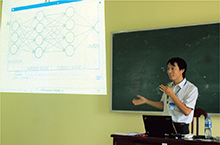
A class in the Department of Information Technology at Dong Thap Community College, Vietnam (Photo: IWAMOTO Hideaki)
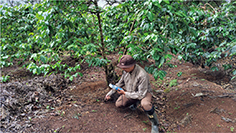
Conducting a soil survey in Tanzania (Photo: IWAMOTO Hideaki)
Note 1 The application of robotics, AI, and other advanced technologies, along with agricultural data, to enhance productivity and efficiency in agriculture.
Note 2 Technology that connects common devices to the internet, enabling remote monitoring, control, detection, and device interconnection via internet.
■Loan Aid
In order to enhance the “visibility of Japanese development cooperation” through utilizing and transferring Japan’s advanced technologies and know-how to developing countries, the Government of Japan continuously improves its systems, including the introduction of the Special Terms for Economic Partnership (STEP). Through these efforts, the ratio of orders received by Japanese companies has remained at around 60% to 70% in loan projects, which supports their business expansion overseas.
- Note 24: In April 2023, the “Private Sector Partnership,” “Local Government Partnership,” and “University Partnership” dispatch programs were reorganized and integrated into the “Partnership Program.”
- Note 25: Strategic fields and approaches to cooperation through the Co-creation for Common Agenda Initiative: “Co-creation for Common Agenda Initiative with Partners”
https://www.mofa.go.jp/mofaj/files/100553362.pdf - Note 26: See Note 15.
- Note 27: For details of the Co-creation for Common Agenda Initiative menu in the digital field for Cambodia, refer to the Ministry of Foreign Affairs website (https://www.mofa.go.jp/mofaj/files/100597089.pdf).
- Note 28: The general limit for each project is ¥20 million, with a maximum of up to ¥100 million.