
2 Institutional Design for Development Cooperation that Aptly Reflects Enhanced Strategic Values
(1) Enhanced Alignment of Policy Formulation and Project Implementation
■Policy Framework on Development Cooperation
Under the Development Cooperation Charter, which sets out Japan’s development cooperation principles, the Ministry of Foreign Affairs (MOFA) formulates the Country Assistance PolicyNote 17 for each recipient country as well as the Sectoral Development PolicyNote 18 in light of international efforts on development, such as the Sustainable Development Goals (SDGs).
The Country Assistance Policy identifies the priority areas and directions of Japan’s development cooperation for a given developing country or region, taking into account its political, economic, and social situations along with its development plans, development challenges, and other relevant factors. As an appendix to the Country Assistance Policy, the Rolling Plan is developed as a compilation list of all ODA projects in the country or region at various stages of implementation, organized by development issue and cooperation program with visualized implementation schedules, in order to increase correlation among and forward planning of development cooperation projects.
To implement Japan’s development cooperation more effectively, Japan shares its medium-term development cooperation policies with the governments of recipient countries, while also strengthening policy consultations with them and promoting efforts to achieve mutual recognition and understanding.
■Implementation Architecture of Development Cooperation
In the implementation of development cooperation in accordance with the relevant policies, the Government of Japan and implementing agencies work together to effectively utilize different modalities such as grants, technical cooperation, and loan aid. With a view to maximizing development impacts, Japan strives to implement development cooperation with the optimized combination of bilateral cooperation and multilateral cooperation through international organizations and NGOs, through “co-creation” in partnership with various actors.
In order to strengthen its posture to realize smooth processing from project conceptualization and formulation to implementation, the Government of Japan has put in place the country-based ODA Task ForceGlossary in each ODA-recipient country, comprised mainly of the Embassy of Japan and the JICA office, who have first-hand knowledge of local development needs and operational realities in consideration of the status of the bilateral relations and political, economic, and social situations of the recipient country. In addition, the ODA Task Force participates in the process of drafting the Country Assistance Policy and the Rolling Plan, formulating and shortlisting project candidates, strengthening collaborations with other donors, international organizations, Japanese companies, and NGOs with active local presence, and recommending and reviewing development cooperation modalities.
Japan also provides follow-up support even after project completion to ensure that each project is widely recognized by the government and people of the recipient country for many years to come and delivers effects properly.
■Improved Project Management and Ensuring Accountability of ODA
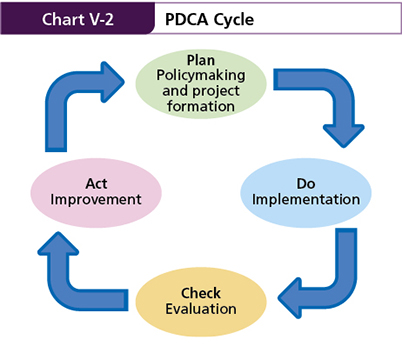
From the perspective of improving the effectiveness and efficiency of development cooperation and ensuring accountability to the Japanese public, it is important to carry out proper evaluations and incorporate the results of evaluations in the improvement of policies and projects. In order to improve management and fulfill the accountability of ODA, Japan has taken the following measures: (i) enhancing the PDCA cycle (policy planning and project formation (Plan), implementation (Do), evaluation (Check), improvement (Act)), (ii) strengthening program approaches, and (iii) reinforcing “visualization.” With these measures, Japan is striving to ensure strategic consistency in the PDCA cycle of its development cooperation.
The ongoing efforts toward the enhanced PDCA cycle include: (i) formulating Country Assistance Policies for all ODA recipient countries, (ii) convening the Development Project Accountability Committee, (iii) setting impact indicators for each project, and (iv) strengthening the evaluation mechanism.
For more effective and efficient ODA operation, it is essential to strengthen the PDCA cycle not only at the project level but also at the policy level. To this end, the Government of Japan carries out evaluations of economic cooperation policies in line with the “Government Policy Evaluations Act (GPEA),”Note 19 and evaluations by third parties are carried out in order to ensure objectivity and fairness. The recommendations and lessons learned from these evaluations are fed back to development cooperation policy for further improvements in ODA management.Note 20
The ODA evaluations by third parties are implemented both from the “development viewpoints,” which concern how well ODA is contributing to the recipient country’s development, and from the “diplomatic viewpoints,” which examine what desired impacts ODA has brought to Japan’s national interests.
Evaluations from the “development viewpoints” are carried out under three evaluation criteria; how the development cooperation policy is aligned with Japan’s high-level policies, global priorities, and local needs of the recipient country (Relevance of Policies); how much impact ODA has delivered (Effectiveness of Results); and what processes have been taken to ensure ODA’s Relevance of Policies and Effectiveness of Results (Appropriateness of Processes). Evaluations from the “diplomatic viewpoints” are conducted under two criteria: how ODA is expected to contribute to Japan’s national interest (Diplomatic Importance) and how ODA has contributed to the realization of Japan’s national interest (Diplomatic Impact).
In addition, following the recommendations from the “Review of Japan’s ODA Evaluations from FY2015 to FY2021,” conducted in FY2022, MOFA is strengthening ODA evaluations in line with the priority policies, approaches, and implementation principles of the Development Cooperation Charter.
MOFA publishes the evaluation results on its websiteNote 21 to ensure accountability to the Japanese public while promoting public understanding and support for ODA through higher levels of transparency.
At the project level, JICA mainly carries out evaluation by modality—grants, loan aid, and technical cooperation—as well as thematic evaluations. Having established a coherent evaluation mechanism for each modality, JICA conducts monitoring and evaluations for each project through ex ante, mid-term, and ex post stages. As for projects whose cost exceeds a certain threshold, JICA commissions third-party ex-post evaluations. JICA also invests in impact evaluationsNote 22 in order to rigorously verify the effectiveness of projects.
MOFA and JICA conduct ODA evaluations primarily based on the Evaluation Criteria of the Development Assistance Committee (DAC) of the Organisation for Economic Cooperation and Development (OECD).Note 23
Glossary
- Country-Based ODA Task Force
- The ODA Task Force was introduced in FY2003 to ensure the effective and efficient implementation of Japan’s development cooperation in a given developing country or region. With the Embassy of Japan of the country or region and the JICA Office at its core, the ODA Task Force convenes representatives of the Japan External Trade Organization (JETRO), the Japan Bank for International Cooperation (JBIC), and other organizations as key members.
- Note 17: Country Assistance Policy and Rolling Plan for Respective Countries https://www.mofa.go.jp/mofaj/gaiko/oda/seisaku/kuni_enjyo_kakkoku.html
- Note 18: Sectoral Development Policy https://www.mofa.go.jp/mofaj/gaiko/oda/bunyabetsu/index.html
- Note 19: Other than at the policy level, ex-ante evaluations are conducted on loan aid projects in which the maximum amount of loan offered through an Exchange of Notes (E/N) is ¥15 billion or more and on grant projects in which the maximum amount of aid offered through an E/N is ¥1 billion or more. In addition, ex-post evaluations are conducted on “pending projects” and “incomplete projects.” (“Pending projects” are projects for which the loan agreement has not been signed or loan disbursement has not begun after five years have elapsed following the decision to implement the project, etc. “Incomplete projects” are projects for which loan disbursements have not been completed after 10 years have elapsed following the decision to implement the project, etc.)
- Note 20: Since FY2017, in addition to policy-level ODA evaluations, grant projects in which the amount of aid offered through an E/N is ¥1 billion or more are subject to third party evaluations while the project in which the aid amount falls between ¥200 million and ¥1 billion are internally evaluated. Japan strives to ensure that the results of these ex-post evaluations are utilized to improve the formation of ODA projects in the future.
- Note 21: ODA Evaluation https://www.mofa.go.jp/policy/oda/evaluation/index.html
- Note 22: Evaluation method verifying the effects of development projects by using methods from statistics and econometrics.
- Note 23: In December 2019, coherence was added to the criteria of relevance, effectiveness, efficiency, impact, and sustainability that had been in use since 1991.