
7 Middle East and North Africa
Japan relies on the Middle East and North Africa region for approximately 90% of its crude oil imports. For global logistics, the region is of critical importance to Japan’s economy and energy security. Moreover, with its high population growth rate and expanding youth population, the region holds significant potential for future growth.
At the same time, the Middle East and North Africa region faces a range of destabilizing factors and challenges. Most recently, the humanitarian situation surrounding the Gaza Strip has become extremely grave due to the armed conflict following the terror attacks on Israel by Hamas and others on October 7, 2023, with repercussions spreading to Lebanon, Syria, and elsewhere in the region. In addition, the escalation of tensions over Iran, along with the ongoing combat in Syria that continues to generate refugees and internally displaced persons, has had a profound impact on the stability of the region as a whole, including neighboring countries. Following the Taliban’s return to power in Afghanistan in August 2021, humanitarian needs have also grown both in the country and in neighboring countries. Risks of the spread of violent extremism, including groups like the “Islamic State of Iraq and the Levant (ISIL),” continue to exist in many areas. In addition, in recent years, the region has also suffered from large-scale natural disasters such as earthquakes and floods, further raising concerns over deteriorating humanitarian and security conditions.
As a responsible member of the international community, Japan has long contributed to peace and stability in the Middle East and North Africa through ODA and other means. Going forward, Japan will build on the good relationships it has cultivated with countries in the region and actively pursue diplomatic efforts aimed at easing tensions and stabilizing the situation.
●Japan’s Efforts
Peace and stability in this region are vital for the stability and prosperity of the international community as a whole, including Japan. At this point, assistance efforts are needed in areas such as economic assistance and human resources development to realize sustainable peace and stability in the region.
■Middle East Peace (Assistance to Palestine)
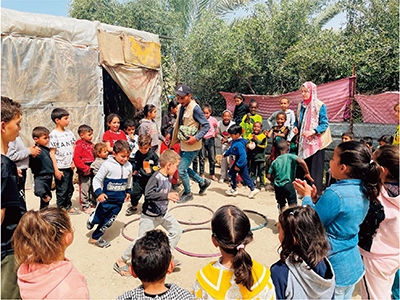
Children playing in a safe area at the shelter in the Gaza Strip (Photo: CCP Japan)
Positioning assistance to Palestine as a key pillar of its policy to contribute to peace in the Middle East, Japan has provided approximately $2.6 billion in support since the Oslo Accords in 1993. In particular, it has delivered a range of humanitarian assistance to improve the severe living conditions of socially vulnerable populations in the West Bank, including East Jerusalem, as well as those affected by conflict in the Gaza Strip.
Following the terror attacks on Israel by Hamas and others on October 7, 2023, and the subsequent military operations by the Israel Defense Forces in the Gaza Strip, numerous civilian casualties occurred and the humanitarian situation severely deteriorated. In response, Japan has been providing humanitarian assistance in areas such as food and health through bilateral cooperation, as well as through international organizations including the United Nations Relief and Works Agency for Palestine Refugees in the Near East (UNRWA), the World Food Programme (WFP), the World Health Organization (WHO), the United Nations Children’s Fund (UNICEF), and NGOs.
Japan is also engaged in a wide range of initiatives aimed at stabilizing and improving the daily lives of Palestinians, strengthening the fiscal capacity, and enhancing administrative quality, in preparation for the establishment of a future Palestinian state and a viable economy. In February 2024, it decided to provide grants for audiovisual materials and ICT equipment to enable remote learning at schools in the West Bank, ensuring students’ access to education. In September, it also decided to provide grants for firefighting equipment at fire stations in three governorates in the West Bank to strengthen firefighting and rescue capabilities (see also “Featured Project”).
After the discovery in January 2024 of allegations that UNRWA staff members were involved in the terror attacks, Japan temporarily suspended its funding to UNRWA (approximately $35 million) as part of its support for Palestine. In April, Japan resumed its contributions after confirming measures to ensure the appropriateness of projects funded by Japan, including (i) the establishment of a “Japan-UNRWA Project Management and Monitoring Mechanism,” (ii) promotion of the participation of women in leadership positions in UNRWA governance reform and other initiatives, and (iii) reaffirmation that Japan would take all necessary measures in the event of fund misuse. Japan will continue to ensure UNRWA’s transparent and proper use of funds.
■Assistance to Lebanon
Following the deterioration of the situation in Gaza after October 7, 2023, exchanges of attacks between Hezbollah and Israel began in Lebanon. In particular, since mid-September 2024, Israel has conducted large-scale air strikes on southern and eastern Lebanon, including the southern suburbs of the capital, Beirut, resulting in over one million internally displaced persons, according to the Lebanese government. In response to the worsening humanitarian situation in Lebanon caused by this escalation, Japan decided in October to provide Emergency Grant totaling $10 million.
■Assistance to Syria, Iraq, and Neighboring Countries
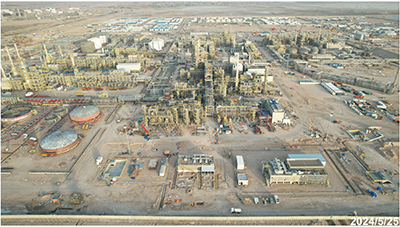
Basrah Refinery under construction with Japan’s yen loan to Iraq (Photo: JGC Corporation)
Regarding the Syrian crisis, a pressing concern for the international community, Japan announced at the seventh Conference on “Supporting the Future of Syria and the Region” (Brussels VII Conference) held in June 2023 that it would continue providing assistance aligned with the needs of the Syrian people and neighboring countries. Japan has provided assistance in areas such as humanitarian aid and social stabilization. In 2024, it decided to provide grants to support agriculture affected by the prolonged crisis and natural disasters, as well as to improve livelihoods and living conditions.
As for Iraq, Japan has provided support for the oil and gas sector, the backbone of Iraq’s economy, as well as for basic lifeline services such as electricity, water, and sewage, through ODA loans and other measures. Japan also works to strengthen governance and improve living conditions through support in the health and education sectors, and promotes women’s empowerment, aimed at helping the self-reliant development of Iraq as a stable and democratic country.
Since the onset of the Syrian crisis in 2011, Japan has provided approximately $3.5 billion in assistance to Syria, Iraq, and neighboring countries. In this region, where humanitarian conditions have been constantly changing, Japan delivers aid in a timely and effective manner.
Under the Japan-Jordan Partnership Program (JJPP), Japan provides training in human resource development for nationals from neighboring countries, including Iraq, in Jordan, which plays a key role in hosting Iraqi refugees and supporting Iraq’s reconstruction. Since the outbreak of the Syrian crisis in 2011, Jordan has received a large number of Syrian refugees. In support of both the refugees and host communities, Japan has helped develop water supply facilities to ensure stable water provision and promote efficient and effective use of water resources amid water shortages due to population growth. It also supports Jordan’s efforts to modernize its economy and public finances, including assistance for stabilizing electricity supply through ODA loans and grants.
Moreover, Japan supports human resource development and the self-reliance of refugees. For example, to cultivate future leaders for Syria’s reconstruction, it has accepted a total of 144 Syrian students from FY2017 to December 2024 under the “Japanese Initiative for the future of Syrian Refugees (JISR)”Note 28 and the Japanese Government Scholarship (MEXT) program.
■Assistance to Yemen
Yemen faces “one of the world’s worst humanitarian crises,” with approximately 60% of its population in need of some form of humanitarian assistance due to the prolonged conflict. Since 2015, as a major donor, Japan has provided a total of approximately over $460 million in humanitarian aid through international organizations. In 2024, in addition to continuing humanitarian support via international organizations, Japan not only provides assistance through NGOs, but also provides higher education opportunities and training in Japan to foster human resources for Yemen’s self-reliant stabilization, including accepting Yemeni students under the Japanese Government Scholarship program and conducting JICA-led training primarily for Yemeni government officials. As part of efforts to create an environment conducive to economic activity, Japan also supports improving logistics efficiency at the Port of Aden.
■Assistance to Afghanistan
Even after the Taliban’s takeover of Kabul in August 2021, international organizations and NGOs have continued to operate in Afghanistan, and the international community has provided support. The humanitarian situation, however, remains dire, due to the Taliban’s repressive policies, including increased restrictions on the rights of women and girls, exemplified by the promulgation of the “Law on the Promotion of Virtue and Prevention of Vice” in August 2024, which imposes severe restrictions on the conduct of the people of Afghanistan. In coordination with the international community, Japan continues to engage with the Taliban to improve the situation. At the same time, Japan has set out a proactive humanitarian aid policy in the international arena, such as in the G7 and the UN Security Council, underscoring the importance of restoring stability to Afghanistan.
Since August 2021, Japan has provided assistance in areas such as shelter, health, water and sanitation, food, agriculture, and education, which includes support for women’s livelihoods through the United Nations Development Programme (UNDP), infectious disease prevention through UNICEF, counter-narcotics capabilities through the United Nations Office on Drugs and Crime (UNODC), and improvements to urban living environments through the United Nations Human Settlements Programme (UN-Habitat). In addition, immediately after the floods that struck northern Afghanistan in May 2024, Japan provided emergency relief supplies.
Since 2001, Japan has offered a wide range of development assistance to Afghanistan in support of its sustainable and self-reliant development, including hosting two ministerial-level meetings (in 2002 and 2012) and providing assistance in fields such as humanitarian relief, health, education, agriculture and rural development, and women’s empowerment. Japan will continue to work closely with the international community and provide support based on a careful assessment of the needs of the Afghan people, while keeping in mind the establishment of a self-reliant economy and the promotion of women’s empowerment.
■Assistance to the North Africa Region
In Egypt, under the initiative of President El-Sisi, efforts are underway to introduce Japanese-style education from early childhood through to postgraduate studies, contributing to education and human resource development. Japan also provides a mix of ODA loans, grants, and technical cooperation across diverse fields: transportation infrastructure such as the Greater Cairo Metro Line No. 4 and Borg El Arab International Airport; the health sector, with a focus on achieving Universal Health Coverage (UHC);Note 29 irrigation agriculture and rural development; and tourism development through projects related to the Grand Egyptian Museum, including its construction, artifact conservation and restoration, and museum operations and exhibitions (For details on the introduction of Japanese-style education, see Part III, Section 3 (5); for support to the Greater Cairo Metro Line No. 4, see “Stories from the Field”).
Furthermore, located at the crossroads of Asia, Africa, and Europe, Egypt plays a key role in promoting peace and stability across the Middle East and Africa. Since the outbreak of civil war in Sudan in April 2023, Egypt has hosted evacuees, asylum seekers, and returnees from Sudan. Following the escalation of the Gaza crisis in October of the same year, it has also admitted severely injured patients from Gaza. In light of these developments, Japan decided in March 2024 to support efforts to improve and strengthen Egypt’s strained medical and health services, providing medical equipment and training for healthcare workers through the WHO.
Tunisia is experiencing a severe nationwide water shortage due to climate change. The government has designated addressing water scarcity and adapting to drought as key national strategies. Japan has been supporting social infrastructure development, particularly in the water sector. In February 2024, it decided to provide a grant for a new advanced sewage treatment plant adjacent to an existing facility, designed for efficient operation and maintenance.
In Morocco, strengthening the health system is a priority, with the aim of achieving UHC by improving access to and quality of health services and establishing medical coverage. In September 2024, Japan decided to provide an ODA loan to support institutional reforms for expanding and improving maternal and child health and nutrition services, as well as enhancing the medical coverage system.
Featured Project 11
Palestine

Capacity Building through the Conference on Cooperation among East Asian Countries for Palestinian Development (CEAPAD) Phase 2
Technical Cooperation (October 2021 - March 2025)
Passing the Baton of Technical Cooperation from Japan to Indonesia, Palestine, and Central America
The Conference on Cooperation among East Asian Countries for Palestinian Development (CEAPAD) is a regional cooperation framework initiated by Japan in February 2013. It aims to support Palestinians’ state-building efforts by leveraging human resources and economic development expertise from East Asian countries, in order to realize peace through a “two-state solution,” where a future independent Palestinian state and Israel live side by side in peace and security.
Indonesia, a key member country of CEAPAD, has been developing livestock artificial insemination technology at the Singosari Artificial Insemination Center since the 1980s with Japan’s technical support through JICA. This project leveraged Indonesia’s expertise to provide training on livestock artificial insemination technology and reproductive management to livestock technicians from the Palestinian Ministry of Agriculture. The Palestinian artificial insemination team that received the training is actively engaged in applying and disseminating not only artificial insemination techniques but also the broader knowledge that they acquired, contributing to the development of the livestock industry in Palestine.
Furthermore, the Palestinian Authority, through the Palestinian International Cooperation Agency (PICA), has utilized this technology not only for domestic application and dissemination, but also for providing technical cooperation to Central American countries such as El Salvador and Nicaragua. In this way, the baton of technical cooperation that originated in Japan has been passed on to the world through “triangular cooperation,”Note 1 where developed countries support South-South cooperation between developing countries.
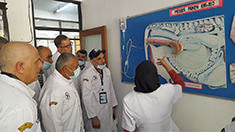
A lecture on artificial insemination using a schematic diagram of the bovine reproductive tract (Photo: JICA)
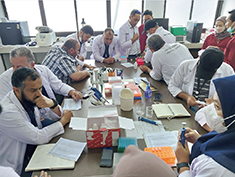
Learning how to use equipment such as pipettes and procedures for semen dilution (Photo: JICA)
Note 1 See the glossary.
- Note 28: This initiative, announced by Japan in May 2016 as part of its Middle East support measures, aims to provide educational opportunities for Syrian youth deprived of schooling due to the crisis. Implemented in cooperation with the United Nations High Commissioner for Refugees (UNHCR), it targets Syrian youth who have fled to Jordan and Lebanon as refugees.
- Note 29: See Note 66.