
2 Southwest Asia
The Southwest Asian region has approximately 1.8 billion people and has maintained a high economic growth rate in recent years, offering an attractive market and production base to Japanese companies and attracting attention as an investment destination. It is also a strategically important region because of its location on critical sea lanes that connect Japan with the Middle East and Africa.
At the same time, the Southwest Asian region still faces many development issues, including infrastructure development, the development of primary education and health and medical care systems, the reform of legal institutions, responses to natural disasters, the consolidation of democracy, and actions on the environment and climate change. In particular, poverty reduction is a major challenge, with approximately one-third of the world’s poor accounted to be living in this region.Note 10
Japan has traditionally maintained friendly relationships with the countries of Southwest Asia and has been providing assistance to the region as its largest partner for many years. By harnessing the region’s economic potential, Japan provides assistance in a wide range of areas such as socio-economic development, democratization and consolidation of democracy, peacebuilding, and emergency humanitarian assistance and recovery efforts after natural disasters.
●Japan’s Efforts
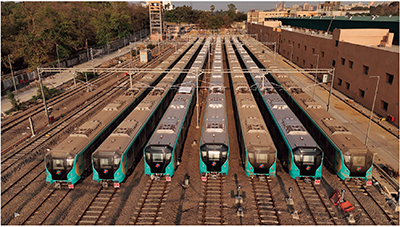
The train depot of the Mumbai Metro Line 3 in India developed with Japanese loan aid (Photo: Mumbai Metro Rail Corporation Limited)
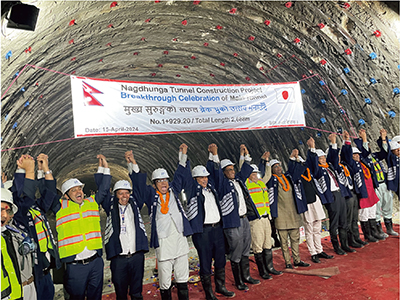
Breakthrough ceremony of the Nagdhunga Tunnel, the very first mountainous traffic road tunnel in Nepal
Development cooperation with India, which has achieved remarkable economic growth in recent years, is a key component of the “Japan-India Special Strategic and Global Partnership.”Note 11 Japan promotes development cooperation that benefits both Japan and India by bringing together the strengths of both countries, creating new value through co-creation, and thereby addressing social challenges. At the same time, given that India accounts for approximately 20% of the poor population in all developing countries, Japan recognizes the significant need for socio-economic development from the perspective of achieving the SDGs globally. Thus, Japan supports the realization of inclusive and sustainable economic growth in India.
Japan has been comprehensively supporting the Government of India’s efforts to achieve the SDGs. In 2024, Japan and India exchanged notes for yen loan projects, which include the construction of roads, bridges, and the Dedicated Freight Corridor to improve connectivity; the construction of a medical university hospital to strengthen the healthcare system; support for entrepreneurs and micro-, small-, and medium-sized enterprises in southern India; urban water supply development in the mountainous areas of northern India; forest and biodiversity conservation efforts to tackle climate change; and the diversification of horticultural crops. Regarding the “Project for the Construction of Mumbai-Ahmedabad High Speed Rail,” then Foreign Minister Kamikawa and Foreign Minister Jaishankar concurred to continue working on the project as a flagship project between India and Japan at the Japan-India Foreign Ministers’ Meeting in July 2024. In addition, Japan is building a new cooperative relationship with India. In March of the same year, the two Ministers concurred to establish a new forum for discussing bilateral development cooperation in third countries to ensure that their joint support for the development of third countries draws on their respective strengths.
Bangladesh, a long-standing friend of Japan, has seen remarkable development in recent years with an increasing presence of Japanese companies. During then Prime Minister Hasina’s visit to Japan in April 2023, the bilateral relations were elevated from a “Comprehensive Partnership” to a “Strategic Partnership.” Japan promotes development cooperation under this partnership along with the “Bay of Bengal Industrial Growth Belt (BIG-B)” initiative, which consists of the three pillars: (i) development of economic infrastructure, (ii) improvement of the investment environment, and (iii) enhancement of connectivity. In the new plan for a “Free and Open Indo-Pacific (FOIP),” announced by then Prime Minister Kishida in March 2023, Japan highlighted its cooperation with Bangladesh as a concrete example of contributing to multi-layered connectivity. This cooperation is guided by the vision of treating northeastern India, Bangladesh, and the surrounding areas as a single economic sphere, with the aim of fostering growth across the region by helping to build an industrial value chain linking the Bay of Bengal to northeastern India. Under this vision, Japan is advancing projects such as the Matarbari Deep Seaport, Dhaka Mass Rapid Transit (MRT), Hazrat Shahjalal International Airport Terminal 3, and the development of economic zones. As Bangladesh is set to graduate from the Least Developed Country (LDC) status in 2026, it faces various challenges such as promoting industrial diversification and addressing rapid urbanization in order to sustain and accelerate its steady economic growth. To support these efforts, Japan provides grants to Bangladesh for human resources development targeting young government officials.
Japan also continues to provide humanitarian assistance to Bangladesh. Following the mass influx of displaced persons from Rakhine State, Myanmar, in 2017, Japan has supported the Government of Bangladesh’s efforts to accommodate them by working in partnership with international organizations such as the United Nations World Food Programme (WFP) and the International Organization for Migration (IOM). Japan’s assistance, focused on human security, extends to displaced persons camps and their host communities in Cox’s Bazar district, as well as on Bhasan Char island, where its support began ahead of other countries. For displaced persons and host community support, fine-tuned cooperation is also provided through Japanese NGOs via the Grants Assistance for Japanese NGO Projects and the Japan Platform (JPF).Note 12
Such humanitarian assistance in cooperation with diverse actors has also proven effective in emergency situations. In response to the flood damage that occurred mainly in southeastern Bangladesh in late August 2024, Japan decided in September of the same year to extend an Emergency Grant of $1 million through the United Nations Children’s Fund (UNICEF) and the United Nations High Commissioner for Refugees (UNHCR) in areas such as Water, Sanitation and Hygiene (WASH), and shelter. In addition, a grant of JPY 300 million to be disbursed for assistance by Japanese NGOs via JPF has been approved.
Sri Lanka, which is located at a key point along sea lanes connecting Asia with the Middle East and Africa, has traditionally been a country that is friendly to Japan. Japan has been working on strengthening cooperation with Sri Lanka in areas such as enhancing connectivity and the maritime sector, toward the realization of a FOIP. Japan has also supported regions where development has lagged behind due to the impact of past conflicts, focusing on improving the livelihoods of people including female-headed households and internally displaced women who have lost their possessions. The support has extended to fostering industrial and human resources development, particularly in the fishery and agricultural sectors, and to enhancing response capabilities for disaster and oil spillage incidents in the ocean. Furthermore, in response to the critical situation following the economic crisis in 2022, Japan has provided emergency humanitarian assistance tailored to Sri Lanka’s needs, such as food and health support, while also supporting the strengthening of governance, including assistance in the formulation of anti-corruption policies.
Following the announcement made by the Government of Sri Lanka in April 2022 regarding its temporary suspension of external debt payments, Japan, as co-chair of the Official Creditor Committee for Sri Lanka, strongly supported Sri Lanka’s efforts toward debt restructuring. In July 2024, the signing of the Memorandum of Understanding on debt restructuring between official creditor countries and Sri Lanka was completed. Following the confirmation of the Sri Lankan government’s intention to swiftly conclude a bilateral agreement with Japan, the Government of Japan decided to resume the disbursement of yen loan projects that had been temporarily suspended. Japan will further contribute to Sri Lanka’s sustainable development and growth.
The Maldives, like Sri Lanka, is located strategically along the sea lanes of the Indian Ocean and has traditionally been a country that is friendly to Japan. In view of this, Japan has been strengthening cooperation with the country toward realizing a FOIP. In 2024, Japan provided grants to the Maldives, an island nation facing security vulnerabilities, for a patrol vessel and related equipment to enhance the capabilities of its Customs Service. Japan also provided dewatering pumps and an emergency support vehicle to help the Maldives, where 80% of the land consists of small, low-lying islands less than one meter above sea level, to quickly respond to frequent natural disasters such as floods. In addition, to ensure that Maldivian citizens can access detailed information on disaster risk reduction in a timely manner during emergencies, Japan provided additional grants to address funding shortfalls caused by price fluctuations for the ongoing support for the development of Integrated Services Digital Broadcasting-Terrestrial (ISDB-T) systems that were developed in Japan.
With the world’s fifth-largest population, and its geopolitical importance as the interface between Asia and the Middle East, Pakistan plays a vital role in the international community’s efforts to eradicate terrorism. The stable development of Pakistan is important from the perspective of peace and stability in the surrounding regions, as well as in the international community as a whole. Japan continues to support Pakistan in enhancing its capacity to monitor meteorological phenomena and improve the accuracy of meteorological and flood information and early warnings, recognizing the country’s frequent vulnerability to natural disasters. Japan also contributes to strengthening maternal and child health and medical systems. As part of its ongoing efforts, Japan provided grants in 2024 to support vaccination for eradication of polio in Pakistan, where wild poliovirus remains endemic, along with grants for human resources development targeting young government officials.
The establishment of democracy, stability, and prosperity in Nepal, a traditionally friendly nation to Japan, is important for Japan to ensure the stability of the entire Southwest Asia region, which is also politically and economically important to Japan. As Nepal aims to graduate from LDC status in 2026, Japan has been supporting the realization of sustainable economic development. The support includes the renovation and reconstruction of bridges, hospitals, and other public infrastructure facilities, as well as the refurbishment and rebuilding of houses and schools. Japan also carries out a range of technical cooperation related to strengthening the government capacity in disaster risk reduction and ensuring compliance with the national building code. In April 2024, the Nagdhunga Tunnel, the very first mountainous traffic road tunnel in Nepal, achieved a breakthrough with Japanese loan aid. When completed, this tunnel will streamline Nepal’s transportation network, accommodate rapidly increasing traffic demand, reduce travel time, and improve road safety.
Japan’s development cooperation toward Bhutan has achieved steady results, especially in the improvement of agricultural productivity, development of economic infrastructure such as road networks and bridges, and human resources development. In 2024, Japan exchanged notes with Bhutan on grants to replace two bridges, Namling Bridge and Durdari Bridge, using Japanese technology. Given that most of Bhutan is mountainous and roads are the primary means of transportation, this support is significant. Furthermore, Japan is supporting human resources development through technical cooperation to ensure that Bhutan’s road infrastructure is maintained and managed more effectively.
Featured Project 7
Pakistan


Project for Improvement of Livelihoods and Well-being of Female Home-Based Workers (FHBWs) in the Informal Economic Sector in Sindh Province
Technical Cooperation (March 2017 – December 2023)
Building Support Systems that Empower Pakistani Women
In Pakistan, many women are engaged in informal employment, with the majority working as home-based workers who carry out paid work in or around their home. These workers often face unstable and unfairly low pay, as well as poor working conditions.
To address this issue, Japan partnered with the Women Development Department and local NGOs in Sindh, a province with a large number of home-based workers, to support women’s livelihoods and improve their living conditions through training sessions, seminars, and guidance at their workplace.
During the training sessions and seminars, the support initially focused on household financial management, helping participants develop life plans and savings strategies to prepare for expenses such as those for their children’s education and unexpected illnesses. The project then worked on promoting basic business and transactional practices, including meeting delivery deadlines, as well as applying quality control and hygiene management techniques. Additionally, efforts were made to develop and expand smartphone-based financial services for women with limited access to formal banking systems.
The model approach developed through the project, along with training materials on livelihood improvement and business skills for female home-based workers, are expected to be used by partner organizations even after the project’s completion, in order to support these workers.
Women support families’ livelihoods and household finances in many households, and their empowerment is essential to Pakistan’s economic and social development. Japan will continue to support maintaining and improving the stable income-generating activities by Pakistani women engaged in home-based work.
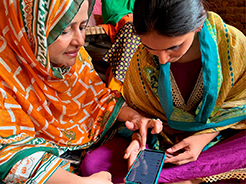
A training session on enhancing financial access using smartphone functions (Photo: JICA)
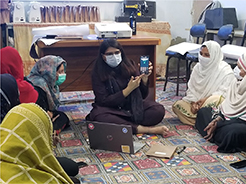
Women participating in a training session (Photo: JICA)
- Note 10: United Nations Development Programme (UNDP) website (note that Afghanistan is included in South Asia)
https://hdr.undp.org/content/2023-global-multidimensional-poverty-index-mpi#/indicies/MPI - Note 11: Japan-India Special Strategic and Global Partnership https://www.mofa.go.jp/s_sa/sw/in/page3e_000432.html
- Note 12: See the glossary.