
3 Oceania
The Pacific Island countries are long-standing friends of Japan, connected by the Pacific Ocean and also share deep historical ties with Japan. In addition, with vast Exclusive Economic Zones (EEZ),Note 13 these countries are key to maritime transport activities and provide essential fishing grounds for bonito and tuna fisheries.
The sustainable development of the Pacific Island countries is important also for Japan. Over many years, Japan has advanced cooperation through bilateral efforts and the Pacific Islands Leaders Meeting (PALM) process, building relationships of trust with these countries.
●Japan’s Efforts
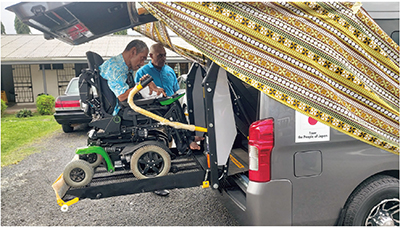
A user boarding a wheelchair-accessible vehicle with a lift provided to the Spinal Injury Association of Fiji through the Grant Assistance for Grass-Roots Human Security Projects
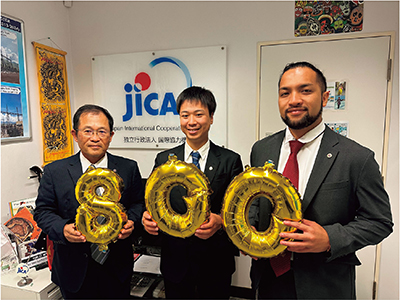
Members of the 800th cohort of Japan Overseas Cooperation Volunteers since dispatching to Papua New Guinea began in 1980 (Photo: JICA)
Pacific Island countries face common challenges unique to small island countries, such as small-scale economies dependent on specific industries, territories dispersed over a vast ocean, difficult access to international markets, and vulnerability to the impacts of climate change and natural disasters.
Recognizing that the sustainable development of the Pacific Island countries requires not only addressing the socio-economic vulnerabilities of each country but also strengthening cooperation across the whole region, Japan has been hosting PALM, a summit meeting between Japan and Pacific Island countries, every three years since 1997.
Japan also promotes cooperation with the Pacific Islands Forum (PIF),Note 14 a regional cooperation framework comprising Pacific Island countries and territories. In 2022, the PIF unveiled “The 2050 Strategy for the Blue Pacific Continent (2050 Strategy),” which presents a vision and strategic pathways for the political, economic, social, and other development in the Pacific Islands region to be achieved by 2050. Japan has consistently expressed strong support for the Strategy.
In PALM10 in Tokyo in July 2024, there were discussions held in line with the seven priority areasNote 15 outlined in PIF’s 2050 Strategy. The meeting reaffirmed the relationship between Japan and the Pacific Island countries and regions to tackle common challenges and stride forward together. The Joint Action Plan also outlined specific initiatives in the seven priority areas of the 2050 Strategy. (See “ODA Topics” for PALM10).
One of the seven priority areas is “Technology and Connectivity.” Enhancing connectivity and expanding access to digital technology are particularly important in bringing economic and social benefits to the Pacific Island region, which faces unique challenges, and are key to achieving sustainable development. A concrete example of strengthening digital connectivity is the East Micronesia undersea cable, a joint cooperation between Japan, the United States, and Australia, which was jointly announced in December 2021 by six countries: Japan, the United States, Australia, Kiribati, Nauru, and the Federated States of Micronesia. In this project, Japan exchanged notes with Kiribati and Nauru on grants in June 2023. In the same month, the components for manufacturing and installation of the undersea cables were officially launched. The project has made steady progress, with the provision of additional grants signed with Kiribati in June 2024 and with Nauru in July 2024.
Japan and the Pacific Island countries have also been advancing cooperation to ensure that the ocean and environment in the Pacific region are sustainably managed and resilient to threats. They work together particularly in areas such as monitoring and sustainable use of fisheries and marine resources, capacity building and provision of equipment in the fields of maritime security and safety, waste management and pollution reduction, countermeasures against illegal, unreported and unregulated (IUU) fishing, and conservation of the Pacific’s biodiversity environment and resources.
During the bilateral summit meetings held during PALM10, then Prime Minister Kishida stated that Japan would continue to provide support in the maritime domain. Japan has been supporting sustainable development by providing patrol boats to Nauru, which will enhance the country’s capabilities in maritime rescue, disaster relief, and the control of territorial violations and illegal fishing. Japan also supported the Solomon Islands by assisting in the establishment of the “Fisheries Research Center” at Solomon Islands National University. Furthermore, to Pacific Island countries where the fishery industry is an important source of income, such as Vanuatu, Papua New Guinea, Fiji, the Marshall Islands, and the Federated States of Micronesia, Japan provided fishery research vessels as well as fisheries-related equipment to conduct sustainable monitoring of changes in fisheries resource stocks and distribution.
People-to-people exchange and human resources development are the foundation of “kizuna” between Japan and the Pacific Island countries. Over the past 50 years, more than 4,000 Japan Overseas Cooperation Volunteers have been dispatched to the Pacific region. They have lived alongside the people of the Pacific, contributing to social improvement in a wide range of fields such as education, health, construction, environment, IT, sports and culture, and have dedicated themselves to the development of those countries. Japan also promotes people-to-people exchange programs that invite and send youth (JENESYS)Note 16 and government scholarship programs so that young people from Pacific Island countries and regions can deepen their understanding of Japan to become leaders of the future.
Through these various initiatives, Japan will work hand in hand with the Pacific Islands countries in building a resilient, stable, and prosperous region.
Featured Project 8
Solomon Islands


The Project for Unexploded Ordnance Disposal in Central and Western Solomon Islands
Grant Assistance for Grass-Roots Human Security Project (March 2022 – March 2025)
Toward Safe and Secure Communities Free from Unexploded Ordnance
Even 80 years after the end of World War II, Solomon Islands, which witnessed fierce battles during the war, still has numerous unexploded ordnances (UXOs) remaining on its territory, leading to several casualties every year. These UXOs not only threaten the safety of residents but also impede the utilization of agricultural land and infrastructure development, hindering the country’s economic development. While donor countries, led by Australia and the United States, have supported efforts to collect and dispose of these UXOs, progress has not been sufficient due to shortages of personnel and equipment. Another challenge is that local residents do not have sufficient knowledge about UXOs or the skills needed to handle them upon encounter.
In response, Japan provided equipment for UXO disposal operations, including hydraulic excavators and trucks for transporting UXOs, to the Royal Solomon Islands Police Force through the Grant Assistance for Grass-Roots Human Security Project.Note 1Japan is also supporting awareness-raising activities on the risks and handling of UXOs for school students and residents in Guadalcanal Province and Western Province, the target areas of this project. Through these initiatives, UXO disposal operations are being carried out efficiently across a combined area of 15,634 km² in both provinces, while local residents are gradually gaining a deeper understanding of UXOs.
As part of initiatives other than the aforementioned ODA efforts, the Ministry of Defense and the Self-Defense Forces of Japan, which possess expertise in UXO disposal, are engaged in activities to share their knowledge on former Japanese military ordnance types and methods for public awareness with the Royal Solomon Islands Police Force. Through these efforts, Japan is providing capacity building support aimed at creating synergistic effects in UXO disposal operations.
Japan will continue to support UXO disposal operations in Solomon Islands, in cooperation with partners like Australia and the United States.
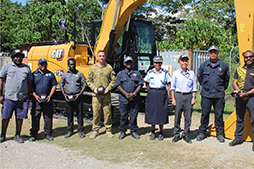
Hydraulic excavator provided for UXO removal
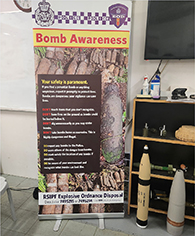
Awareness-raising poster on UXO
Note 1 See Part V, Section 2 (2).
- Note 13: Maritime zones where a sovereign country has certain economic rights that can be established outside its territorial waters.
- Note 14: As of November 2024, the PIF is comprised of 16 member countries and two territories, including Australia, New Zealand, Kiribati, Cook Islands, Samoa, Solomon Islands, Tuvalu, Tonga, Nauru, Niue, Vanuatu, Papua New Guinea, Palau, Fiji, Marshall Islands, Federated States of Micronesia, French Polynesia, and New Caledonia.
- Note 15: (1) Political Leadership and Regionalism, (2) People-Centered Development, (3) Peace and Security, (4) Resources and Economic Development, (5) Climate Change and Disasters, (6) Ocean and Environment, (7) Technology and Connectivity.
- Note 16: People-to-people exchange between Japan and the Asia-Pacific region. An abbreviation of Japan-East Asia Network of Exchange for Students and Youths.