
ODA Topics 3
The 10th Pacific Islands Leaders Meeting (PALM10) and Japan’s Development Cooperation in the Pacific Region
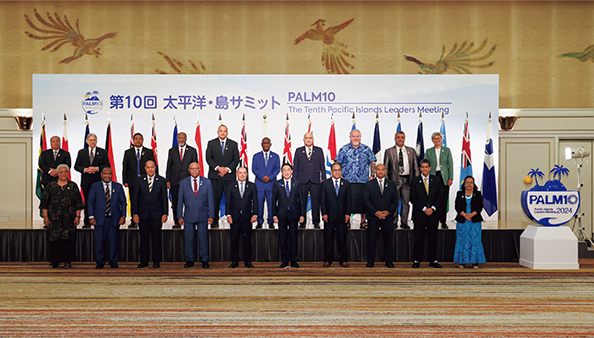
Then Prime Minister Kishida, leaders and representatives from the Pacific countries and regions attended the PALM10 Summit (Photo: Cabinet Public Affairs Office)
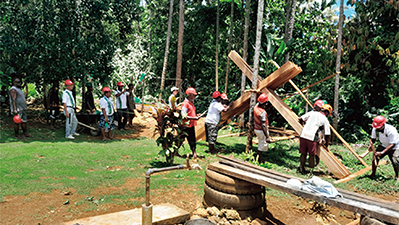
Training session on forest resource management and portable sawmill safety, conducted as part of technical cooperation project, Capacity Development for Sustainable Forest Resource Management in Solomon Islands (Photo: JICA)
The 10th Pacific Islands Leaders Meeting (PALM10) was held in Tokyo from July 16 to 18, 2024. The Pacific Islands Leaders Meeting is a summit-level meeting that Japan has been hosting every three years since 1997. It aims to contribute to the stability and prosperity of the region through candid exchanges of opinions at the leaders’ level on various issues facing Pacific Island countries, while enhancing the partnership between Japan and these countries. PALM10 was co-chaired by the leaders of Japan and the Cook Islands, with the participation from leaders and representatives of 19 countries and regions,Note 1 including 16 Pacific Island countries and regions, as well as Australia and New Zealand.
At the PALM10, the leaders reaffirmed the relationship of “striding forward together” toward the future while tackling common challenges, based on the discussions held in light of changes affecting the region. Building on this, the leaders adopted the Leaders’ Declaration and endorsed its annex, the “PALM10 Joint Action Plan,” which identified seven priority areas of cooperation: (1) Political Leadership and Regionalism, (2) People-Centered Development, (3) Peace and Security, (4) Resources and Economic Development, (5) Climate Change and Disasters, (6) Ocean and Environment, (7) Technology and Connectivity. These areas are consistent with the “2050 Strategy for the Blue Pacific Continent” or “2050 Strategy”Note 2 developed by the Pacific Islands Forum (PIF).Note 3 The Joint Action Plan outlines concrete actions for the next three years in these priority areas for Japan and PIC Members to jointly undertake in order to realize the future vision described in the “2050 Strategy.”
In the area of climate change, Japan announced “the Pacific Climate Resilience Initiative,” as an “All Japan” initiative that mobilizes Japan’s technology, know-how, and financial resources. Pacific Island countries are frequently exposed to natural disasters such as cyclones and are vulnerable to the effects of climate change. For example, in Fiji, Japan supports the establishment of a seamless disaster management system through “Stand-by Loans for Disaster Recovery and Rehabilitation” and demonstration experiments of disaster risk management notification services using the Quasi-Zenith Satellite System “Michibiki.”
In addition to supporting “hard aspect” such as infrastructure and facility development, Japan provides support in “soft aspect” such as dispatching technical experts and Japan Overseas Cooperation Volunteers (JOCVs), to address the specific challenges faced by Pacific Island countries. For example, in Solomon Islands, for enhancing the capacity development of the staff members at the Ministry of Forestry and Research as well as promoting the community-led forest management model, JICA dispatched Sustainable Forest Resource Management Advisor and utilized timber processing equipment provided by grant aid in collaboration with JOCVs.
Through such cooperation, Japan and Pacific Island countries will further strengthen their partnership founded on mutual trust and KIZUNA, which signifies “bonds” in Japanese.
Note 1 Japan, Cook Islands, Federated States of Micronesia, Fiji, Kiribati, Nauru, Niue, Palau, Papua New Guinea, Marshall Islands, Samoa, Solomon Islands, Tonga, Tuvalu, Vanuatu, French Polynesia, New Caledonia, Australia, and New Zealand.
Note 2 See Part IV, Section 3.
Note 3 See Note 14.