
ODA Topics 4
Diplomatic Initiative toward Latin America and the Caribbean
– Japan’s Development Cooperation Efforts during the Year of
Latin America and the Caribbean –
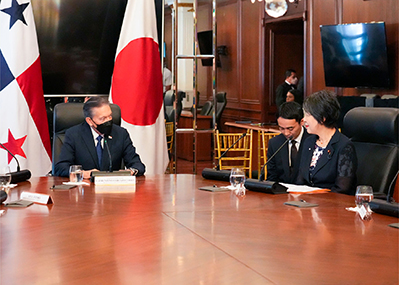
Then Foreign Minister Kamikawa paying a courtesy visit to then President Cortizo of Panama
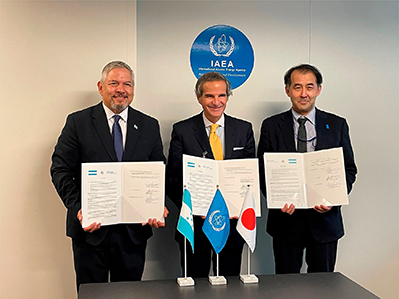
Foreign Minister of Honduras Enrique Reina, IAEA Director General Grossi, and then Director-General of the Latin American and Caribbean Affairs Bureau Noguchi (from left), holding the signed letter of intent on trilateral cooperation in medicine in Honduras
In 2024, the world turned its attention to Latin America and the Caribbean as the “Year of Latin America and the Caribbean,” with Brazil presiding over the G20 and Peru over APEC.
Many Latin American and Caribbean countries are key partners that share values and principles such as freedom, democracy, the rule of law, and human rights. As the free and open international order based on the rule of law is coming under serious challenges, collaboration with these countries is becoming all the more critical. With a combined population of approximately 660 million and a regional GDP of around $7 trillion, the Latin American and Caribbean region not only holds immense economic potential but is also rich in mineral and energy resources essential for decarbonization, as well as food resources. Its importance is growing further in terms of strengthening supply chain resilience and ensuring economic security. Moreover, beyond the trust and friendship cultivated over history between Japan and the region, a unique bond exists through the world’s largest Nikkei community (Japanese immigrants and their descendants) comprising approximately 3.1 million people.
In 2024, the “Year of Latin America and the Caribbean,” Japan deepened its cooperation with the region through high-level visits and other efforts, reflecting the region’s importance.
In February, then Foreign Minister Kamikawa visited Panama and announced the “Diplomatic Initiative toward Latin America and the Caribbean,” building on the principles, achievements, and trust Japan has cultivated through its past diplomatic engagement with the region. It seeks to establish and foster new partnerships with Latin American and Caribbean countries by integrating themes of growing global relevance and Japan’s unique perspectives into existing bilateral and multilateral diplomatic efforts.
Japan is undertaking various cooperative efforts to concretize the initiative. As part of its development cooperation, in March, then Foreign Minister Kamikawa and visiting International Atomic Energy Agency (IAEA) Director General Grossi agreed to collaborate and cooperate in the field of peaceful uses of nuclear energy under the framework of the initiative. Building on this agreement, in September, the signing procedure of a letter of intent on trilateral cooperation in medicine (radiotherapy) in Honduras, was completed among the three parties, including Honduran Foreign Minister Enrique Reina. Going forward, Japan and the IAEA are expected to contribute to the expansion of radiotherapy in Honduras, a country that is striving to reduce its cancer mortality rate.
Furthermore, the initiative emphasizes cooperation on ocean-related issues as one of the key areas of partnership between Japan and the region. As 2024 was designated the “Japan-CARICOM Friendship Year,” Japan decided in February to provide grant aid for fisheries and marine research vessels to Jamaica. In recent years, Jamaica’s fisheries and marine sector, and more broadly its economy, has been heavily affected by declines in fish catches. Through the provision of these vessels, it is expected to enable Jamaica to grasp the impacts of climate change on its marine ecosystems, thereby leading to sustainable resource management and fisheries and marine development.
Japan will continue to enhance its cooperation with Latin American and Caribbean countries in areas of growing importance to the international community, while also strengthening its historically strong bilateral ties through diplomacy that leverages diverse networks.