
Press Conferences
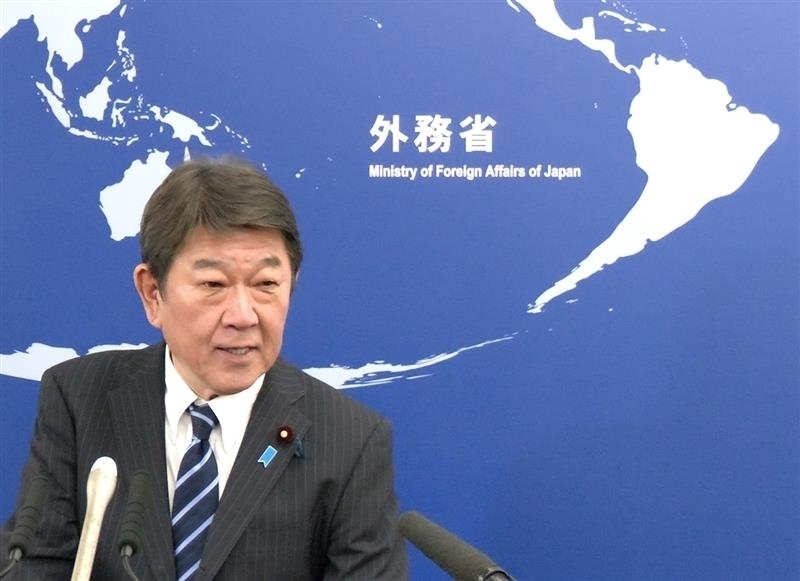
Press Conference by Foreign Minister MOTEGI Toshimitsu
Friday, July 10, 2026, 4:03 p.m. Ministry of Foreign Affairs
Japanese
Opening Remarks
Emergency Grant and Dispatch of the Second Japan Disaster Relief Medical Team in Response to the Earthquake Disaster in Venezuela
Foreign Minister MOTEGI Toshimitsu: At the outset, I have an announcement related to the earthquake in Venezuela.
Today, the Government of Japan decided to provide an Emergency Grant of USD 3.5 million in response to the catastrophic earthquake disaster in Venezuela.
Through this Emergency Grant, we will provide humanitarian assistance, including food, health and medical care, shelters and non-food items, via international organizations.
In response to the earthquake disaster, Japan decided on June 30 to provide emergency relief goods, and decided on July 1 to dispatch the Japan Disaster Relief (JDR) Medical Team. The JDR Medical Team is currently providing assistance to affected people on the ground.
In addition to this assistance, today we decided to dispatch the second batch of the JDR Medical Team to continue meeting the high demand for medical support on the ground.
Japan intends to continue working closely with international agencies and organizations to provide necessary assistance to affected people in Venezuela.
That concludes my opening remarks.
Response to the Situation in Iran
Sankei Shimbun, NAGAHARA: I would like to ask about the exchange of attacks between the U.S. and Iran. When asked by reporters the other day whether the ceasefire with Iran is over, President Trump responded, “I think it’s over.” The U.S. has since expanded its airstrikes against Iran. Given that Japan has been conducting diplomatic efforts toward the early de-escalation of the situation, could you please share Japan’s view on the current situation and its policy for protecting Japanese nationals?
Foreign Minister MOTEGI: While a Memorandum of Understanding was signed on June 18 and talks began between the U.S. and Iran, military tensions between the two countries have recently been escalating. Japan is closely monitoring the situation with grave concern.
During my visit to Türkiye this week, I held meetings with foreign ministers of various countries, and we shared similar concerns.
What is important now is an early de-escalation of the situation, the continuation of the U.S.-Iran talks, ultimately leading to the earliest possible restoration of free and safe navigation through the Strait of Hormuz, and the early realization of a final agreement, including on the nuclear issue.
This week, on the sidelines of the NATO Summit held in Türkiye, I participated in a meeting between NATO Secretary General Rutte and the Indo-Pacific Partners (IP4) and held meetings with the foreign ministers of the U.S., Kuwait, the European Union (EU), and Germany. We concurred on continuing to coordinate on the situation in Iran. Japan will continue to make every diplomatic effort to foster the conditions necessary for a final agreement.
With regard to the protection of Japanese nationals, both before and since the current situation arose, the Ministry of Foreign Affairs (MOFA) has been providing maximum support for their protection, evacuation and safe return to Japan. In light of the current situation, yesterday MOFA issued a region-wide safety advisory for the Middle East. We intend to continue taking all possible measures to protect Japanese nationals throughout the region.
Japan-Iran International Law Dialogue and the Strait of Hormuz
Kyodo News, ONDA: I would like to ask about the situation in the Strait of Hormuz. The Japanese and Iranian directors-general of international legal affairs held a virtual dialogue on July 8. In May, at a meeting of the Committee on Foreign Affairs of the House of Representatives, you responded that the Strait of Hormuz constitutes an international strait under international law. Was this position of the Government of Japan conveyed to Iran during the virtual dialogue? I would also like to ask once again what led the Government to designate the Strait of Hormuz as an international strait, as well as what effects this position is expected to have, given that the Iranian side is moving to collect transit fees.
Foreign Minister MOTEGI: On July 8, the Japan-Iran International Law Dialogue was held with the participation of Director-General NAKAMURA from Japan. During the dialogue, both sides exchanged their views on matters including international law issues related to the situation surrounding the Strait of Hormuz. The Japanese side explained its position that, under international law, the Strait of Hormuz constitutes an “international strait” to which the transit passage regime applies.
We determined that the Strait of Hormuz constitutes an “international strait” to which the transit passage regime applies, for reasons I explained at the Diet, as you noted. To summarize, the Government took into account that the core elements of the transit passage regime have become part of customary international law, and that the Strait of Hormuz is used by various countries for international navigation.
Furthermore, the Government’s decision is consistent with recent international documents, such as United Nations Security Council resolutions and G7 joint statements, which contain language implying that the Strait of Hormuz is an “international strait” to which the transit passage regime applies.
Based on this position, Japan will work even more closely with the international community and emphasize the importance of free and safe navigation through the Strait of Hormuz, as well as the importance of transiting it free from additional fees, as has been the case.
I have discussed this matter with Minister Araghchi on numerous occasions. During my recent visit to Türkiye, I explained Japan’s position in meetings with my counterparts and reached a shared view.
U.S. President Trump’s Statement
Pan Orient News, Azhari: US President Trump, speaking with the Ukrainian President in Ankara two days ago, talked about the conflict with Iran and said that a US aircraft carrier had been hit by 111 missiles launched by what he called the "Islamic Republic of Japan". Obviously, he meant "Islamic Republic of Iran". But this gaffe has spread all over the world, so my question is: has Japan received an apology from President Trump and a retraction of this statement? What are your thoughts on this matter?
Foreign Minister MOTEGI: We are aware of the statement made by President Trump. However, the Government would like to refrain from commenting on individual statements made by foreign dignitaries.
Matters Related to China (The “New-Militarism” Critique and China’s Missile Launch Training)
ABC Australia, SAIKI: I have two questions. First, China describes Japan’s recent shift in defense policy as remilitarization, but other neighboring countries are looking to increase engagement with Japan. Overall, how do you think this shift is being received internationally? Second, could you please tell us Japan’ reaction to China’s recent missile drill?
Foreign Minister MOTEGI: Japan has consistently followed the path of a peace-loving nation since the end of World War II and has contributed to peace and prosperity in Asia and the world by upholding freedom, democracy, and the rule of law.
Japan has not changed its policy. Japan’s basic policy on defense, an exclusively national defense-oriented policy, remains unchanged, and the defense capabilities Japan possesses are the minimum necessary capabilities. Amid an increasingly severe security environment surrounding Japan, it is the natural responsibility of a sovereign nation to secure the minimum necessary defense capabilities to protect the lives and property of Japanese people and ensure the defense of territorial land, waters, and airspace.
Accordingly, China’s assertions are unfounded, and the path Japan has followed as a peace-loving nation since the end of World War II will remain unchanged. We believe that Japan’s vision, actual behavior, and contributions to peace and prosperity in Asia and the world have earned the trust and support of many countries.
With regard to China’s assertions or narratives about Japan’s policies and position that are inconsistent with the truth, the Government of Japan has firmly countered them and communicated the facts.
It is essential to secure understanding of other countries regarding the Government of Japan’s position. We have seized various opportunities to explain the facts and Japan’s position, and believe that these efforts have generally earned the understanding of other countries.We will continue to appropriately explain and communicate Japan’s position and views to the international community.
A question was also raised regarding China’s launch of a submarine-launched ballistic missile (SLBM). China has been increasing its defense expenditures at a continuously high level, and has been extensively and rapidly enhancing its nuclear and missile capabilities without sufficient transparency, including intercontinental ballistic missiles (ICBMs). Furthermore, China is expanding and intensifying its military activities around Japan. These developments and China’s other activities, coupled with a lack of transparency, have become matters of serious concern not only for Japan but also for the international community.
Given these circumstances, we are concerned about China’s SLBM launch this week from the perspective of the security of Japan and the region. I raised this issue at the meetings held on the margins of the NATO Summit, including the Japan-U.S.-Republic of Korea Foreign Ministers’ Meeting. We will continue to closely monitor the related developments.