
Development Cooperation Charter and Japan’s Development Cooperation
Japan’s development cooperation is founded on the Development Cooperation CharterNote 1 (Cabinet decision on June 9, 2023). The Charter defines the objectives of Japan’s development cooperation as follows: (1) to work together with developing countries to address their development challenges and global issues common to all humankind based on equal partnerships, and to contribute even more actively to the formation of a peaceful, stable, and prosperous international community under a free and open international order based on the rule of law; (2) at the same time, to contribute to the realization of Japan’s national interests, such as securing peace and security for the country and its people and achieving further prosperity through economic growth, while creating a favorable international environment for Japan and the world, as well as maintaining and strengthening foreign relations based on trust. As the international community stands at a historic turning point and faces complex crises, Japan is committed to utilizing even more effectively and strategically development cooperation, one of the most important tools of Japanese diplomacy.
1 Basic policies of the Development Cooperation Charter
The Development Cooperation Charter sets out the following four basic policies in development cooperation: “contributing to peace and prosperity,” “human security in the new era,” “co-creation of social values through dialogue and cooperation with developing countries,” and “leading the dissemination and implementation of international rules and guidelines based on inclusiveness, transparency, and fairness.”
2 Priority policies of the Development Cooperation Charter
In line with these basic policies, Japan pursues the following three priority policies: “‘quality growth’ in the new era and poverty eradication through such growth,” “realization of peaceful, secure, and stable societies, and maintenance and strengthening of a free and open international order based on the rule of law,” and “leading international efforts to addressing increasingly complex and serious global issues.”
Japan’s ODANote 2
●What is ODA?
Development cooperation refers to “international cooperation activities that are conducted by the government and its affiliated agencies for the main purpose of development in developing regions” (Development Cooperation Charter), and ODA is the public funding for those activities. The government or its implementing agencies provide financial and technical assistance to developing regions, international organizations, or the private sector through ODA for “development,” including peacebuilding, governance, promotion of basic human rights, and humanitarian assistance.
The ODA recipients are presented in the list (see Chart II-10) compiled by the Development Assistance Committee (DAC) of the Organisation for Economic Co-operation and Development (OECD).
●What types of ODA exist?
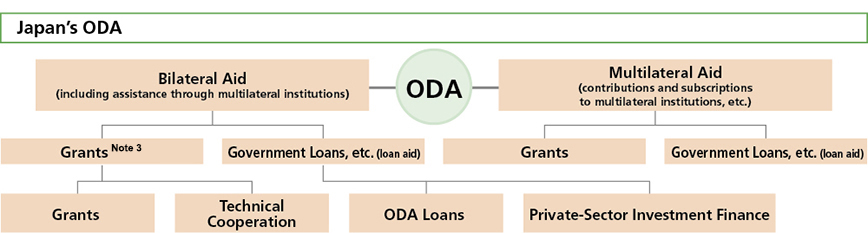
ODA can be categorized into grantsNote 3 and government loans, etc. (loan aid). ODA can also be grouped into bilateral aid, which directly assists developing regions, and multilateral aid, which concerns contributions and subscriptions to international organizations, etc.
GrantsNote 3 in bilateral aid are assistance provided to developing regions without repayment obligations. The grant scheme implemented by Japan is comprised of grants, which provides financial resources needed for the socio-economic development of developing regions without repayment obligations, and technical cooperation, which develops human resources responsible for the socio-economic development of developing regions through the transfer of Japanese expertise, technologies, and experience. Among contributions and subscriptions to multilateral institutions, etc., those earmarked for specific countries and projects are counted as bilateral aid in the statistics (see Chart II-1).
Additionally, Japan’s government loans, etc. (loan aid) in bilateral aid include ODA loans that lend funds needed by developing regions on concessional terms, through low interest rates or long repayment periods, and private-sector investment finance, which offers loans and investment to corporations and other private entities responsible for implementing projects in developing regions.
Multilateral aid includes contributions and subscriptions to UN organizations, such as the United Nations Development Programme (UNDP) and the United Nations Children’s Fund (UNICEF), other international organizations, as well as multilateral development banks including the World Bank. Most of the contributions are provided as grants, but in recent years, government loans, etc. (loan) have also been used for multilateral institutions.
Various information about ODA is available on the Ministry of Foreign Affairs website.Note 4
The Development Cooperation Charter is available here:
https://www.mofa.go.jp/mofaj/gaiko/oda/files/100514705.pdf
The White Paper on Development Cooperation 2024 and past White Papers are available on the Ministry of Foreign Affairs website.
https://www.mofa.go.jp/policy/oda/page_000017.html
Information on ODA is available here:
https://www.mofa.go.jp/policy/oda/index.html
ODA-related statistics and an overview of economic cooperation in other countries (development cooperation reference materials) are available here (in Japanese only):
https://www.mofa.go.jp/mofaj/gaiko/oda/shiryo/hakusyo.html#section4
Information by ODA recipient country (Japan’s ODA Data by Country) is available here:
https://www.mofa.go.jp/policy/oda/data/index.html
Details on the ODA email newsletter are available here (in Japanese only):
- Note 1: Development Cooperation Charter https://www.mofa.go.jp/files/100514705.pdf. It can also be accessed via the 2D code on page v.
- Note 2: Unless otherwise stated, “grants” in this White Paper refers to Japan’s aid scheme. The exception is Part II and Reference Statistics 2, where it indicates “grants” based on the OECD-DAC definition.
- Note 3: As defined by the OECD-DAC: “transfers in cash or in kind for which no legal debt is incurred by the recipient”.
- Note 4: Various information on ODA https://www.mofa.go.jp/policy/oda/index.html. It can also be accessed via the 2D code on page v.