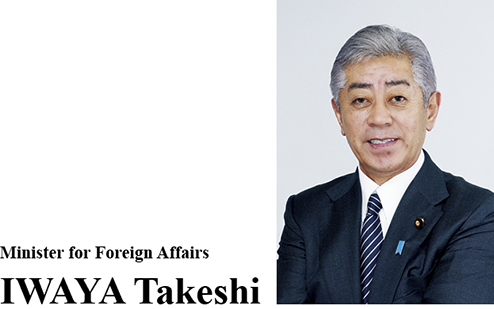
Foreword
In recent years, the international landscape has undergone significant changes. The international community faces complex crises, including Russia's aggression against Ukraine, the current situation in the Middle East, and global challenges such as climate change and infectious diseases.
Against this background, Japan must firmly demonstrate its commitment to upholding and strengthening a free and open international order based on the rule of law. In cooperation with the Global South, which is gaining increasing importance in the international community, we must work to lead the international community from “division and confrontation” toward “dialogue and cooperation,” transcending differences in values and interests.
Japan’s international cooperation marked its 70th anniversary in 2024. The developing countries that Japan once assisted are now confronting similar social challenges to those in Japan, including the rise of lifestyle-related diseases, urban issues such as traffic congestion and air pollution resulting from rapid urbanization, and the pursuit of green transformation (GX) and digital transformation (DX). In today's international landscape, there is a growing need for international cooperation of the new era—one that fosters solutions to these challenges through the sharing of wisdom and “co-creation” through dialogue and collaboration.
Building on this approach, Japan has strengthened collaboration with a wide range of actors under the Development Cooperation Charter revised in 2023 by promoting the “Co-creation for common agenda initiative” to jointly develop solutions to the challenges faced by partner countries. Japan has already agreed with several countries to cooperate through this initiative. In addition, Japan will review its ODA mechanisms and promote measures to mobilize private finance, with ODA as a catalyst.
Another promising avenue for international cooperation in this new era is the expansion of “triangular cooperation.” Cambodia, a recipient of Japan’s support in mine action over many years, is now sharing its expertise with other countries. Building “connectivity for peace”—broadening the geographic reach of peacebuilding efforts—lays the foundation for resilient and sustainable development in societies and regions through cross-border collaboration.
Amid Russia's ongoing aggression, recovery and reconstruction are of critical importance for the future of Ukraine. At the Japan-Ukraine Conference for Promotion of Economic Growth and Reconstruction held in February last year, Japan was able to outline a pathway to reconstruction through advanced technologies and investments of Japanese private companies. We will continue to show the people of Ukraine hope for tomorrow.
Regarding the situation in the Middle East, including Gaza, Japan, as a responsible member of the international community, has provided assistance for peace and stability in the region through ODA and other channels. Japan will continue advancing cooperation to help stabilize the Middle East, which remains vital for our energy security. With regard to the situation surrounding Gaza in particular, Japan will tirelessly continue humanitarian assistance. For the sake of Gaza’s future, Japan is also determined to play a constructive role in the forthcoming phases of recovery and reconstruction.
Co-creation and solidarity under equal partnerships with developing countries are essential in addressing global challenges. Japan has placed great importance on the concept of “human security” and has actively contributed to the achievement of the SDGs. Moving forward, we will continue to promote international cooperation for the comprehensive realization of the SDGs. This will involve fully mobilizing private-sector expertise and capital—particularly in the field of disaster risk reduction, where Japan has played a leading role. In addition, looking beyond 2030, the target year for the SDGs, Japan will take the lead in shaping international rule-making.
The foundation for advancing this new international cooperation and shifting the global community from confrontation to cooperation is the vision of a “Free and Open Indo-Pacific (FOIP).” FOIP aims to increase connectivity and make the Indo-Pacific a prosperous region, free from force and coercion, where freedom and the rule of law are respected. Japan has supported ASEAN's efforts to strengthen connectivity, both through structural and non-structural cooperation, and has promoted infrastructure projects such as roads and ports in Southwest Asia. Beyond Southwest Asia, across the Indian Ocean, lies Africa—a continent where over half the population is young, presenting tremendous potential.
In August 2025, Japan will host the Ninth Tokyo International Conference on African Development (TICAD 9) in Yokohama. Mobilizing the dynamism of the private sector and investing in youth and women will be essential to addressing the challenges faced by Africa. Through co-creation between Japan and Africa, we will work to create innovative solutions to the shared challenges that the international community is confronting.
Moreover, the Japan Overseas Cooperation Volunteers (JICA Volunteer Program), which celebrates its 60th anniversary in 2025, has dispatched approximately 57,000 volunteers to nearly 100 countries. By working hand in hand with local communities, they have built relationships founded on trust. These efforts have not only contributed to the economic and social development of developing countries and enhanced Japan’s credibility in the international community, but also empowered returning volunteers to apply their experiences within Japan—tackling challenges such as regional revitalization and multicultural coexistence—thus becoming a driving force for co-creation.
Even amid a changing international landscape, the importance of mutual understanding and trust remains constant. Japan is committed to advancing international cooperation of the new era—one that steers the global community away from division and confrontation, and toward dialogue and cooperation.
The White Paper on Development Cooperation 2024 reports to the people of Japan on the implementation status of Japan’s development cooperation over the past year. Public understanding and support are indispensable to the success of these efforts. Looking ahead, we will continue to listen closely to public feedback and strive to make Japan’s development cooperation more strategic and effective. We hope this White Paper reaches a broad audience and contributes to a deeper understanding of Japan’s development cooperation efforts and their significance.
March 2025