
Japan-Bangladesh Relations
Japan-Bangladesh Summit Meeting
 (Photo: Cabinet Public Affairs Office)
 (Photo: Cabinet Public Affairs Office)
 (Photo: Cabinet Public Affairs Office)
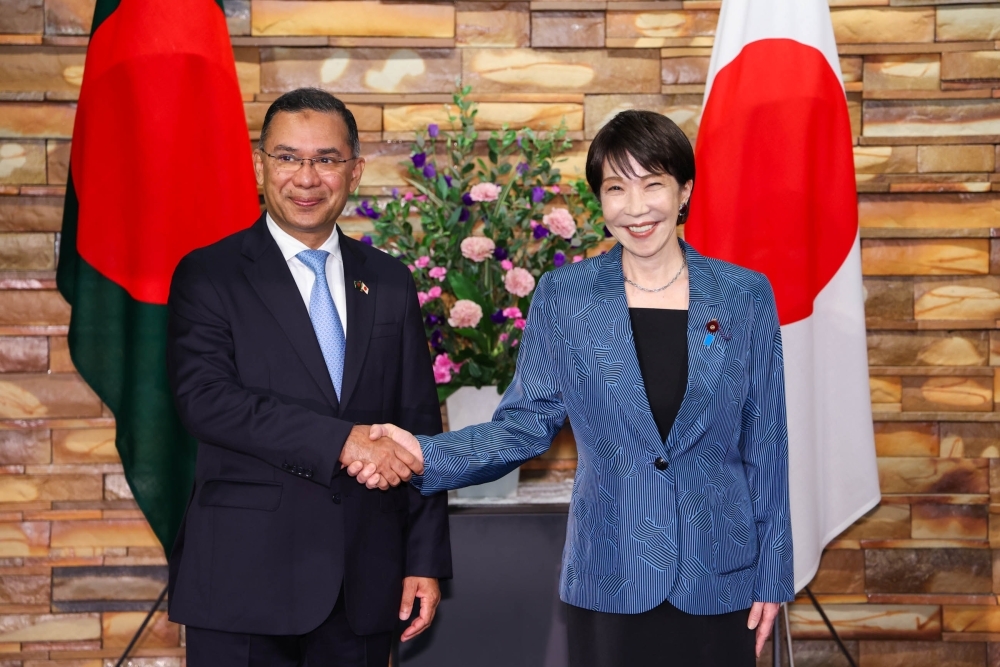
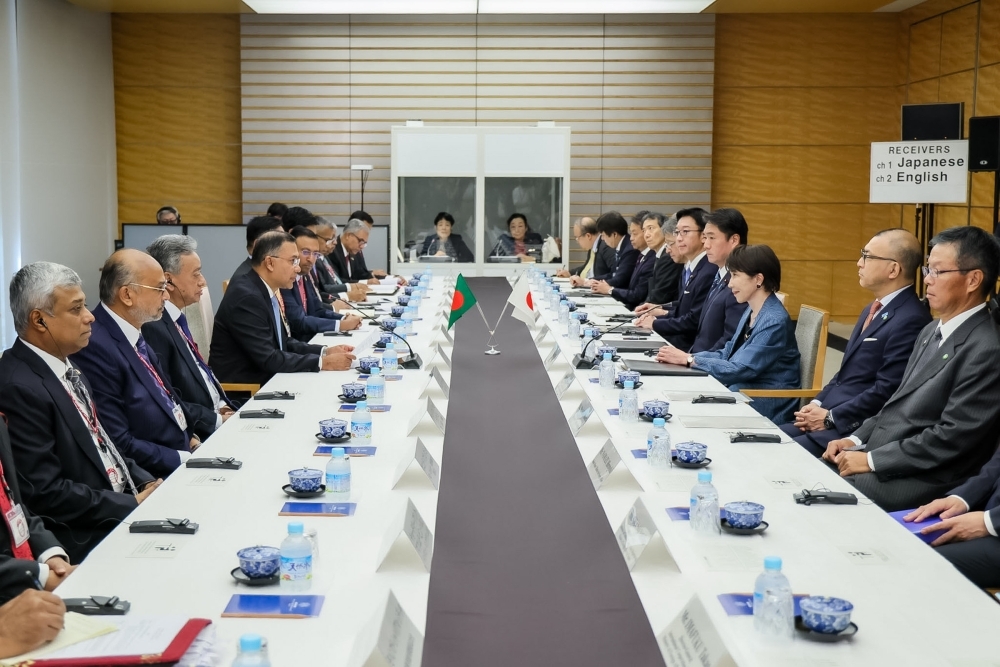
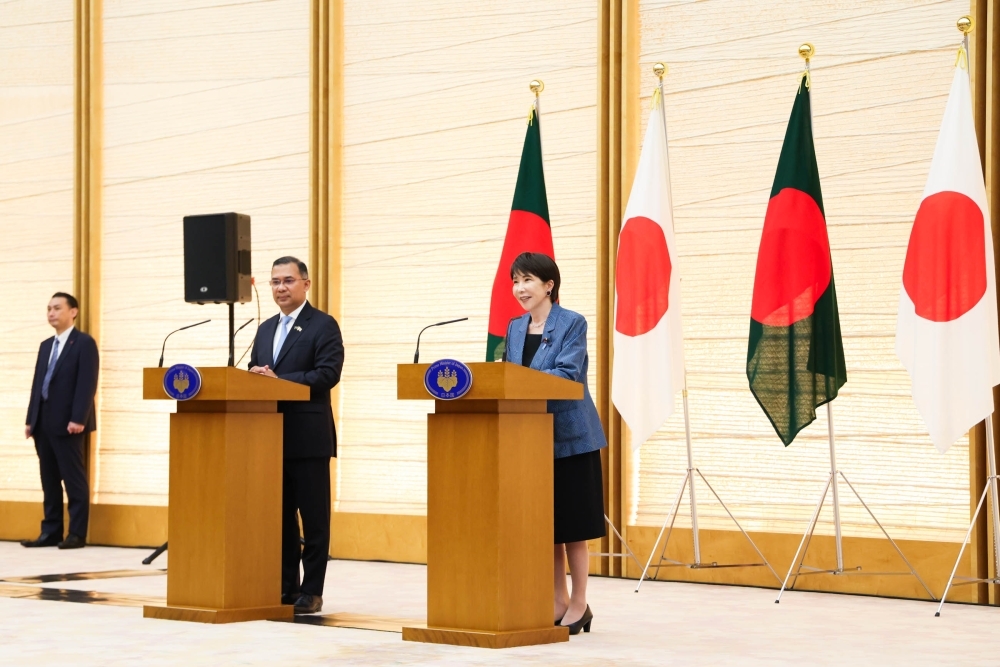
On October 27, commencing at 11:45 a.m. for approximately 25 minutes, Ms. TAKAICHI Sanae, Prime Minister of Japan, held a summit meeting with H.E. Mr. Tarique Rahman, Prime Minister of the People's Republic of Bangladesh, who is visiting Japan, followed by a joint press occasion and luncheon. The two leaders announced “Japan-Bangladesh Joint Statement” after the Summit Meeting.
1. Opening Remarks
- Prime Minister TAKAICHI once again expressed her congratulations to Prime Minister Rahman’s inauguration as a friend who shares the values of democracy and stated that, amid growing instability in the international situation, Japan strongly supports Bangladesh’s capability to have freedom to decide for itself and resilience under the updated “Free and Open Indo-Pacific (FOIP)” and intend to further develop bilateral relations under the “Strategic Partnership”. She also expressed her intention to work with Prime Minister Rahman towards peace and prosperity in the region.
- In response, Prime Minister Rahman stated that Japan has followed the path as a peace-loving nation and was among the first to recognize the independence of Bangladesh. He claimed that Japan holds a special place in the heart of the people of Bangladesh. He also stated that Japan and Bangladesh have cultivated a long-standing amicable relations and his commitment to work together with Prime Minister TAKAICHI to take bilateral relations to new heights.
2. Bilateral Relations
- The two leaders concurred to upgrading the concept of “Bay of Bengal Industrial Growth Belt (BIG-B)” into a new strategic cooperation initiative, “BIG-B for Shared Prosperity”, under the four pillars of 1) strengthening connectivity; 2) preparedness for natural disasters and geopolitical risks; 3) public-private partnership for co-creation of economic growth opportunities and rule-making; 4) cooperation for peace and stability. They also concurred to working together to make the Bay of Bengal region, with Bangladesh as its hub, a “region of shared prosperity.”
- Prime Minister TAKAICHI stated that upcoming private investment by Japanese businesses in Bangladesh is projected to mount up to one trillion yen over the next five years, with an expected 200,000 jobs to be created, and expressed her intention to send a business mission to Bangladesh in the near future. In response, Prime Minister Rahman stated that he welcomes and highly values investment from Japanese businesses.
- The two leaders concurred that their governments would work to ensure the early entry into force of the Japan-Bangladesh Economic Partnership Agreement (EPA) and promote cooperation in the areas such as trade and investment, agricultural, forestry and fishery products, the environment and climate change as well as aviation. Prime Minister TAKAICHI expressed her expectation towards Prime Minister Rahman’s leadership in facilitating the environment conducive to Japanese business activities in order to promote public-private cooperation, to which Prime Minister Rahman responded that the Government of Bangladesh would also work toward this goal in a transparent manner.
- Furthermore, regarding the security domain, Prime Minister TAKAICHI announced that Japan had decided to provide a patrol vessel to enhance Bangladesh’s capability in maritime security as Security-Contributing ODA. The two leaders reaffirmed to continue security and defense cooperation and to work together to maintain peace and security in the region.
- Prime Minister Rahman expressed his deep gratitude for the cooperation extended by the Government and people of Japan to Bangladesh to date, and stated his intention to work toward shared prosperity” for the two countries. Reflecting on the cooperation between the two countries, which has expanded across a wide range of fields including security, economy and people-to-people exchange, he expressed his intention to continue strengthening cooperation in various areas with Japan.
3. Regional and International Situations
The two leaders exchanged views on regional and international situations, including the situation in North Korea such as the nuclear and missile issues as well as the abductions issue, as well as the situation in Myanmar. Following the appointment of Dr. Khalilur Rahman, Minister for Foreign Affairs of Bangladesh, as President of the 81st Session of the United Nations General Assembly, the two leaders reaffirmed to coordinate their efforts at the United Nations as well.
(Reference1) Attachments
- Japan-Bangladesh Joint Statement (English (PDF)
 / Provisional Japanese Translation (PDF))
- “BIG-B (Bay of Bengal Industrial Growth Belt) for Sharing Prosperity” (Japanese (PDF) / English (PDF))
(Reference2)
Memoranda of Cooperation and other documents signed between the two countries:
- Memorandum of Cooperation Between the Ministry of Economy, Trade and Industry of Japan and the Economic Relations Division, Ministry of Finance of the People’S Republic of Bangladesh on Economic Relations and the Improvement of the Business Environment
- Memorandum of Cooperation Between Ministry of Agriculture, Forestry and Fisheries, Government of Japan and Ministry of Agriculture, Government of the People’s Republic of Bangladesh (Japanese)

- Memorandum of Cooperation Between Ministry of Agriculture, Forestry and Fisheries, Government of Japan and Ministry of Fisheries and Livestock, Government of the People’s Republic of Bangladesh (Japanese)
- Memorandum of Cooperation between the Ministry of the Environment of Japan and the Ministry of Environment, Forest and Climate Change of the Government of the People’s Republic of Bangladesh on Environment
- Letter of Intent between the Global Environment Bureau, the Ministry of the Environment of Japan and the Department of Environment, Forest and Climate Change of the Government of the People’s Republic of Bangladesh