Japan's Official Development Assistance White Paper 2008

 Next Page
In order for developing countries to achieve self-sufficient and sustainable growth, it is essential to develop infrastructure, such as electricity, gas, water and sewerage systems, roads, railways, ports, airports, and communications, necessary for creating a trade and investment environment that will attract private-sector investment, while promoting activities by the private sector. Moreover, the importance of "Visibility of Japanese Aid" and financial aid utilizing Japan's advanced technology and know-how are stipulated in Japan's Official Development Assistance Charter, the February 2006 report of the Review Meeting on Overseas Economic Cooperation, and recommendations of private-sector groups such as Nippon Keidanren (the Japan Business Federation). By making use of its knowledge and expertise in infrastructure, Japan has been working towards realizing technical transfers to developing countries through ODA loans (Japanese ODA Loans).
In July 2002, Japan introduced STEP*, an ODA Loan system that enables Japan to make use of its advanced technology and know-how. Through this system, Japan aims to transfer various types of advanced technology to ODA yen loan recipient countries, whose prime contractors are limited exclusively to Japanese companies in accordance with the Organisation for Economic Co-operation and Development (OECD) regulations. For projects financed with ODA loans through the STEP system, more than 30% of equipment, work and services must be procured from Japan, and developing countries can expect transfers of state-of-the-art Japanese technological capabilities. Furthermore, interest rates and loan repayment periods under the STEP system are more advantageous to developing countries than conventional ODA loans.
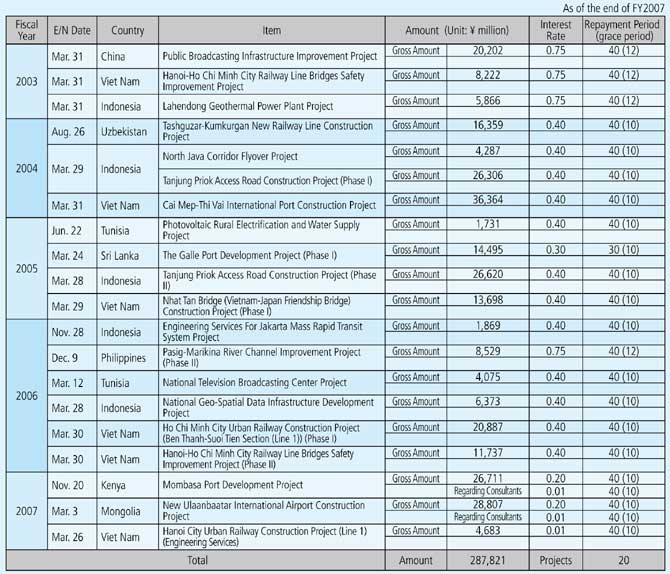
Japan has implemented a total of 20 projects in nine countries (as of the end of FY2007) using ODA loans under this system. In FY2007, exchanges of notes were concluded for three projects: the Mombasa Port Development Project, Kenya (loan amount: approximately ¥26.71 billion), the New Ulaanbaatar International Airport Construction Project, Mongolia (loan amount: approximately ¥28.81 billion) and the Hanoi City Urban Railway Construction Project (Line 1), Viet Nam (loan amount: approximately ¥4.68 billion) (total loan amount for all three projects: approximately ¥60.2 billion).
Disbursements of STEP (Special Terms for Economic Partnership)