
Japan's Official Development Assistance White Paper 2008

To overcome issues faced by developing countries, active commitments to international cooperation by civil societies are important, in addition to government initiatives. In Japan, too, a growing number of citizens are participating in international cooperation. In response to the rising awareness of the people, JICA has been implementing the JICA Partnership Project since FY2002, to support citizen-level grassroots activities. This Project caters to cooperation activities that use experiences and techniques nurtured by Japan's non-governmental organizations (NGOs), universities, local municipalities, and public interest corporations, etc. The activities are implemented under the support of or jointly with JICA. Applicant organizations present their plans to support developing countries to JICA, which subsequently screens the plans, in light of whether they are appropriate to be carried out as part of ODA and whether they directly contribute to the lives of the local residents. Having cleared these conditions, the plans will be launched, with JICA entrusting them to the entities that proposed the plans.
The JICA Partnership Project is divided into three categories of: Grassroots Cooperation Support Type, Grassroots Partner Type, and Local Government Type.
Grassroots Cooperation Support Type
- Budget ceiling: total of ¥10 million or less
- Duration: three years maximum
This type of support caters to those NGOs and public interest corporations that are experienced in activities within Japan, but less so in developing countries. JICA supports these entities to pursue international cooperation activities. Support activities in developing countries can be different from those carried out in Japan. JICA uses its know-how in assisting developing countries and thereby joins the applicant organizations in creating their projects, by offering advice from the planning stage and utilizing the expertise of its overseas offices.
An example of the Grassroots Cooperation Support Type and the Grassroots Partner Type
Miyazaki International Volunteer Center (MIVC), a Japanese NGO, has been implementing a JICA Grassroots Technical Cooperation Project (Support Type) since FY2005. The Center collaborates with a local NGO, Dr. Graham's Homes, which runs a school in the District of Darjeeling, West Bengal, India. Until 2003, MIVC by itself had engaged in horticulture Projects in India as part of its educational activities, and it received many requests for technical instruction from farming households in the neighborhood of the Dr. Graham' s Homes School.* The center therefore has responded since 2005 by building a horticulture technical center as well as giving instruction on the latest technologies for flower and vegetable farming. As a result of these activities, the neighboring farmers have increased the varieties of flower and vegetable they grow. Now they cultivate flowers such as gladiolus, sweet pea, statice, and delphinium. As well, they plant vegetables such as Chinese cabbage, sweet potato, tomato, and even Japanese rice. Furthermore, the farmers have also tried to establish their own sales channel. As a result, their products are now being sold in various places in India including Kolkata, Sikkim, and Delhi.
Thus far, MIVC has built greenhouses for flowers, with assistance of Miyazaki Prefecture, as well as a postal saving system to use interest for international cooperation. The Center has also participated in Miyazaki Prefecture's project to accept technical trainees from overseas. Having experiences with Japan Overseas Cooperation Volunteers in India in the 1960s, Ms. Sakuyo Sugimoto, MIVC's chief director, plays central roles in the Center's projects. She has promoted the cultivation of flowers and agricultural products, by launching the Japan committee for Dr. Graham's Homes School and setting up the horticulture department in the school.
In FY2008, acknowledging those various achievements, the Center was approved as an eligible promoter for Grassroots Partner Type. Ms. Sugimoto is now aiming at the further spread of flower production technologies in the neighboring farm villages, organizing shipments by producers, and further expansion of their sales channels.
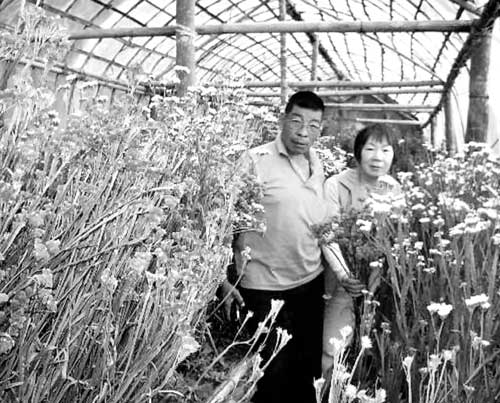
Ms. Sugimoto and a local leader at their horticultural farm
Grassroots Partner Type
- Budget ceiling: total of ¥50 million or less
- Duration: three years maximum
This type of support caters to those including Japanese NGOs, universities, and public interest corporations that are well-experienced in international cooperation activities. JICA supports the activities they propose based on its experiences and techniques that it has cultivated in assisting developing countries. After participant organizations further accumulate experience in this system, they are expected to contribute to the growth of developing countries, along with the efforts of JICA and other government aid organizations.
Local Government Type
- Project budget: total of approximately ¥4.5 million per year
- Duration: three years maximum
This type of support caters to projects led by local municipalities, taking advantage of their local communities' knowledge and experiences to be applied to international cooperation and assistance for developing countries. This type aims at the maximum use of various know-how and broad channels nourished by local municipalities to contribute to the economic and social growth of developing countries. Expected effects include finely tuned cooperation combining the acceptance of developing countries' manpower into local communities in Japan and on-site technical guidance. Local municipalities can also contribute through international exchange of their local residents. They are also able to cooperate with NGOs and private entities when implementing projects.
An example of the Local Government Type
Fruit growing is an active industry in areas including Date City, Fukushima Prefecture. To use fruit growing technologies nourished in this area, Date City began activities to disseminate its outstanding home-grown fruit growing technologies in a developing country in 2005. The city chose the central Asian country of Uzbekistan, in particular the Fergana Province that has rich soil and a favorable climate for growing fruit.
This project is carried out by the Fukushima Uzbekistan Culture Economy Exchange Association, which also works as the liaison office for the project. Mr. Toshio Shishido, the association's chief director, formerly set up the Fukushima branch, the Japan-Soviet Goodwill Association, in the 1970s. Since 1979, he has focused his main activities on exchange and cooperation with Uzbekistan. Since the country's independence, Mr. Shishido has promoted mutual goodwill visits every year and accepted trainees in the medical and agricultural sectors in the region. In this fruit growing project, he serves as the project manager, planning and executing, and coordinating the whole project. In the project, specifically, a model orchard was set up in Fergana Province of Uzbekistan. There, a number of cooperation activities have been underway, such as dispatching fruit-growing experts and accepting trainees. These Projects aim at breed improvements of peaches and apples, modernization for farming machinery, and prevention of blights and insects. In this way the Projects contribute to technical cooperation that conforms to the Fergana Province's climate, soil, environment, and experience. As a result, local people have grown young trees sent from Date City, begun breed improvement work, and nourished peaches and apples for regular harvesting. As these activities gained such significant appraisals in Fergana, the project commenced the second phase from FY2008. This second phase aims at the generation of adequate incomes through broader technical enhancements such as the prevention of blight and insect damage, breeding and soil improvements, and frost damage countermeasures.
This project not only contributes to the transfer of significant fruit-growing technologies from Date City to Fergana, but also to the international exchange of local residents. The exchange Projects involve its whole community, and include annual visits to a primary school near public-run orchards as well as participation in the school's athletic meeting by trainees from Fergana.
The relationship between Date City, Japan and Fergana, Uzbekistan has been certainly strengthened. To illustrate, another organization for agricultural cooperation, Date Uzbekistan Agricultural Exchange Association, was newly established. The organization promotes agricultural cooperation activities such as granting machines to spray agricultural chemicals, called speed-sprayers.
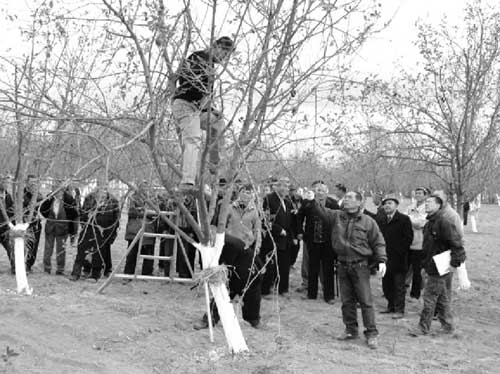
Mr. Sato showing how to prune an apple tree