
FY2024 MOFA ODA Evaluation Results
Evaluation of Japan’s Grant Aid for Economic and Social Development Programme for the Republic of Djibouti in FY2018

| Chief Evaluator | INADA Juichi, Professor, Department of Economics, Senshu University |
| Consultant | Global Group 21 Japan, Inc. |
| Evaluation Period | April 2024 to January 2025 |
| Field Survey Country | Djibouti |
Background, Objectives, and Scope of the Evaluation
This project-level evaluation was conducted on Japan’s Grant Aid for Economic and Social Development Programme for the Republic of Djibouti in FY2018” (grant amount: 3.9 billion yen), which was implemented by the Ministry of Foreign Affairs of Japan (MOFA), with the main objectives of deriving recommendations and lessons learned from the evaluation results to be used in the planning and implementation of future ODA, and fulfilling accountability to the public. The evaluated project was implemented with the objectives of facilitating smooth traffic flow and improving safety by rehabilitating a particularly deteriorated section (approximately 20 km) of Djibouti’s National Road 1 (hereinafter referred to as “RN1”), the main artery on the international corridor connecting Djibouti and Addis Ababa, thereby contributing to economic and social development necessary for the country’s sustainable growth.
Summary of the Evaluation Results
(1) Relevance of the Plan
Development of the national road network, including corridor roads, has remained one of Djibouti’s priority areas from the time of project planning to the present. The rehabilitation of RN1 was a top priority issue for Djibouti, with a high level of urgency. Japan regards Djibouti as a strategic partner, and this project was positioned in the priority areas of Japan’s Country Assistance Policy for Djibouti. The adoption of modified asphalt in this project was consistent with Japan’s policy of implementing “quality infrastructure” in Africa. The implementation structure was appropriate, in line with the standard implementation structure of Grant Aid for Economic and Social Development Programmes. This project was planned in accordance with the “Principles for securing the appropriateness of development cooperation” in Japan’s Development Cooperation Charter (2015). Eight months after the request, this project was changed from JICA grant aid to MOFA grant aid (Grant aid for Economic and Social Development Programme). This was an appropriate response that took into consideration the strong desire of the Djibouti side for fast-tracked project implementation. Thereafter, the project was carried out in accordance with the standard workflow for grant aid (Grant Aid for Economic and Social Development Programme). For these reasons, the relevance of the project plan is assessed as ‘Satisfactory’.
(Rating: Satisfactory)
(2) Effectiveness of Results
Despite overlapping with the COVID-19 pandemic, this project was completed in 18 months. There is a high level of trust in the quality of the construction, and the modified asphalt applied at the Japanese section has become the unified quality standard for all sections on the Djibouti side of the Djibouti-Addis Corridor. The resulting road is accommodating anticipated cargo volumes as well as contributing to smoother traffic and improved safety, as set out in the project objectives. This project conforms to the “Principles for securing the appropriateness of development cooperation” in Japan’s Development Cooperation Charter (2015) and was implemented appropriately in line with the standard work implementation flow for grant aid (Grant Aid for Economic and Social Development Programme). Some sections of the improved road suffered damage from heavy rains following completion, but at that time the Embassy of Japan requested countermeasures from the Djibouti side. For these reasons, the effectiveness of results for this project is evaluated as ‘Satisfactory’.
(Rating: Satisfactory)
*Rating: Highly Satisfactory; Satisfactory; Partially Satisfactory; Unsatisfactory
Recommendations and Lessons Learned
Recommendations
(1) Cooperation and Collaboration with JICA in Project Follow-up
Although this project has implemented road rehabilitation through grant aid (Grant Aid for Economic and Social Development Programme), in order to ensure project sustainability, the Embassy of Japan in Djibouti should conduct follow-up (understanding the situation on-site, etc.) in cooperation with JICA in the future. The maximum effect of this project will be realized when all north and south sections are completed (scheduled for 2028). At least until then, the Embassy should endeavor to grasp the overall development status of the Djibouti-Addis Corridor by the Djibouti Road Agency (ADR) along with the status of this project. This will enable the Embassy to consider the appropriateness of extending specific support and to provide advice and recommendations to the Djibouti side. As such, the Embassy and JICA should build upon the cooperative relationship they already have in other projects to inspect the project site as necessary and share information.
(2) Monitoring to Ensure Sustainability of Project Effects (Measures for Sections Affected by Heavy Rain)
Heavy rains in August 2022 caused damage to culverts and other project structures, and the Djiboutian side is considering measures to address the issue. In order to ensure the sustainability of the project’s effects, it is important for the Japanese side to monitor progress by regularly checking in with ADR. It is also necessary to continue to closely monitor the maintenance and management system for this project in the future.
(3) Close Consultation and Strengthened Collaboration with Other Donors
This project rehabilitated a part of the Djibouti-Addis Corridor, which is supported by several donors including the World Bank. Starting with this project, funding for the Djibouti side of the Djibouti-Addis Corridor has been secured gradually, with the entire section expected to be rehabilitated in 2028. In light of such unfolding developments, it is important to share information and cooperate as necessary with development finance institutions such as the World Bank and the African Development Bank (AfDB), which are not usually closely linked to MOFA projects, as well as emerging donors such as Saudi Arabia and China, in order to ensure the project’s effects are sustained. Doing so will also further raise awareness of Japan’s cooperation, including this project, in the local donor community, thus enhancing its diplomatic effects.
(4) Emphasis on a Broader Regional Perspective in Project Formulation
The Djibouti-Addis Corridor, of which this project rehabilitated a section, has the potential to contribute to the promotion of logistics not only between Djibouti and Ethiopia, but also between South Sudan and other countries in the future. Strengthening connectivity in the East African region as such is also an important issue for Djibouti. From this perspective, it is essential to design and assess regional projects for Djibouti, including those involving Ethiopia, such as transportation, water supply, and electricity projects. For transportation and trade-related projects in particular, cooperation with neighboring countries is essential to One-Stop Border Posts (OSBPs) and the like. When planning new projects, it will be necessary to observe the trends of other regional projects, such as the Horn of Africa Initiative, and consider how to position projects within this context.
(5) Promoting More Effective Public Relations
Residents around the project area were aware of Japan’s cooperation, which was largely due to the contributions of ADR staff working in the region. On the other hand, ADR was not aware of “quality infrastructure” advocated by Japan. Although the completion ceremony and other events were reported in local newspapers, the project is located in a remote area on the border with Ethiopia and so is mostly unseen by the general public in Djibouti. Considering that the project is extremely important for Djibouti and was positioned as a “quality infrastructure” project by Japan, more active public relations activities could have been carried out. For example, efforts should be strengthened to appeal the benefits of Japan’s ODA projects in the local language in the recipient country through promotional videos and YouTube, etc., with an increased budget for this purpose. One idea is to have external evaluators produce field survey videos that can be used for public relations as a component of future evaluation work.
Lessons Learned
(1) The Importance of Close Cooperation Between MOFA and JICA in Emergency Situations
This project was initially considered as a road rehabilitation project through JICA’s grant aid project. However, given the urgency of the situation, it was deemed appropriate to implement under MOFA’s grant aid (Grant Aid for Economic and Social Development Programme). Procedures leading up to the E/N were expedited, and the project was completed about four months earlier than initially expected, which is considered to have had a significant diplomatic effect not only with regard to Djibouti but also Ethiopia. In addition, the quality standards of the Japanese construction section (modified asphalt) were adopted as the quality standards for the entire Djibouti-Addis Corridor on the Djibouti side. This can be said to have contributed to spreading awareness of the high quality of Japan’s infrastructure support. As such, in the event of projects requiring urgency, the close cooperation of MOFA and JICA is necessary to be able to respond flexibly in the future, as was achieved this time.
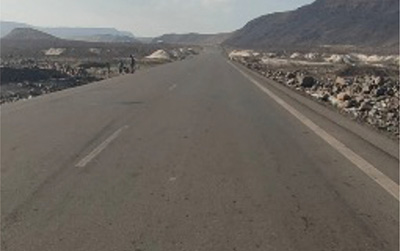
National Road 1 (RN1) (Photo: Evaluation Team)