
FY2024 MOFA ODA Evaluation Results
Evaluation of Japan’s ODA to COVID-19 Related Cooperation

| Chief Evaluator | Prof. NISHINO Keiko Professor, Integrated Center for UN and Foreign Affairs Studies, Kwansei Gakuin University |
| Advisor | Prof. YAMAMOTO Taro Professor Emeritus, Nagasaki University / Doctor, Asama General Hospital |
| Consultant | Foundation for Advanced Studies on International Development |
| Evaluation Period | FY 2019 - FY 2023 |
| Period of the Evaluation Study | June 2024 - February 2025 |
| Field Survey Country | Target regions include countries around the world with a track record of cooperation. Case study countries are Viet Nam and Malawi. |
Background, Objectives, and Scope of the Evaluation
In response to the COVID-19 pandemic, assistance was provided through bilateral cooperation and international organizations with the aim of achieving universal health coverage (UHC) based on the concept of “Leave no one’s health behind.” In May 2022, a global health strategy was formulated based on the track record of cooperation until that time. The strategy emphasized building a global health architecture and strengthening prevention, preparedness, and response (PPR) to public health emergencies. This evaluation was conducted to comprehensively evaluate Japan’s support in response to COVID-19 using ODA between fiscal year (FY) 2019 and 2023, and to obtain recommendations and lessons regarding Japanese cooperation in global health, including measures against infectious diseases. The evaluation results have also been published to fulfill the obligation of accountability to the public.
Summary of the Evaluation Results
● Development Viewpoints
(1) Relevance of Policies
To respond to the needs of emergency assistance, the implementation of cooperation was prioritized over policy formulation as much as possible. Nevertheless, Japan’s projects in response to COVID-19 were consistent with the Development Cooperation Charter, which is the national high-level policy, and were consistent with the policies and needs of developing countries, as well as international priority issues. Japan’s comparative advantages were put to good use, such as the combination of diverse modalities, results from many years of cooperation, and the strong reputation of Japanese-manufactured medical equipment. Based on the above, the relevance of policies is rated as “Satisfactory”.
(Rating: Satisfactory)
(2) Effectiveness of Results
In response to the multifaceted challenges faced by developing countries during the COVID-19 pandemic, wide-ranging cooperation has been provided on a global scale, including the provision of vaccines, the development of cold chains, strengthening of testing and epidemic prevention systems, provision of medical equipment, emergency assistance loans, and contributions to international organizations. The results have been evaluated as being highly effective. In Malawi, as part of a Japanese cooperation project, medical and testing equipment were provided and vaccination information management systems were strengthened. These provisions have been utilized in response to other infectious diseases following COVID-19, contributing to the enhancement of the country’s pandemic response capability. In Viet Nam, long-standing cooperation has led to the construction of a foundation for a resilient and inclusive health system, which has increased the effectiveness of COVID-19-related support. This pandemic has led to significant progress in the country’s infectious disease response capabilities, leading to enhanced PPR for future public health emergencies. Based on the above, the effectiveness of results is rated as “Satisfactory”.
(Rating: Satisfactory)
(3) Appropriateness of Processes
Appropriate budgets were allocated to each region and country. Generous support was provided to Asia, in particular, in light of its economic and diplomatic importance and past cooperation records. This contributed to controlling the spread of infections in that region, where the number of infected people was high. In future pandemics, when determining bilateral input, in addition to economic and diplomatic relations and past cooperation records, it will be important to place greater emphasis on the magnitude and urgency of the need as the basis for decision-making. It is also highly evaluated that, when providing cooperation, close contacts were maintained with local governments and other donors, which made it possible to deal with on-site issues flexibly. On the other hand, delays in procurement caused an issue in the provision of equipment for grant aid projects. However, this was due to disruptions to logistics services during a crisis, a lack of administrative capacity in the partner government, and different regulatory responses in each country, which were unavoidable in some respects. In the “Last One Mile Support” program, Emergency Grant Aid was provided frequently alongside international organizations, and a rapid response was achieved. However, some issues were identified regarding the simplification of procedures when plans were changed and the publicizing of projects. While there was effective interproject collaboration in Viet Nam, in other countries, collaboration was limited because promptness was prioritized despite a lack of local personnel. When considering how to provide assistance in future pandemics, it will be necessary to promote information sharing among relevant Japanese parties and to improve procedures with international organizations while learning from successful cases. Based on the above, the appropriateness of processes is rated as “Partially Satisfactory”.
(Rating: Partially Satisfactory)
*Rating: Highly Satisfactory; Satisfactory; Partially Satisfactory; Unsatisfactory
● Diplomatic Viewpoints
(1) Diplomatic Importance
Japan provided a wide range of assistance to low- and middle-income countries, contributing to the maintenance of global harmony and bilateral relations. In multilateral cooperation, emphasis was placed on equity, and in bilateral cooperation, support was provided mainly in Asia, making use of strategic approaches. In particular, Japan’s provision of vaccines to Asian countries and assistance to countries where Japanese companies have established operations, such as Viet Nam, contributed to the recovery of economic activities and the security of the Japanese people. Japan’s support in response to COVID-19, which combined multilateral equity and bilateral strategy, deserved recognition from a diplomatic viewpoint.
(2) Diplomatic Impact
When providing assistance in response to the COVID-19 pandemic, Japan worked toward achieving UHC and played a leading role in COVAX (COVID-19 Vaccines Global Access), contributing to improving its international presence and credibility. In addition, Japan’s assistance has contributed to strengthening bilateral relations with various countries around the world, just as the provision of vaccines in Viet Nam became a symbolic example of deepening friendship between the two countries. Cooperating in measures against infectious diseases has had various diplomatic impacts, such as ensuring the safety of Japanese people and promoting economic reconstruction.
Recommendations
1. Recommendations for the direction of support in the health and medical care sector
(1) Give priority to the capacity building of emergency responders in healthcare and medical service in developing countries.
(2) Establish an information gathering structure at all times to prepare for emergencies.
(3) Build strategic partnerships in the health and medical care sector.
(4) Promote cooperation with regional organizations (Africa CDC and ASEAN Centre for Public Health Emergencies and Emerging Diseases (ACPHEED)) and strengthen their capabilities.
2. Recommendations regarding specific strategies for assistance during pandemics
(1) Give more importance to timing than quantity and improve the system to make cooperation possible without missing opportunities.
(2) Promote further utilization of accumulated knowledge and networks of local staff.
(3) Simplify the procedure to be able to respond flexibly in emergencies in cooperation with international organizations.
(4) Monitor activities and outcomes in cooperation with international organizations and conduct PR to highlight Japanese assistance.
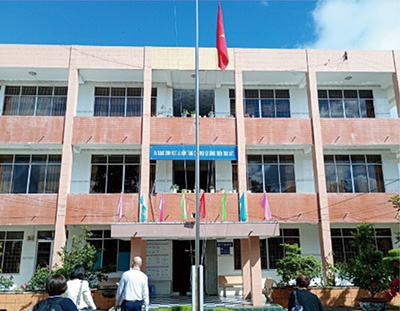
Ben Tre CDC, visited during field research in Viet Nam
(Photo: Evaluation Team)
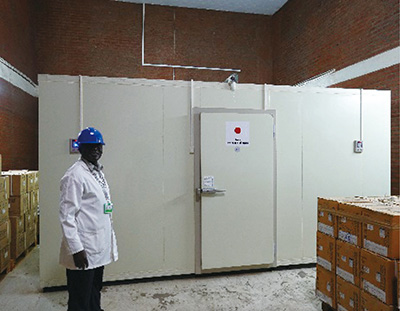
Cold room provided to the central pharmaceutical warehouse in Malawi (Photo: Evaluation Team)