
FY2024 MOFA ODA Evaluation Results
Evaluation of Japan’s ODA to Nepal

| Chief Evaluator | NISHINO Keiko Professor, Kwansei Gakuin University |
| Advisor | TANAKA Masako Professor, Sophia University |
| Consultant | IC Net Limited |
| Evaluation Period | FY 2019 - FY 2023 |
| Period of the Evaluation Study | April 2024 - February 2025 |
| Field Survey Country | Nepal |
Background, Objectives, and Scope of the Evaluation
Nepal is located between India and China, and geopolitically important. The establishment of democracy as well as the stability and prosperity of Nepal are important for Japan to ensure stability in the entire Southwest Asia region, which is politically and economically significant.
This evaluation aimed to evaluate Japan’s Official Development Assistance (ODA) and cooperation policies and assistance to Nepal over the past five years (FY 2019–2023) and obtain recommendations and lessons learned for formulating and implementing Japan’s next Country Development Cooperation Policy for Nepal, which is scheduled to be revised in FY 2026. The results of this evaluation will be made public to ensure accountability to the people of Japan and promote public understanding and support.
Summary of the Evaluation Results
● Development Viewpoints
(1) Relevance of Policies
Japan’s ODA and cooperation policies toward Nepal are highly consistent with Japan’s high-level policies and international priorities. They are also well aligned with Nepal’s development policy needs. However, addressing the challenges and needs of strengthening governance after the country’s transition to federalism will require further consideration. The relationship between Japan’s assistance to Nepal and the aid policies of other donors is highly consistent, as they play complementary roles, especially in addressing priority issues such as reconstruction and rehabilitation after the 2015 earthquake and the mitigation and prevention of coronavirus disease 2019 (COVID-19)’s impact. Japan’s comparative advantage in implementing each aid project has been confirmed.
(Rating: Satisfactory)
(2) Effectiveness of Results
Japan’s assistance to Nepal accounts for 18.16% of the total assistance from major donor countries, excluding India and China, and has contributed significantly to Nepal’s social and economic development. At the micro level, Japan’s projects have been implemented in line with the Country Development Cooperation Policy for Nepal and Rolling Plans. Regarding evaluation items, the inputs for Japan’s assistance to Nepal were appropriately allocated to priority areas of the country’s needs. Moreover, outputs were appropriately produced by achieving the expected results. Although delays were observed in some projects because of organizational restructuring, dismantling, and personnel changes following the transition to federalism in Nepal, as well as the impact of the COVID-19 pandemic, the desired outcomes were achieved and completed through partial changes in project designs and extensions of cooperation periods. It is difficult to objectively verify the impact of projects owing to the lack of clear indicators. However, the sustainability of key projects after the completion has been confirmed to some extent.
(Rating: Satisfactory)
(3) Appropriateness of Processes
Japan’s Country Development Cooperation Policy for Nepal was appropriately formulated and implemented, with various initiatives to promote transparency, information disclosure, and publicity. The policy implementation process was also appropriate, as gender and inclusiveness considerations were well integrated into various projects based on Nepal’s characteristics and features, leading to the promotion of participation and benefits for women and socially vulnerable groups. However, some challenges were identified in the implementation process of ODA and cooperation policies and Nepal’s aid implementation system, which involved complex factors. While effective collaboration and solidarity with diverse stakeholders led to tangible results in various sectors, there was room for improvement in some processes.
(Rating: Partially Satisfactory)
*Rating: Highly Satisfactory; Satisfactory; Partially Satisfactory; Unsatisfactory
● Diplomatic Viewpoints
(1) Diplomatic Importance
Japan’s assistance to Nepal, which is located between China and India, is geopolitically important. The establishment and sustainable development of democracy in Nepal, following its transition through elections, is also crucial for securing stability in the Southwest Asian region. Moreover, Japan’s assistance to Nepal is significant for maintaining and strengthening good bilateral relations between the two countries. Furthermore, in the medium- to long-term, if Nepal’s connectivity with northeastern India and Bangladesh is improved and assistance is provided for industry development in related regions as well as legal and institutional reforms, it is expected to benefit not only Japanese companies in Nepal, but also Japan’s industries.
(2) Diplomatic Impact
It can be inferred that Japan’s assistance to Nepal has had a certain effect on the Government of Nepal’s support for Japan’s position in the international community. Over the years, this support has also helped foster a broad pro-Japanese sentiment extending from the Government of Nepal to the general public, which has influenced the friendship, exchanges, and movement of people between the two countries. Moreover, Japan’s assistance to Nepal has contributed greatly to the peace, stability, and prosperity in Nepali society, and to peace and stability in the Southwest Asian region across Asia. On the other hand, the ripple effect on economic relations between the two countries is limited, and more assistance is needed before significant economic impacts are realized.
Recommendations and Lessons Learned
Recommendations
(1) Formulate Japan’s next Country Development Cooperation Policy for Nepal in line with Nepal’s 16th Plan and needs and continue support in three priority areas.
(2) Strengthen cooperation among ODA schemes within the Japan’s Assistance Programs and with various stakeholders (partners) and improve knowledge management.
(3) Promote strategic human resource development, capacity building and the active participation of pro-Japanese knowledgeable and supportive groups and implementing agencies.
Lessons Learned
(1) Synergistic effects can be achieved through cooperation of grant aid (“hard support”) and technical cooperation (“soft support”) in areas where Japan has a comparative advantage.
(2) It is effective to dispatch individual experts to advise implementing agencies.
(3) Comprehensive disaster recovery and reconstruction assistance through ODA not only enhances the resilience of affected areas, but also improves social inclusion and sustainability, contributing to diplomatic effects.
(4) To enhance the significance of ODA, it is important and necessary to strengthen the concept of sector programs in the priority areas of each Country Development Cooperation Policy and to clarify how each project contributes to addressing development issues and to the development of the sector concerned, as well as the path to realizing the benefits of the project.

Slope stabilization done by the Project for the Rehabilitation of Sindhuli Road after the 2015 earthquake (Photo: Evaluation Team)
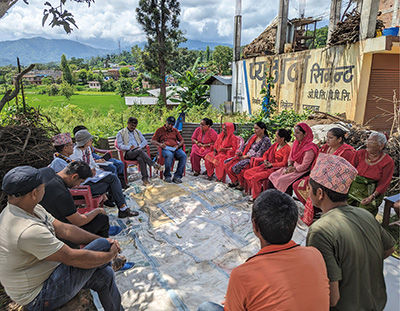
Kavre Palanchok Agricultural Group (Photo: Evaluation Team)
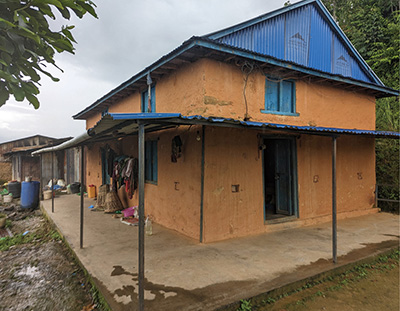
Houses reconstructed with Japan’s assistance (Photo: Evaluation Team)