
The Hague Convention (Convention on the Civil Aspects of International Child Abduction)
Application Flow for Assistance in Contact with a Child in Japan
(Procedures for Contact with a Child in Japan)
1. Outline of Procedures
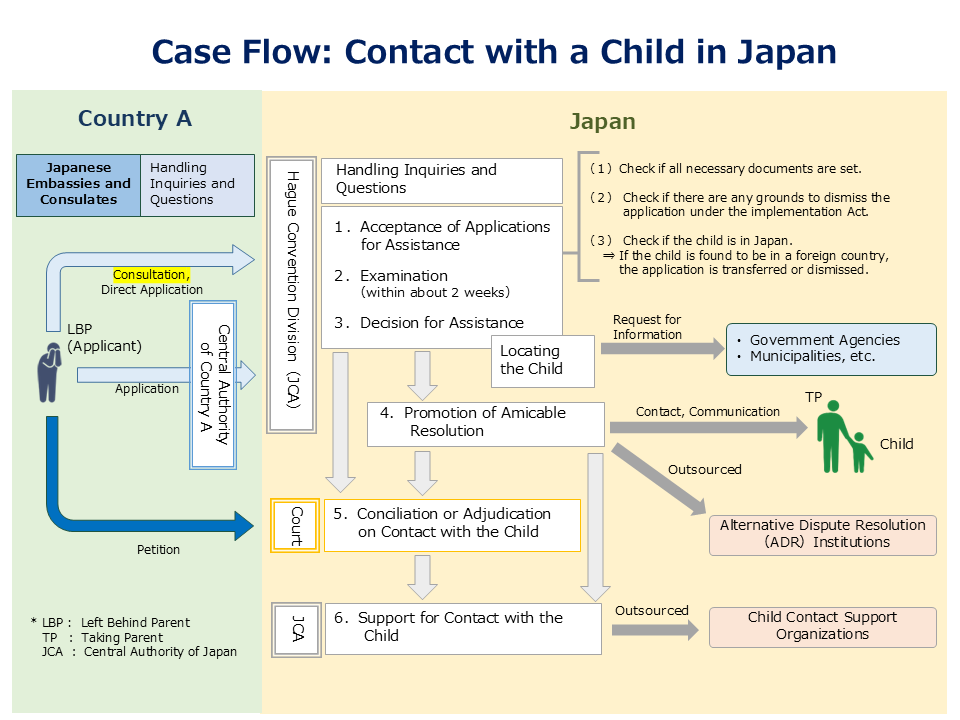
If you reside in a foreign State (Contracting State of the Hague Convention other than Japan) and are currently unable to make contact with your child who is in Japan, you can file an application for assistance to ensure access to the child (Application for Assistance in Contact with a Child in Japan) under Japan’s Act for Implementation of the Convention on the Civil Aspects of International Child Abduction (Hague Convention Implementation Act). The flow of procedures for such cases is outlined in the diagram below.
You can submit the application either to the Central Authority of your country of residence or directly to the Japanese Central Authority (JCA) - Minister for Foreign Affairs of Japan. JCA’s daily business is handled by the Hague Convention Division, Consular Affairs Bureau, Ministry of Foreign Affairs.
2. Procedures of the Ministry of Foreign Affairs
(1) Receipt of Application
When the JCA receives an application, either directly or through the Central Authority of a foreign State, it will promptly issue a document acknowledging receipt of the application to the contact address of the applicant as provided on the application.
(2) Examination of Documents
The JCA will examine the application documents (application form and supporting documents) as required by the Hague Convention Implementation Act. If there is a lack of necessary information in the application documents, the applicant will be requested to make corrections or submit additional documentation.
The JCA will work to locate the whereabouts of the child and the person who lives together with the child in Japan while examining the application.
Once examination is complete, the JCA will proceed with one of the following steps and notify the applicant of the result.
- Decision for assistance in contact with a child [Note]
- Dismissal of the application
- Where it is obvious that the child pertaining to the application is located in a Contracting State other than Japan, copies of the application documents will be transmitted to the Central Authority of that Contracting State.
[Note] This means that the JCA has decided to provide assistance, and does not imply any legally binding decision regarding contact with the child.
(3) Support by the Ministry of Foreign Affairs
In furtherance of an amicable resolution, the JCA, with applicant’s consent, will contact the other party and act as a liaison between both parties. In addition, the following support is offered to both parties.
- Lawyer Referral Service
- Financial Support for the Use of Alternative Dispute Resolution (ADR)
- Court Documents Translation Service [Note]
- Financial Support for the Use of Child Contact Support Organizations
[Note] For more information on the translation service, refer to "3. Procedures Related to Court Petition for Contact with Child” below.
3. Procedures Related to Court Petition for Contact with Child
If a person residing in a Contracting State of the Hague Convention other than Japan wishes to have contact with their child in Japan, that person may, in addition to applying for assistance from the JCA, file a petition for adjudication or conciliation with a family court in Japan to ensure such contact with the child in Japan.
Conciliation to seek contact with a child is a court-supervised procedure employed in order to formulate an agreement between the parents with regard to arrangements for contact with the child. Adjudication, on the other hand, refers to the procedure by which a judge makes a decision regarding contact with the child. While it is possible to file a petition for adjudication from the outset, the judge may still decide to refer the case to conciliation procedures first. For information on how to file a petition, please contact a family court, or consult with a lawyer.
- [Related Links]

- Translation of court documents
In court proceedings seeking contact with a child, documentary evidence and other relevant texts submitted to courts in Japan must be presented in the Japanese language. As such, translation from a foreign language into Japanese is required. For those cases where the JCA has made a decision to provide assistance, both parties involved can use the translation service provided by the JCA at no charge, within certain limits.